In December 1996, Apple agreed to buy a company called NeXT for $400 million. The purchase included software, engineers and a founder whose previous employer had been Apple. Steve Jobs was coming back through the acquisitions department. Corporate life occasionally develops a sense of humor.
Eleven years earlier, a struggle with chief executive John Sculley had stripped Jobs of his operating responsibilities. He resigned in 1985. Now Apple needed a route to a new operating system, and NeXT had technology it could use. The company he built after leaving became his route home. The detour had acquired a purchase price.
A tidy comeback story would hurry through the intervening years. Jobs found another computer business, bought into animation, waited for vindication and returned. But that skips the interesting part. At NeXT and Pixar, he had to work out what an organization should make, how long it could afford to wait and which people needed room to do their work.
The second Apple chapter is easier to understand with those years left in. So is Jobs himself: curious about beautiful objects, forceful about his preferences, capable of recruiting collaborators and capable of wearing them out. His career repeatedly brought artistic judgment into a negotiation with engineering, money and the calendar. The calendar was seldom impressed by charisma.
A useful education in useless things
Steven Paul Jobs was born in San Francisco on February 24, 1955, and adopted by Paul and Clara Jobs. He grew up in the Santa Clara Valley, where electronics were close enough to encounter through neighbors and workshops. In his 1995 oral history, he described learning to use tools alongside his father and meeting an engineer who lived down the street.
That setting offered an unusually direct introduction to making things. A device could be opened. Someone nearby might know how it worked. Years before Jobs became famous for presenting sealed products, he inhabited a world in which technical curiosity had a local address. His later ease around engineers grew out of proximity as well as ambition.
Reed College supplied a different vocabulary. Jobs enrolled in 1972, left the formal program after six months and continued attending classes that interested him. Calligraphy caught his attention. Reed had a tradition shaped by Lloyd Reynolds and Robert Palladino, where lettering belonged to the visual culture of the campus rather than merely the stationery cupboard.
Jobs later connected that exposure to the Macintosh’s attention to typography. The connection matters because it was specific: letterforms, spacing and proportion. A computer could be judged by the experience of reading its screen. The young dropout had wandered into an education in how small visual decisions change the feeling of an entire object.
“Real artists ship.”
Steve Jobs, Macintosh team retreat, 1983
Pirates have deadlines, too
Apple was founded in 1976 by Jobs, Steve Wozniak and Ronald Wayne. Wozniak brought the engineering behind the early computers; Jobs helped turn that work into a business. Their partnership deserves its two names. Remembering only the person on stage makes the circuit board rather difficult to explain.
The Macintosh, introduced in January 1984, widened the cast. Software developers, hardware engineers and designers made a computer whose graphical interface invited people to point, click and explore. Susan Kare’s graphics and the work of colleagues including Andy Hertzfeld and Bill Atkinson gave that invitation its practical form. Jobs helped set the expectations and applied the pressure.
At a 1983 team retreat, Jobs urged the Macintosh group to preserve its rebellious spirit. Programmer Steve Capps took the idea literally and arranged a pirate flag; Kare added an Apple logo to its eye patch. Office decoration rarely makes a clearer management statement. A growing company had a department announcing its independence from the company.
Hertzfeld’s recollections describe enthusiasm alongside autocratic behavior. Jobs could issue unreasonable demands or veto what others wanted, though he could also relent. That combination complicates the souvenir version of the pirate flag. The work could be exhilarating and the leader difficult. Both belonged to the same room. Neither fact cancels the other.
The 1985 rupture exposed the limits of a founder’s authority. Owning the origin story did not give Jobs permanent control of Apple. The board backed Sculley in their conflict. After Jobs left, he had to build another organization without assuming that the first one would eventually welcome him back.
- 1985Leaves Apple.
Starts NeXT. - 1986Establishes independent Pixar.
- 1995Toy Story opens.
Pixar goes public. - 1996Apple agrees to acquire NeXT.
Two bets, two clocks
NeXT began in 1985 with a focus on computers for higher education. Its hardware never became a mass-market business. Its software proved more durable. That distinction is central to the return: Apple’s 1996 acquisition announcement emphasized the operating-system technology and a new software direction. The commercial outcome of a machine and the usefulness of its underlying ideas had diverged.
The other bet began in 1986, when Jobs bought Lucasfilm’s computer division and established it as an independent company, Pixar. The group already contained technical and creative expertise. Jobs supplied ownership, financing and business leadership. He did not arrive with Woody and Buzz tucked under his arm.
Pixar’s own chronology shows the distance between incorporation and the film audiences remember. There were image computers, animation tools, short films and work with Disney before Toy Story opened in November 1995. Pixar went public days later. A business that looked sudden from a cinema queue had spent years developing the means to put characters on that screen.
Ed Catmull and John Lasseter were essential collaborators. Jobs’s responsibility was different from directing a scene or designing an animation system. He helped sustain the company and negotiate the terms under which its work reached the world. That required a different relationship with creative authority from the one suggested by the familiar picture of a chief executive approving every detail.
A filmed interview from November 1996 catches him considering incentives, retaining talented people and making stories with lasting cultural value. The timing is useful: Toy Story had already changed Pixar’s prospects, while the Apple deal was still ahead. He was discussing the organization behind the work, rather than merely the next object to sell.
Disney’s 2006 agreement to acquire Pixar valued the transaction at $7.4 billion and provided for Jobs to join its board. The deal also gave Catmull and Lasseter expanded creative leadership responsibilities. The structure acknowledged what the studio had become: a collection of people and practices worth preserving, alongside films worth distributing.
The comeback included Bill Gates
Jobs returned to an Apple that needed decisions more urgently than nostalgia. One decision involved Microsoft. In August 1997, the companies announced an agreement covering software development, patent cross-licensing and a $150 million Microsoft investment in non-voting Apple shares. Microsoft also committed to continued Macintosh Office development.
For anyone attached to the old rivalry, this was awkward theater. For customers who needed their applications to keep working, it had an obvious logic. Jobs could be combative about competitors and still make an agreement with one. An Apple customer’s practical needs could outweigh the pleasure of seeing Microsoft lose.
The product line also needed an intelligible shape. Jobs organized the computer strategy around consumers and professionals, with desktop and portable machines for each. Four positions imposed a limit on the discussion. A company could still argue intensely about what belonged in each position, but it had fewer places to hide an unfocused proposal.
The iMac, unveiled in May 1998, gave that return a visible object. Its translucent enclosure, developed by Apple’s design team under Jony Ive, moved the home computer away from anonymous beige. Its all-in-one form and internet emphasis made the sales proposition legible. A machine intended for ordinary rooms had been allowed to look as if someone wanted it there.
Jobs’s four-part strategy after his return
A thousand songs is a human measurement
When Apple introduced the iPod on October 23, 2001, it led with a capacity people could imagine: up to 1,000 songs in a pocket-sized player. The original model held five gigabytes, cost $399 and worked with a Mac. Those specifications mattered, but the musical promise gave the numbers a destination.
The accompanying software mattered just as much. Automatic synchronization moved songs and playlists from iTunes onto the player. Carrying music involved a relationship between a small object and a computer, with Apple designing both sides. The presentation compressed that relationship into an everyday desire: taking the collection along.
The iPhone announcement in January 2007 used another act of compression. Jobs presented phone calls, music and internet communication as functions of a single device. The original announcement described a 3.5-inch display, touch controls, a camera and web browsing. He walked an audience through a combination that might otherwise have sounded like an untidy list.
There is a craft to making a complicated object understandable without giving a lecture on its construction. Jobs used demonstrations and pacing to turn features into things people could picture doing. His stage presence depended on work completed elsewhere: interfaces that responded, hardware that could be held and teams that had made the demonstrations possible.
The continuity from Macintosh to iPod to iPhone lies partly in that concern with the person at the other end. Typography affects reading. Synchronization affects whether a music player becomes a chore. Touch controls affect how a screen can change its purpose. The design questions get smaller and more concrete as the ambition gets larger.
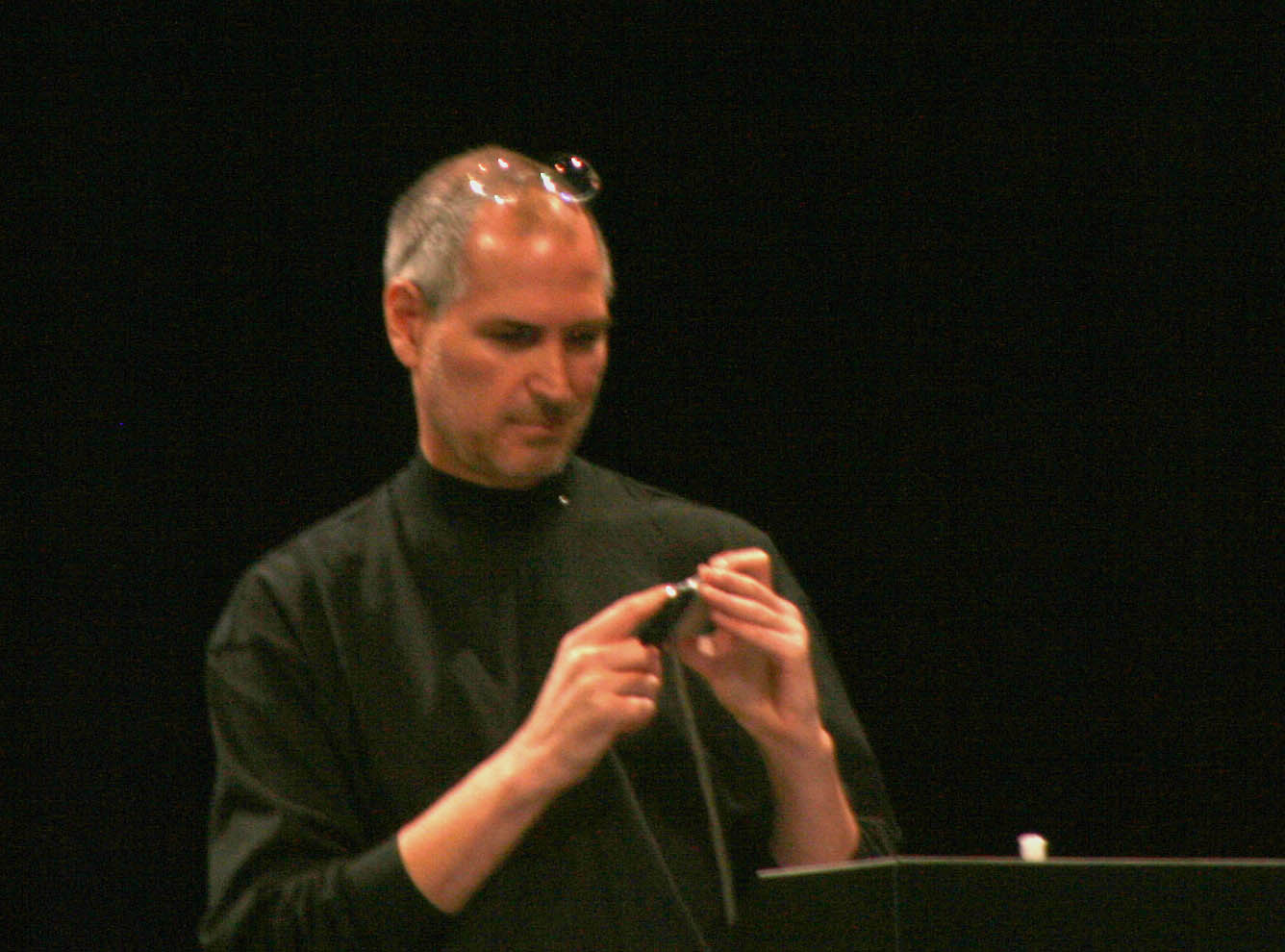
Photo: JD Lasica / CC BY 2.0. Unmodified.

What survives the launch
Jobs’s historical ambition was to make useful, carefully considered things and build companies capable of making more of them. That second part receives less attention because an organization is harder to photograph than a phone. Yet Pixar, NeXT and the restored Apple all turn the conversation back to colleagues, persistence and choices about what deserves investment.
He married Laurene Powell in 1991 and made Palo Alto his home. The public figure in the black turtleneck was also someone whose life extended beyond a keynote. Even his much-repeated commencement address was an exercise in looking backward, attempting to give a coherent account of decisions that had felt uncertain when he made them.
The Steve Jobs Archive, launched by Powell Jobs in 2022, now makes parts of that working life available through publications, recordings and programs for young creators. Its release of the 1996 Pixar interview in November 2025 returned attention to the years that a familiar comeback narrative can rush past.
Those years leave a more useful picture than a sequence of triumphant entrances. Jobs built things that struggled, supported people whose skills differed from his own and returned to a company that needed the experience he had acquired elsewhere. Apple bought NeXT for its future. It also got a founder with a past he had finally put to work.
Keep the conversation going
Explore the Steve Jobs Archive and Make Something Wonderful, its collection of Jobs’s words. Browse Apple’s remembrance, Macintosh team recollections and Pixar’s history.
Watch the Stanford commencement address ↗
Watch the 1996 Pixar interview ↗
Visit the Archive’s YouTube channel ↗