A father and his children were throwing baseballs at a roadside speed sign. The municipal equipment had acquired an unexpected second job: telling a family how fast a child could pitch. For Steve Goody and his fellow engineers, that borrowed scoreboard offered a rather good question. Why should a parent need a piece of street furniture to obtain a number?
The answer eventually became Pocket Radar. But the distance between spotting an awkward workaround and building a business around it proved longer than the founders expected. Goody had spent years making complicated electronics work. Now he would have to understand people whose working day involved dugouts, batting cages and practice schedules. A functioning circuit could pass a test. A useful invention had to earn a place in somebody else's routine.
There is a pleasing complication in this story. Goody was hardly the obvious candidate to build equipment for baseball. He remembers one Little League season spent on the bench, striking out when he did bat. His childhood interests ran to mathematics and circuits. Years later, he would find himself selling to the very sporting world he had once watched from an uncomfortable distance.
The workbench came before the dugout
Goody studied electrical engineering at the University of California, Davis, earning a BSEE. He spent more than twelve years at Hewlett Packard, working as a hardware designer and principal engineer/scientist on networking equipment. Hubs, switches and network adapters were his territory. These were products whose achievements happened largely out of sight: information arriving where it belonged, when it belonged there.
He moved through Next Level Communications, then joined the early engineering team at Cerent, the company later acquired by Cisco. His work included Ethernet hardware design and architecture for the Cisco ONS15454. At Caymas Systems, he became a co-founder and hardware system architect, helping develop network access control appliances. His company biography credits him as inventor or co-inventor on seventeen patents.
That career gave Goody a substantial technical vocabulary. It also gave him collaborators. Grant Moulton knew him from Next Level; their professional paths crossed again at Cerent. Chris Stewart belonged to the same wider engineering circle. Their eventual partnership grew out of years of acquaintance, rather than a chance introduction followed by an ambitious slide deck.
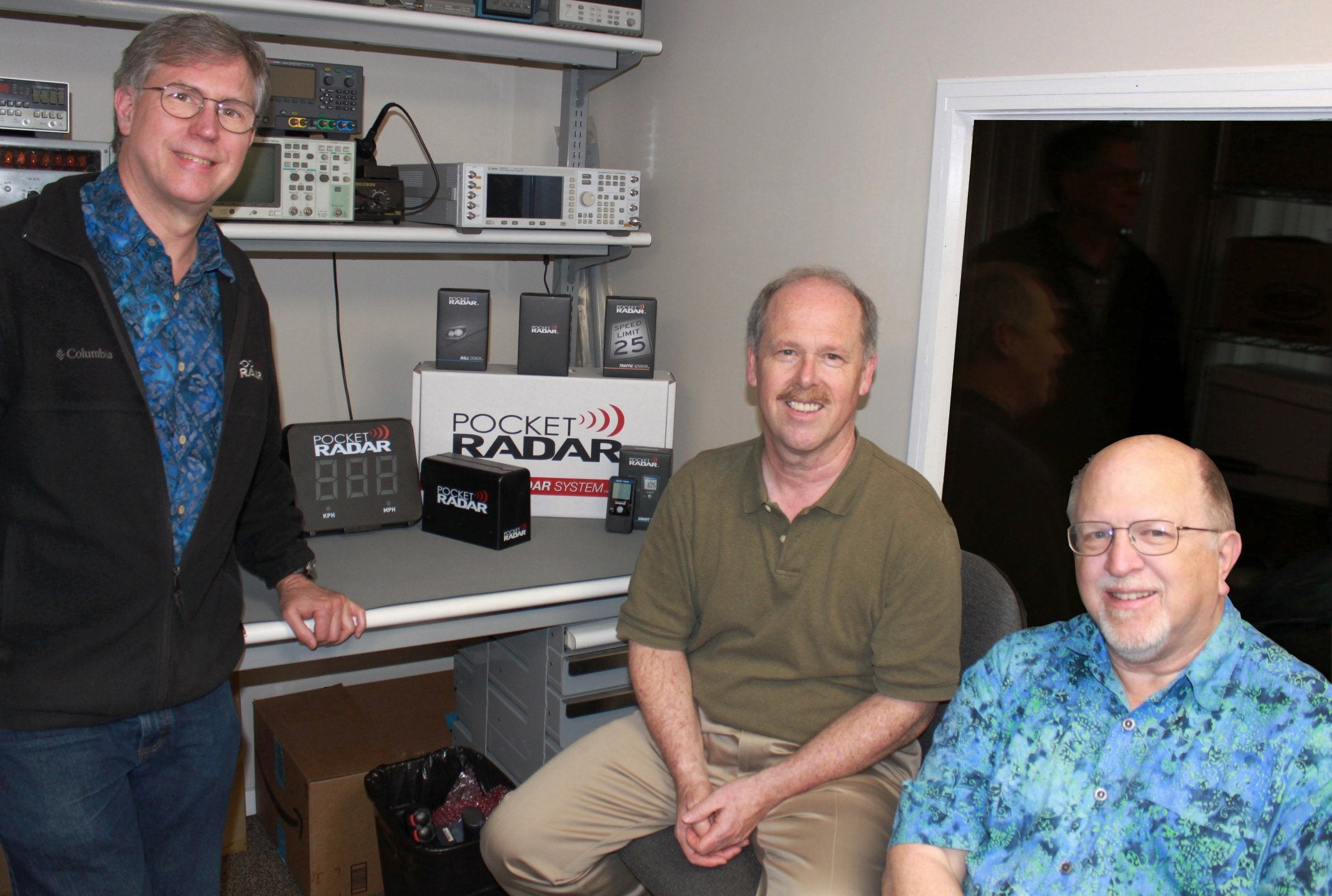
The three met weekly in Sonoma County while considering what to build together. They remembered an earlier Hewlett Packard culture of workbenches, access to equipment and colleagues willing to help solve a problem. Their ambition included recreating some of that environment. Before there was a particular customer or product, there was an idea of how working together ought to feel.
A speed sign with a second career
The roadside episode supplied a use for that shared experience. In Goody's telling, a partner saw a father and two children using a trailer-mounted radar sign to measure their throws. The company also recounts the origin as a friend resorting to a police radar trailer for his Little Leaguer. The central problem was plain: accurate speed measurement was inconvenient enough to send a family down the road looking for it.
The team set out to rebuild the device around portability and cost. Doing so required repeated changes of approach. The company describes having to start again several times before the core technology worked satisfactorily. This was an unusually literal exercise in making a large idea fit into a small object.
The original Pocket Radar Classic arrived in 2010 at $199. Contemporary coverage placed conventional radar guns at prices reaching roughly $1,000. At the Consumer Electronics Show that January, Goody demonstrated the smaller device to technology reporters. The proposition was easy to grasp: speed measurement that could travel in a pocket. The engineering behind that sentence had taken considerably more effort.
Goody also showed television personality Al Roker how to use it. He later recalled the demonstration working well and the exposure failing to produce the sales they had hoped for. That memory is a useful corrective to the usual launch-day mythology. A camera can establish that something exists. It cannot arrange a lasting purpose for it in the viewer's life.
The stopwatch test
By 2017, Goody was describing a more precise ambition: coaches should be able to use radar as casually as a stopwatch. They should be able to reach for it when useful, rather than organize a session around an elaborate piece of equipment. The distinction sounds modest until you imagine carrying the equipment through an entire working week.
For a coach, size belongs in the same conversation as accuracy. A tool left in storage has a very limited sampling rate. Something that fits into the day's ordinary movements has more chances to contribute. Goody's argument brought the discussion away from a specification sheet and toward the small practical decisions that determine whether a purchase gets used.
“Convenience was a big thing for us.”
Steve Goody
The team consulted college and professional baseball coaches, developing Ball Coach around their needs. It pursued a similar process with traffic engineering professionals for another application. The founders had started with an engineering capability; listening helped them turn it into distinct products. One technical achievement could serve different customers, provided someone paid attention to the differences.
Goody's early demonstrations included a visit to University of Arizona coach Andy Lopez, comparing Pocket Radar's readings with those of an established radar gun. Matching numbers made the case in the language a coach could evaluate immediately. The customer could see the result. The inventor could see whether the result mattered.
Softball had something to teach him
Women's softball became an important early community for Pocket Radar. Goody credits coach Teresa Wilson with introducing the device to other coaches. That kind of adoption depends on a relationship between people who already have reasons to trust each other's judgment. Passing a small instrument along the sideline can accomplish something a distant advertisement cannot.
By May 2018, the National Fastpitch Coaches Association was announcing a renewed, multiyear official sponsorship. Pocket Radar would supply its technology for coaching clinics and other association events. Goody emphasized training, recruiting and player development. The association's executive director, Carol Bruggeman, described a longstanding relationship with the company and the relevance of its products for coaches.
Those clinics mattered as places where people could connect a reading with a coaching decision. A number on a screen invites questions: what changed, what should we try, and did the next attempt differ? Bringing equipment into a teaching setting gives those questions somewhere to go. It also gives the manufacturer a close view of the questions customers actually ask.
Goody's encounters changed his own understanding of athletes and coaches. He has described discovering leadership, intelligence and generosity among people he once regarded through the crude childhood division between sporting children and bookish ones. Building the company required him to revise a judgment about a whole community. The device measured speed; its maker had some assumptions to recalibrate.
Learning to enjoy the company
In a 2019 interview, Goody spoke about enjoying encounters with Olympians and baseball general managers, and about finding satisfaction in creating jobs. Those are revealing choices of subject for an engineer discussing a technology business. He had plenty of circuitry to explain. He also wanted to talk about the people the work had brought into his life.
“We had to learn the market to reach the market,” he said. The sentence contains an admission that technical experience alone had been insufficient. It also suggests a form of patience: keep listening long enough for customers to show you where the value lies. His enthusiasm extended to other entrepreneurs and to connecting products that had developed separately.
In 2019 he was already discussing the possibility of joining information about body mechanics with information about ball movement and velocity. Separate tools could become more useful when their readings met. For Goody, the next problem was beginning to look like a familiar one from his networking career: getting useful information to the place where somebody could act on it.
The pocket grows connections
That direction has produced concrete business developments. In January 2022, Pocket Radar signed a letter of intent to acquire The Scout Hub, a software company led by Todd Blyleven. Its scouting and athlete résumé tools addressed evaluation and presentation. An intention to acquire is a distinct milestone from a completed transaction, but it showed the company's interest in software around the measurement.
The connections continued. At the 2026 American Baseball Coaches Association convention in Columbus, Goody joined Tom House and Mustard's Weston Lombard to discuss integrating Pocket Radar with the Mustard app. Subscribers to Pocket Radar PLUS could see velocity alongside the pitch used to create a Mustard report card. The old wish to connect mechanics and measured performance had acquired a visible, practical form.
In August 2026, Pocket Radar and Seam announced another integration. A coach's pitch call, delivered through Seam, could be paired with Smart Coach velocity data. The relationship between decision and outcome became easier to review within a game. It was another example of the business reaching beyond the handheld instrument while keeping that instrument central.
These developments bring Goody back to the practical question that made the roadside story interesting. Where does useful information belong? In this case, with the people throwing, teaching and deciding what to try next. The route there has taken him from network hardware to coaching conversations, from a television demonstration to years of listening at fields and conventions.
The father at the speed sign had already supplied a convincing demonstration of demand. Someone wanted a number badly enough to borrow the town's equipment. Goody and his partners spent the following years working out how to put that number within reach, and how to help it earn its keep once it arrived.