The useful detail in Chris O'Dowd's story is a batting cage with Todd Helton in it. When O'Dowd struggled as a player, he had people like Helton to help him work through it. Clint Hurdle could offer a timely word. His father, Dan, ran the Colorado Rockies. For a young baseball player, that is quite a customer-support department.
O'Dowd has been unusually direct about this advantage. In describing why he and his father built WIN Reality, he called his upbringing a “silver-spoon experience.” The phrase matters because it makes access, rather than personal brilliance, the starting point. He had skilled people nearby, useful feedback and opportunities to practice. Plenty of players with ambitions of their own had considerably less.
The company he now leads in Austin began with virtual reality training for baseball and softball. Its more recent acquisitions reach into bat sensors and cameras installed at real fields. Across those changes, a personal question keeps returning: how much of what helped him can be delivered to someone whose father does not have a major league front office?
A surname with season tickets
Christopher Kelley O'Dowd was born in Cleveland on October 4, 1990. His childhood followed his father's work in baseball; after Dan took over the Rockies in 1999, the Denver area became home. Chris attended Regis Jesuit in Aurora, Colorado. By his senior baseball season, he was hitting .542, with seven home runs. Oakland selected him in the 40th round of the 2009 draft.
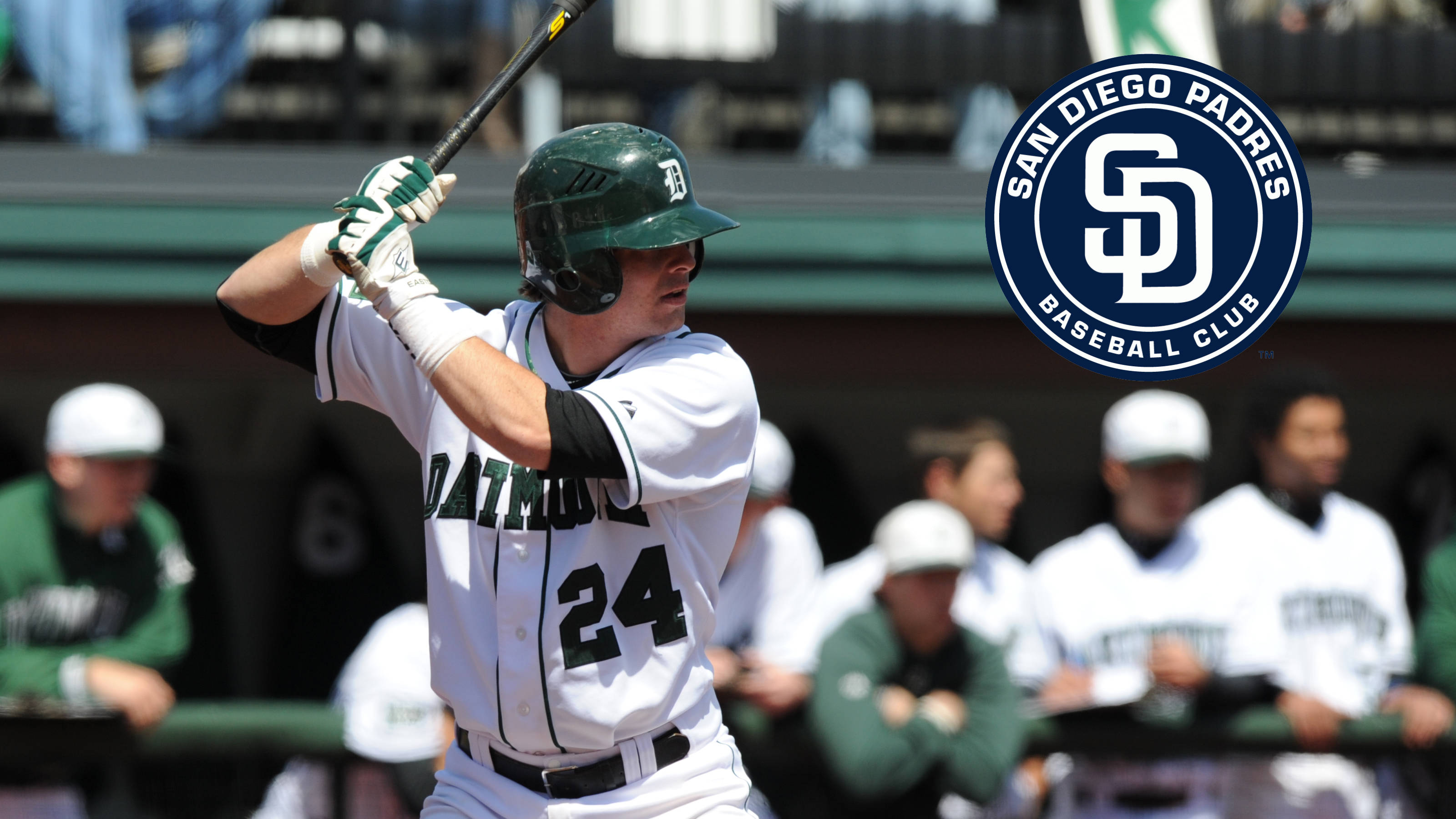
He chose Dartmouth instead. There was a professional invitation on the table, but he wanted the education and time to mature before the demands of the minors. At Dartmouth, baseball came with academic obligations that did not rearrange themselves around a catcher's schedule. He played three collegiate seasons, earned Ivy League Co-Rookie of the Year honors in 2010 and became an All-New England first-team selection as a sophomore.
His father could explain the business. Chris still had to play the games. In June 2012, the Padres drafted him in the 23rd round, 705th overall. He finished his Dartmouth playing career with a .315 average across 116 games. The family connection supplied knowledge and proximity; the draft supplied a place to begin doing the work professionally.
The education on the other side of the plate
Catching puts a player on both sides of a baseball argument. Behind the plate, he watches a pitch defeat a hitter. In the batter's box, he becomes the person trying to prevent that happening. O'Dowd's professional record belongs to the minor leagues, where he accumulated 259 hits in 1,006 at-bats, a .257 average. He reached Triple-A and played in organizations including the Padres, Rockies, Braves and White Sox.
Early in that career, his routine already attracted attention: arriving for extra work and asking coaches questions. He talked about deliberate practice, with a purpose attached to each task. He also resisted turning his father's job into a manufactured rivalry. Baseball could make them competitors in uniform while leaving their relationship intact outside it. There was more affection here than a tidy sports-business plot requires.
That combination helps explain the later founder. O'Dowd had experienced the ordinary difficulty of getting better, alongside an extraordinary supply of advice. A coach can identify a problem. A player then needs an opportunity to work on it under conditions that resemble the next game. Those are separate requirements, and even a well-connected player can encounter a gap between them.
“My dad has always been my best friend.”
Chris O'Dowd · 2012
Batting practice has a speed limit
O'Dowd's explanation of that gap is straightforward: a young player trains at one pace, then discovers a faster one in the batter's box. The transition gives the pitch rather an unfair advantage. He has also described watching players dodge virtual pitches while wearing headsets. Whatever their rational understanding of the equipment, they were responding to the ball they thought they saw.
Dan had wrestled with the same preparation problem from the executive's side. His experiments included elevated platforms, high-speed machines and live batting practice. He even investigated immersive technology during his Cleveland years through a visit to the NASA Space Center. Those earlier approaches were expensive or failed to recreate enough of the timing and rhythm of facing an actual pitcher.
Chris and Dan co-founded WIN Reality in 2018. The core proposition was specific: let a hitter encounter realistic pitches repeatedly in a virtual environment. The company's training runs on a Meta Quest headset. The appeal is easy to understand without becoming a VR enthusiast. A batter needs to recognize what is coming, decide whether to swing and get the timing right. A bucket of balls cannot offer every version of that problem.
A living room, a pitcher, three hits
In March 2021, Rangers outfielder David Dahl installed the program O'Dowd had sent him during the offseason. He used it to watch a simulation of Johnny Cueto's delivery, tracking the release and timing rather than swinging a bat. Then Dahl went three-for-three against Cueto and the Giants. His wife shared a video of the living-room preparation. Baseball had acquired a rather unusual piece of domestic furniture.
Three hits do not establish what caused them. The revealing part is the task Dahl chose: seeing and timing a particular pitcher before the real encounter. O'Dowd's idea had become useful enough for a professional to try within his existing preparation. That is a more concrete story than a general promise that technology will improve sport.
College players found their own uses. Cape Cod League hitters Marcus Brown and Bennett Lee worked on recognition and decisions with WIN. For Lee, configuring a right-handed pitcher throwing in the low-to-mid 90s offered preparation for the kind of opponent he would face. Different levels of baseball, the same practical wish: arrive with some familiarity rather than learn everything on the first pitch.
The headset still needs a coach
Growth brought a different test for O'Dowd. In 2021, WIN more than tripled revenue and customer count. In June 2022, Spectrum Equity invested $45 million, with John Connolly joining the board. By that announcement, the platform was used by a majority of MLB franchises and more than 100 NCAA baseball and softball teams. A former player's concern had become a business with institutional backing.
It would have been convenient to declare that the software could do everything. O'Dowd's next move made room for a person. WIN launched its Elite coaching program in 2023, combining VR training with individual coaching and development plans. He emphasized the value of a personal coach in guiding a player's progress. The headset supplied repetitions and feedback; someone still needed to help the player make sense of the work.
That judgment connects the business to his upbringing. Helton's presence in a cage was useful because a particular person understood a particular difficulty. Giving more players access to that kind of attention involves more than distributing hardware. O'Dowd's product decisions suggest an ongoing effort to combine practice, measurement and instruction, each answering a different part of the same player's question.
Spectrum Equity's growth investment in WIN Reality
The swing gets more witnesses
WIN acquired Blast Motion in June 2025. Its sensors measure the bat's movement, complementing WIN's work on recognizing pitches and making swing decisions. O'Dowd described the limits of treating those views separately: “Neither on its own is a complete picture.” SwingAI, the company's analysis tool, adds another perspective on how the hitter moves. The acquisitions make sense when seen from the player's side of the plate.
Imagine reviewing an unsuccessful at-bat. The hitter might have chosen a poor pitch, timed a good pitch badly or moved the bat ineffectively. A result alone will not settle which explanation deserves the next practice session. Combining different measurements is an attempt to make that conversation more precise. It also places a responsibility on the company: the answer has to be understandable enough to use.
Blast brought an existing customer base across baseball, softball and golf. The combined businesses reported more than 500 million swings in their data, a cumulative total rather than a count of athletes. O'Dowd said the intention was to build on what Blast customers valued. The immediate announcement kept the apps operating separately while the companies worked toward a shared product roadmap.
- TrainVRRead the pitch.
Choose the swing. - SwingAIReview how
the hitter moves. - Blast MotionMeasure the
bat's movement. - SmartParkCapture what
happens in games.
Back to the actual diamond
The next step took O'Dowd beyond the training session. In December 2025, WIN announced its acquisition of optical tracking company Yakkertech and the public launch of SmartPark. Cameras would capture live-game information and connect it with the training tools. The announcement described more than 125 performance metrics and more than 2,500 fields committed to installations scheduled to begin in February 2026. Commitments are a plan for expansion, not a completed installation count.
O'Dowd's stated aim is for performance in games to help personalize what a player practices afterward. A session can feel productive; the game then asks whether it changed anything that matters. Linking those records would let coaches revisit that question over time. His ambition now includes the field itself, with information for players, coaches, recruiters and families, alongside tools to assist officiating.
The child of a general manager has become an executive trying to redistribute some of the advantages that came with being one. That ambition remains large, but its origin is pleasingly concrete. Someone notices a struggle. Someone offers useful advice. The player gets another chance to try. O'Dowd is building more ways to arrange those moments before the next pitcher starts his delivery.
More time in the batter's box
Follow Chris on LinkedIn and Instagram. Explore WIN Reality and its YouTube videos.