The restaurant Steve Ells wanted to open was never supposed to sell burritos. It would be a proper dining room, the sort of place a young chef could imagine after working at Stars in San Francisco. Chipotle was the financing arrangement. Sell lunch, collect the proceeds, move on to the serious cooking. Then the customers kept coming, and the supposed detour became his career.
There is a pleasing inconvenience in that origin story. Ells became associated with an entire way of eating by setting out to do something else. Now, more than thirty years after opening his first Denver shop, he is back with sandwiches in New York. Between those two counters sits a corporate departure, an experiment with robots, and a reminder that customers retain an irritating freedom to order elsewhere.
The dinner party before the business plan
Born in Indianapolis in 1965 and raised in Boulder, Colorado, Ells learned to treat dinner as an occasion before he treated it as a business. His mother grew vegetables. Meals brought people together. By junior high he was reading about cooking; as a teenager, he was feeding friends. Those early dinners gave him an audience long before he had a customer.
He graduated from the University of Colorado Boulder in 1988 with a degree in art history. Cooking school followed after a friend suggested it. That sequence matters. His professional education began with looking closely at things, then moved to making something other people would experience. It is tempting to turn every undergraduate decision into a master plan. Ells has described considerably less certainty.
He finished at the Culinary Institute of America in 1990 and went to work for Jeremiah Tower at Stars. Tower’s restaurant offered a close view of the discipline behind apparently simple food. Outside work, San Francisco’s taquerias offered another education: generous burritos, compact menus, quick service. Ells saw two restaurant worlds that could usefully borrow from each other.
A temporary job that lasted 27 years
In 1993, with $85,000 of family backing, he opened Chipotle in a former Dolly Madison ice cream shop near the University of Denver. A small space and a short menu suited the immediate objective: make money without building the elaborate restaurant he could not yet afford. The humble surroundings were part of the arithmetic. There was no need to buy grandeur by the square foot.
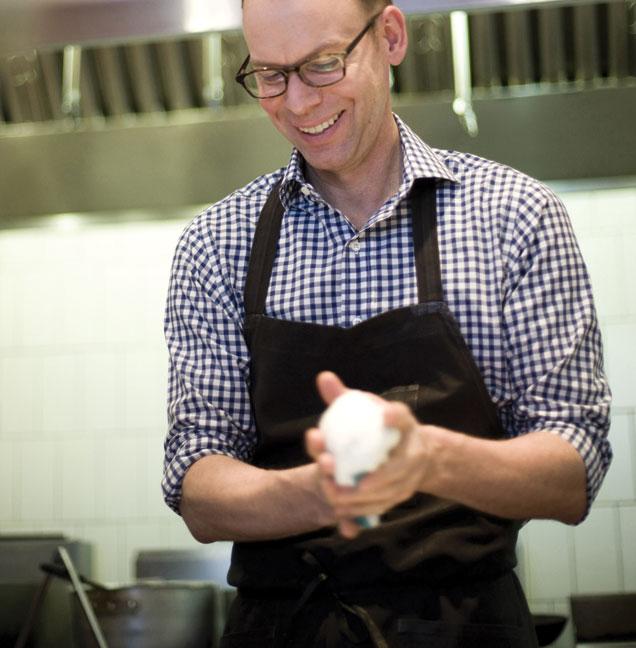
Classical cooking techniques went into food handed across a counter. Customers could watch the preparation and choose what went into their meal. The service line made customization manageable, turning a set of ingredients into many possible lunches. A chef could care about preparation while a customer cared about getting back to work. Both could leave the transaction satisfied.
That balance became more consequential than the planned dining room. A second Chipotle followed, then more. McDonald’s invested in 1998, providing money for expansion. Chipotle went public in 2006, and McDonald’s divested that year. The company that began as a means of financing another restaurant had become a public business in its own right.
Ells has said he originally kept the operation simple because he expected to step away from it. The unintended result was something other people could reproduce. That is a useful wrinkle in the usual founder mythology. The discipline came partly from a desire to leave room for a different ambition. The side project turned out to have better prospects than the project it was meant to support.
What the customer could see
For Ells, the kitchen was more than a place to hide the work. At Chipotle, watching people prepare ingredients helped explain why the meal deserved attention. In a 2013 interview, he described his earlier ambition as opening a “real restaurant.” The phrase catches the young chef’s hierarchy of prestige. Eventually the burrito counter made that hierarchy look rather silly.
His attention also moved upstream. A visit to farmer Paul Willis in Iowa prompted him to examine how pigs were raised and how Chipotle purchased pork. Sourcing became part of the company’s identity, expressed through its Food With Integrity program. The question widened from how a cook handled an ingredient to what had happened before the ingredient arrived.
That was an expensive kind of curiosity to acquire at scale. A single restaurant can build relationships with a few suppliers. A chain has to make its preferences work through purchasing, distribution and thousands of daily preparations. Ells’s public ambitions increasingly involved the food system, even while the customer’s immediate concern could remain magnificently specific: more salsa, please.
There was another customer lesson hiding in plain sight. People opened their burritos in the red serving baskets and ate the contents with forks. Ells later described taking a basket to a paper mill in Maine to request a bowl of the same shape. The burrito bowl arrived in 2003. A diner’s awkward workaround had become a product.
Leaving the company, keeping the question
Ells shared the chief executive role with Monty Moran for several years before returning to the sole position in 2016. Brian Niccol succeeded him as CEO in 2018, while Ells remained executive chairman. In March 2020, he stepped down from that role and the board. His formal departure came twenty-seven years after the first shop opened.
Leaving the company did not dispose of the underlying puzzle. How much cooking could a quick-service restaurant do? How could an operation use less space and energy? Could repetitive tasks be moved away from employees while the remaining jobs paid more? The next venture put those questions unusually close to the customer’s lunch.
Kernel opened in Manhattan in February 2024 with a plant-based menu and a robotic arm. A central kitchen handled preparation, while smaller restaurant locations finished and dispatched orders. Customers ordered digitally and collected food from lockers. It was a deliberately different encounter from the lively, visible assembly line that had helped make Chipotle familiar.
People prepare→Smaller stores
Robotics assist→Pickup lockers
Customers collect
A new division of the work, with a new kind of customer experience.
Ells’s ambition extended beyond his own locations. He hoped other operators might adopt the model, spreading efficiencies in the way fast casual had spread after Chipotle. The plan attached environmental aims to operating decisions: smaller footprints, different ingredients, less energy. Its appeal on paper was easy to follow. The difficulty was persuading enough people to make it part of their day.
The robot did not get the last word
Kernel changed while it was still young. Chicken and dairy joined what had begun as a vegan offering. Ells discussed adjustments to the menu, staffing and interiors as he responded to customers. The experiment was public, and so were the revisions. An established founder could bring capital and experience to a new restaurant, but those advantages could not place the next order.
By early 2025, the business was being recast as Counter Service. The change was substantial: sandwiches, recognizable deli pleasures, and less conspicuous machinery. Roast beef, a chicken club and roast pork offered a more familiar invitation than a demonstration of the future. A person deciding what to eat could understand the proposition before learning anything about the operating model.
Ells’s explanation of Kernel’s reception was blunt: people had not enjoyed having technology so visibly involved in the meal. The broader lesson is less tidy than declaring robots unwelcome everywhere. At Chipotle, visible work had helped sell the food. At Kernel, visible equipment could command the attention that the food needed. Designing the process and designing the encounter had produced different answers.
Counter Service kept technology in the business while moving the emphasis toward the sandwich. Peloton cofounder Tom Cortese became CEO; Ells serves as founder and chief concept officer. Chef Andrew Black, formerly of Eleven Madison Park, joined as chief culinary officer. The division of responsibility gives Ells a role closer to the restaurant idea itself, alongside people responsible for executing and extending it.
Back to bread, still watching the details
By March 2026, Counter Service had four Manhattan locations. A Wall Street lease followed in May. In July, reporting described plans to take the concept beyond New York, including Charlotte and Dallas in 2027. Those are expansion intentions, with the usual distance between a proposed market and a sandwich actually being handed to someone there.
The food still asks for inconvenient work: roasting meat, making sauces and attending to the components that can disappear inside the word sandwich. The operating system aims to support that work at volume. Ells is revisiting the old tension between cooking and repetition with a different menu and a different partner. A familiar lunch can contain a fairly demanding business problem.
In June 2026, he delivered Baruch College’s commencement address and received an honorary doctorate. His advice returned to small decisions: identify the details worth protecting, hold on to them when doing so becomes troublesome, and return to fundamentals after a miss. The example he chose was cumin. Even at a graduation ceremony, the chef was concerned with the seasoning.
“find the details that matter in whatever you build”
Steve Ells · Baruch commencement, June 2026
There is continuity here, though no guarantee of a repeat performance. The teenage host, the cook at Stars, the burrito founder and the sandwich entrepreneur all seem interested in how care survives the journey to another person’s plate. His restaurants have supplied different answers, with different commercial results. That makes the question more interesting than a straight line of success.
Chipotle began as a way to earn permission to open the restaurant he really wanted. Counter Service arrives after he has already earned that permission many times over. He is still working on the ordinary meal. The fine-dining restaurant can wait. Apparently, lunch has more questions.
Keep a seat at the counter
- Visit Counter Service ↗
- Watch Ells discuss the Kernel experiment with Daniel Roth ↗
- Watch Baruch’s 2026 commencement on YouTube ↗
- Listen: How I Built This with Guy Raz ↗
- Listen: This Is TASTE, episode 416 ↗
- Visit the sandwich shop with Nation’s Restaurant News ↗
- Read: At the Table with Steve Ells ↗
COUNTER SERVICE SOCIALS
Instagram ↗ · TikTok ↗ · Facebook ↗