Jason Lee wanted pizza. What he got was a question about the plumbing of American commerce. Trying to order through an online delivery service, he noticed a restaurant he expected to find was missing. He knew a bistro owner, asked to see a merchant agreement, and started reading. This is an unusual response to dinner. Most people simply order something else.
In Lee’s telling, the agreement exposed a delay between the customer paying for a meal and the restaurant receiving the money. He began wondering where else that delay existed. A restaurant had already served its food. A worker had already finished a shift. In both cases, the work could be complete while the payment remained somewhere over the horizon.
That observation became the starting point for DailyPay, which Lee cofounded with Rob Law in 2015. The company offered workers at participating employers access to earned wages before their scheduled payday. A familiar calendar arrangement became a problem that software might solve. Lee had found a business opportunity in something so ordinary that it generally escaped being called a choice.
Consider the awkwardness of the arrangement. The electric bill has its date. The paycheck has another. Neither is particularly interested in the other’s plans. Lee’s career as a founder would keep returning to this mismatch between the way institutions organize money and the way people actually need to use it.
A banker changes the unit of analysis
Before DailyPay, Lee spent more than 16 years on Wall Street. At Goldman Sachs, he founded and led the Global Structured Equity Group. He was used to constructing financial products for companies, managing risk, and assembling teams. The son of immigrants and a University of Pennsylvania graduate, he came to entrepreneurship with a financial engineer’s habit of examining the mechanism underneath the result.
He later described a connection between those two careers. At Goldman, one of his jobs involved helping corporations reduce fluctuations in their share price through structured contracts. At DailyPay, he thought about the fluctuations in a worker’s bank balance: up when wages arrived, down as bills were paid, sometimes below zero. The scale had changed; the interest in timing and predictability remained.
That comparison helps explain why he saw payroll as a product problem. A completed hour of work already had economic value. The worker simply lacked immediate access to it. Lee’s attention settled on the interval between earning and receiving, and on the systems that made that interval seem inevitable.
Building around that interval required cooperation from employers. DailyPay connected with payroll and timekeeping systems so that access to earnings could sit alongside existing processes. Behind a simple balance on a phone lay the unglamorous business of integrations, payment rails, and funding. The app’s convenience depended on considerable activity out of sight.
THE TIMING PROBLEM
The balance the bank could not show
Lee called the missing number the Pay Balance: a digital representation of money already earned but not yet received through the normal payroll cycle. In a 2021 essay, he argued that the usual view of available money omitted something consequential. A checking account could tell a worker what had arrived. It did a poorer job of describing the work already completed since the last payday.
The distinction matters to the story. A worker looking at the balance could see value accumulating as work was recorded, rather than treating the coming paycheck as an invisible lump. It gave Lee a way to describe the product without asking people to become experts in payroll infrastructure. Here was another balance, attached to another part of their financial life.
DailyPay grew while he was CEO. In May 2021, the company announced $500 million in financing: $175 million of equity and $325 million of debt. The round put its valuation above $1 billion. The split is useful. Equity financed a company; debt was part of the resources behind a service moving money ahead of the employer’s usual payday.
Growth also gave the idea a wider audience. By the time of a 2021 interview, Lee was describing a service used by millions of employees. The premise had traveled from an interrupted pizza order into benefits departments and payroll offices. He led DailyPay through 2022. The company continued under new leadership, while he and Law went back to building.
DAILYPAY · MAY 2021 FINANCING
Two forms of financing, one announced total. Company valuation exceeded $1 billion at the time.
After payday, another gap
Salt Labs, founded in 2022, began with a different concern about the same workforce. Getting money sooner addressed timing. Lee also wanted hourly workers to accumulate something that could last beyond the next round of expenses. His attention moved from access to earnings toward the long-term value of work.
The company’s March 2023 introduction described the ownership opportunities that often accompany other kinds of employment: company shares, partnership interests, and retirement arrangements. Salt’s founders wanted to create another route for frontline workers. Their proposed product rewarded time at work with Salt, a digital reward that employees could accumulate and use.
The launch announcement distinguished the reward from familiar loyalty points by saying that Salt would not expire. It also set out possible future features, including vesting and ways to turn rewards into cash. Those were ambitions, rather than a list of capabilities already delivered. That distinction keeps the early idea in focus: work could leave a balance behind after the wage itself had gone.
Lee and Law also returned to investors who knew them. Salt’s introduction said all its institutional backers had backed the founders at DailyPay. Fin Capital led a $10 million pre-seed round. In December 2023, an $8 million investment from Third Prime brought the announced total to $18 million. A second company had the advantage of some familiar faces across the table.
There was a practical employer argument, too. Salt sold rewards as a way to strengthen the relationship between a business and its workers, with retention and productivity among its goals. Lee’s pitch joined a worker’s interest in getting more from employment to an employer’s interest in keeping people. The challenge was making both sides care about the same balance.
“financial progress begins with employment”Jason Lee · Chime acquisition announcement, 2024
The employer becomes the doorway
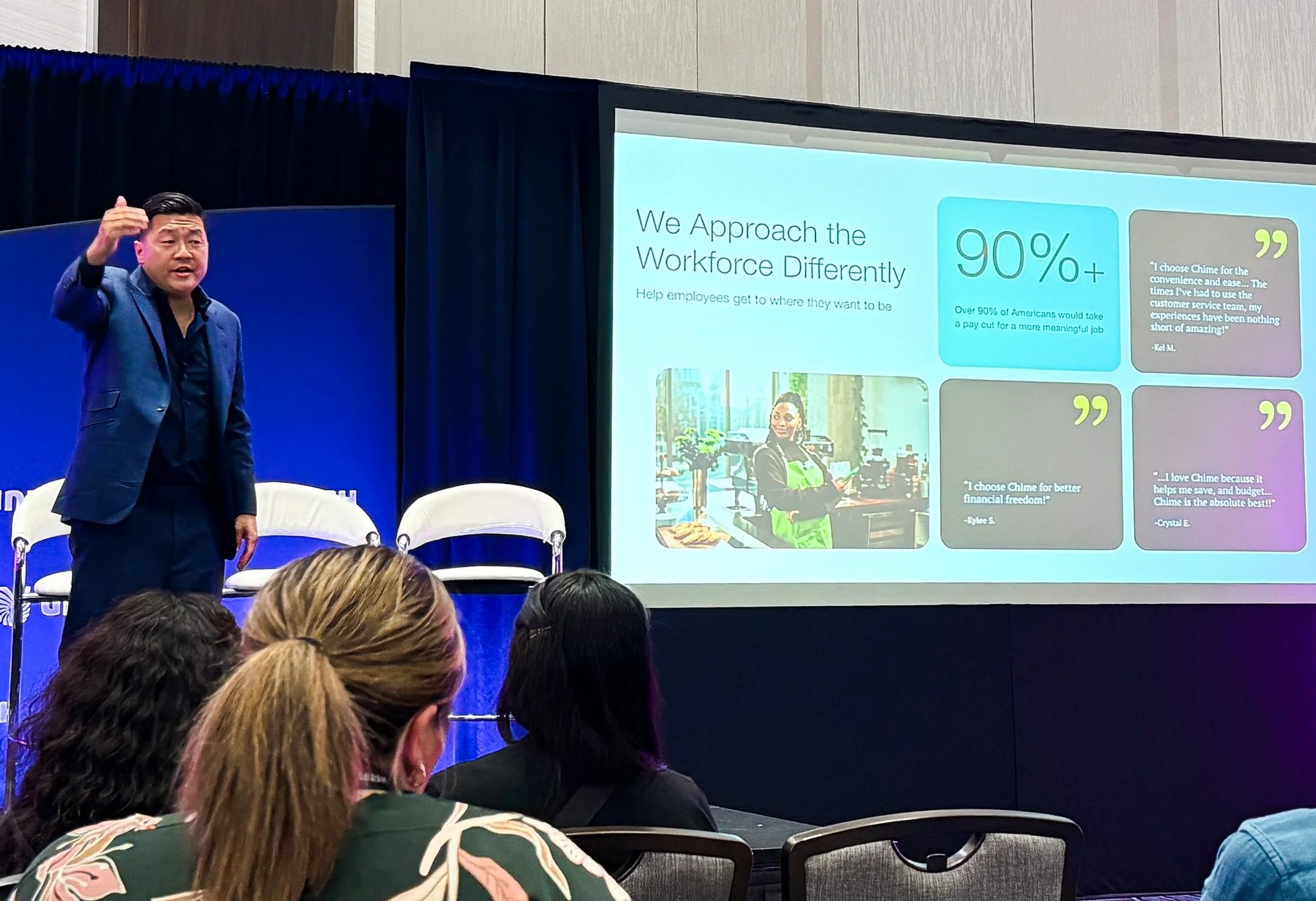
On June 26, 2024, Chime announced its acquisition of Salt Labs. Lee would lead a new business unit, Chime Enterprise. The deal brought Salt’s team, products, and employer relationships into a consumer financial technology company. The employer channel offered Chime another way to reach people who might make it their primary financial account.
For Lee, that connected the workplace more directly to the destination of the paycheck. Employment was already where the money began. Chime could supply more of the tools used after it arrived. In announcing the acquisition, he put the connection plainly: “financial progress begins with employment.” It was a concise description of the territory he had been working for years.
Chime Workplace launched on March 31, 2025. Its announced suite brought together pay access, savings, credit-building tools, and employee rewards. Lee’s complaint about existing benefits was practical: scattered vendors and repeated logins made it harder for workers to get useful results. A product could be available in the benefits catalog and still be a nuisance to use.
This was a broader undertaking than moving payday forward. The sequence now extended from getting paid to setting money aside and building a financial record. Chime’s launch framed the suite around those different needs. Lee had arrived at a distribution strategy that began with the employer but followed the employee beyond the payroll screen.
The toy cash register test
Lee’s public writing can be grand in its ambitions and wonderfully domestic in its evidence. In a LinkedIn post, he shared that his daughter Lucy had received a toy cash register that looked like a Square terminal. To him, it illustrated what a company could do over a generation: change a familiar object so thoroughly that the new version became a child’s starting point.
The detail is revealing because he had used the idea of a company lasting generations in a 2019 reflection on DailyPay. He wrote about investing in employees and building an organization meant to endure. A toy checkout counter offered a smaller, funnier illustration of that ambition. Children are demanding judges of what looks normal. They rarely consult an investor presentation first.
His life outside the companies has included similarly concrete projects. In 2021, the Alicia and Jason Lee Foundation partnered with University Settlement on free self-defense classes on Manhattan’s Lower East Side, responding to racially motivated attacks. The program was to run in English and Chinese, with one class designed for adults over 60. He has also served as chairman of SafeSpace, a New York nonprofit focused on family rights advocacy.
Lee lives in New York with his wife and three children. His current biography lists a board role with the New York Asian Film Festival, adding filmmakers to the communities represented in his public commitments. Alongside the finance vocabulary, there is a recurring interest in who gets represented, who gets access, and who has to wait.
A founder with an eye on the clock
His advice to other founders is less ceremonial than the phrase “serial entrepreneur” might suggest. In 2025, he urged them to concentrate on one product, seek independent directors, and recognize that even a small investor might open an unexpected door. He also ranked hiring priorities differently as a company grew: commitment first at the beginning, intellect in the middle, experience later.
Those are the observations of someone thinking about changing requirements rather than a permanent formula. A company that needs people to begin building may later need people who have already managed its next stage. The founder has to notice when yesterday’s sensible arrangement has become today’s obstacle.
In a May 2026 payroll podcast, Lee returned to the connection between pay and banking. He described them as different names applied to the same money at different points in its journey. His current personal biography names him founder and CEO of Minim Science. The question that made his fintech career distinctive remains easy to recognize: why should a useful financial fact disappear merely because it sits between institutions?