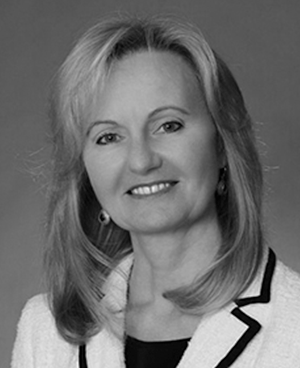
Stephanie Feraday runs a company that answers a question most manufacturers would rather not ask out loud: what does this part actually cost, and what does it cost the planet, before anyone has cut a single piece of metal? aPriori Technologies, headquartered on Baker Ave in Concord, Massachusetts, sells software that estimates manufacturing cost and carbon impact at the design stage, when changing your mind is still cheap. Feraday has been its president and CEO for nearly 17 years, which in software time is closer to a geological era than a tenure.
She joined in 2009. That detail matters more than it sounds. 2009 was the year credit markets seized, factories idled, and most executives were busy explaining why hiring freezes and canceled capital projects were the responsible move. Feraday walked into a manufacturing software company at that exact moment and has spent the years since arguing the opposite case: that downturns are when the gap opens up between companies that invest in better tools and companies that wait it out. "This isn't a market to be timid," she said on aPriori's CEO podcast in 2025, discussing the pressures manufacturers face heading into 2026. "This is a market where people have to do things that will make a difference."
The pitch itself is specific enough to be interesting. aPriori's software lets engineers and sourcing teams get a cost and manufacturability estimate on a part in seconds, pulling from cost models, regional labor and material data, and manufacturing process libraries, instead of waiting days or weeks for a quote to come back from a supplier or an internal costing team. Feraday frames this as a competitive problem as much as an efficiency one. "They might take a few weeks to do a quote," she said of some manufacturers, "while their Chinese competitors do it in five days." The gap isn't abstract to her customers; it shows up in lost contracts.
Feraday's own path to this job runs through a string of enterprise software companies that reads like a syllabus in how the industry actually operates, rather than how it's described in pitch decks. She started in 1988 as a Director of Product Management and Marketing at Delrina, the Toronto software company later absorbed into Symantec. From there she moved through roles at Symantec itself, strategy and M&A work at HP OpenView, Vice President at Computer Associates, Vice President of Marketing and Business Development at Netegrity, Managing Director at Systara, and Vice President of Strategy at Virtusa. By the time she arrived at aPriori, she had spent roughly two decades learning the mechanics of how software companies grow, get sold, and get restructured, from several different seats at the table.
She holds a bachelor's degree in applied science from the University of Waterloo, and attended Mackenzie High School before that. Waterloo has a long track record of producing engineers and technologists who end up running software companies rather than building the underlying technology themselves, and Feraday's career fits that pattern: two decades in marketing, strategy, and business development roles rather than engineering ones, culminating in the top job at a company whose entire value proposition is engineering-adjacent data.
Under her leadership, aPriori has grown to roughly 400 employees and raised a total of $66.3 million, including a Series D round that closed in September 2021. Its customer base sits heavily in aerospace and defense, automotive, and industrial equipment, sectors where a single bad engineering change order can cost between $1 million and $3 million, according to figures Feraday has cited. That's the kind of number that makes a slow costing process look less like an inconvenience and more like a line item.
In July 2021, Feraday was accepted into the Forbes Technology Council, an invitation-only group of technology executives vetted for their track record on business growth metrics. Her stated interest at the time was less about aPriori specifically and more about the wider trajectory of technology: "I'm especially interested in sharing insights and global perspectives about the trajectory of where technology is headed in the future." That membership has since lapsed, according to Forbes' own council directory, but the underlying instinct, treating her company's problem as a piece of a much larger shift in how physical goods get made, has stayed consistent across her public appearances.
Feraday has also positioned aPriori's product at the intersection of cost and sustainability, an increasingly common pairing in manufacturing software marketing but one she frames in fairly concrete terms. "Manufacturers today face constant pressure to simultaneously increase profitability and sustainability," she has said, adding that the company aims "to cut costs, reduce carbon emissions, and improve productivity from early product design through production." The argument, stripped of the marketing language, is that carbon accounting and cost accounting are now close enough to the same spreadsheet that a company shouldn't need two separate tools to manage them.
What comes through across her podcast appearances, press quotes, and Forbes Council bio is a fairly narrow, consistent worldview: manufacturing is getting faster and more global whether incumbent firms like it or not, the companies that survive are the ones that shorten their decision cycles, and technology adoption is less a nice-to-have than a defensive necessity. She describes her tenure at aPriori as "exploring the possible," a phrase vague enough to mean almost anything, but consistent with someone who has spent 17 years at the same company slowly expanding what the product does and who it's sold to, rather than chasing a quick flip.
Feraday is based in Natick, Massachusetts, not far from aPriori's Concord headquarters. Her leadership team includes a chief technology officer, chief revenue officer, and chief information officer, a structure that suggests a company that has moved well past its startup phase into something closer to an established enterprise software vendor. For a woman who took the top job during a financial crisis and is still there through the recessions, tariff fights, and labor shortages that followed, that kind of stability might be the least surprising part of the story.