When Darren Nix tried to insure his first rental property, the purchase became an irritation memorable enough to produce a company. Buying a building was one transaction. Persuading the insurance machinery to accommodate its new landlord was another. Steadily began with that awkward interval: the moment an ordinary house becomes somebody’s business, and familiar consumer services suddenly become less accommodating.
- Insurance for rental owners, with digital quotes and specialist agents.
- Distribution inside property platforms, plus independent insurance agencies.
- An agency, MGA programs and a carrier behind the same brand.
- Fast purchasing still requires attention to occupancy, exclusions and deductibles.
The house was easy. The insurance was the nuisance.
Founded in 2020, Steadily brought together Nix, insurance operator Datha Santomieri and technologist David Tulig. Tulig had worked at Indeed; Santomieri is the company’s COO. The combination matters because landlord insurance involves two problems at once. Someone must make the purchase tolerable. Someone must understand the risk being purchased. A prettier form can solve only so much.
“After Steadily launched, I became its first customer.”Darren Nix · April 2025
Consider the customer who moves house but keeps the old place to rent out. The building has barely changed. Its use has. Steadily’s audience includes that owner alongside portfolio investors, small multifamily landlords and vacation rental hosts. Property damage, premises liability and rent lost after covered damage belong in this conversation. A tenant’s belongings belong in a different insurance conversation altogether.

The address is the beginning
The obvious improvement was to stop asking landlords to retype information a property database could supply. Steadily pre-fills details such as building size and construction year. Customers can begin online and consult specialist agents when the questions become less mechanical. Technology handles repetitive entry; people help interpret a property that refuses to behave like a tidy dropdown menu.
The more interesting move concerns where that purchase begins. An investor using a property platform already has an address in mind. Steadily offers partners an estimate widget, prefilled links and dedicated quote pages. Its API supports deeper integrations, including policy binding for licensed partners. An address-only estimate can appear without first asking for contact details. The insurance conversation arrives alongside the property conversation.
- 01Property address
- 02Insurance estimate
- 03Quote + eligibility
- 04Bind coverage
By April 2025, Steadily reported integrations with more than 400 companies, including Roofstock, TurboTenant, Furnished Finder and BiggerPockets. These are distribution relationships, not 400 insurance products. Their attraction is straightforward: landlords encounter coverage in tools they already use. Partners can earn referral compensation. Steadily gets another doorway into a fragmented customer base, without requiring every buyer to start at its homepage.
Behind the quote, an insurance business
A smooth screen is the visible part of a considerably busier operation. Steadily’s group includes an insurance agency, managing general agent programs and its own carrier. An MGA exercises authority delegated by an insurer; it is a different role from simply introducing a buyer. Expanded binding authority and program-administrator capabilities helped Steadily shorten the distance between a quote and an issued policy.
In November 2024, the company announced its carrier’s first bound policy and a Demotech Financial Stability Rating of A, Exceptional. The agency remains another route to coverage. This combination gives Steadily several ways to serve a rental owner. It also means the brand on the website cannot, by itself, tell a buyer everything about the insurer and contract behind a particular quote.
Annualized gross written premium reported in April 2025
Premium volume is not company revenue.The agency discloses commissions or fees for insurance placement and related services. Those earnings differ from the total premiums attached to policies. Venture capital is a third number again: Steadily announced a $30 million Series C in April 2025, at a $355 million valuation. The company reported cumulative funding of $89.5 million. These figures describe financing and valuation, not profitability.
Steadily competes with digital landlord specialists such as Obie, as well as established insurers and independent brokers. Its pitch combines rental expertise, fast purchasing and several distribution routes. In June 2026, a partnership with RLI added access through appointed agents and brokers. Digital distribution here accommodates the insurance agent, rather than assuming every landlord wants to conduct the entire purchase alone.

One house, several lives
A rental investment may spend time empty, then under renovation, then occupied. Each stage changes the risk. Steadily’s August 2026 HomeVestors program addresses that sequence with one policy and certificate for franchisees. Its self-serve portal allows quoting and binding without a pre-bind review. The convenience is specific to this program; it should not be mistaken for a promise about every Steadily application.
The details make the offer more instructive than the adjective “fast.” The program advertises dwelling coverage up to $1 million, builders risk during renovation and optional loss-of-rent coverage. Ordinary-peril deductibles start at $5,000, or $7,500 in Michigan. Water discharge and sewer-backup coverage has a $10,000 per-occurrence limit. New York is excluded. A faster transaction can still leave an owner carrying a substantial first slice of loss.
Fast is useful. Correct is essential.
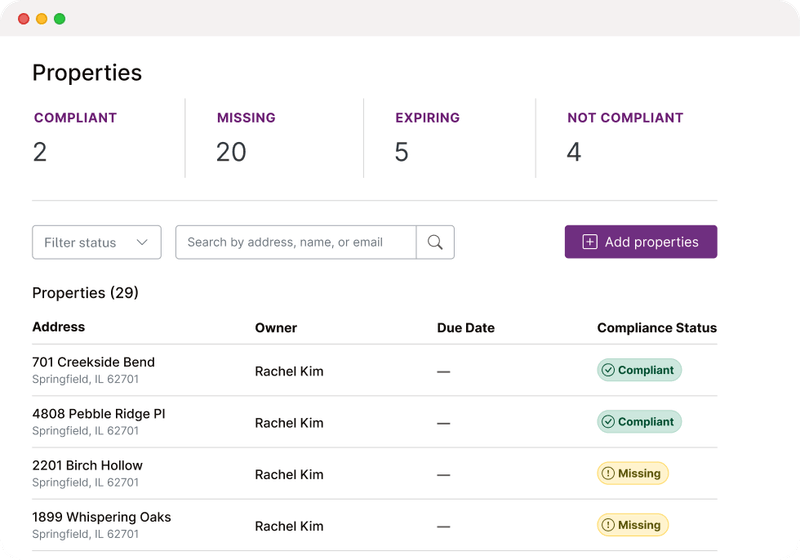
CoverageCheck takes the same attention to workflow into property management. Steadily describes a dashboard showing coverage status, certificates and upcoming expirations, with quote links for gaps. Its April 2026 Real Property Management relationship makes the tools available to franchise owners. The practical problem is ordinary: a manager can collect a certificate once and discover much later that the underlying insurance has changed.
For the buyer, the remaining work is to describe the property accurately and compare the actual contract. Sudden plumbing damage, sewer backup and rising floodwater can require different protection. Loss-of-rent coverage should not be read as an unlimited guarantee that tenants will pay. Vacancy and renovation deserve explicit discussion. Speed is valuable precisely because the questions that remain are worth spending time on.
There is a lesson here for businesses far outside insurance: choose a customer whose routine you understand, reuse information they have already supplied, and meet them during the task that creates demand. Steadily’s advantage depends on those connections working. The landlord still needs the right policy. Having fewer boxes to fill makes room to ask better questions.