The problem with selling access to investors is that people arrive needing everything else. A business plan. A customer. Someone to explain why their pitch makes perfect sense to them and absolutely no sense to a stranger. Fundable, the crowdfunding business launched in 2012, encountered precisely this problem. Its customers wanted money. Many needed preparation.
- Tools, education and advisors for founders getting a business off the ground.
- Investor matching turns a startup description into a ranked outreach list.
- Paid plans sell preparation and access. Investors still make the investment decision.
“We found that most people just weren’t ready to raise money,” founder Wil Schroter told Columbus Underground in 2015. That observation explains Startups.com better than a list of its acquisitions does. The company’s opportunity sat upstream of the transaction it had originally set out to enable. To serve the founder asking for funding, it would have to serve the founder before the ask.
A fundraising problem with homework attached
Startups.co arrived as an umbrella brand in February 2015. Fundable supplied fundraising; Launchrock helped collect early customer interest; Bizplan addressed planning; KillerStartups offered exposure; Clarity connected entrepreneurs with experts. The idea was to cover consecutive obstacles in starting a business. A founder could learn something, build something, test demand and return with a more convincing proposition.
There was a pleasingly practical detail behind Launchrock: Fundable had used it before acquiring it. The buyer already understood the job. A page that captures interested customers can give a young company evidence to discuss with investors. Buying the service brought that earlier step into the same family. The company was assembling the things its own customers kept missing.
the idea
interest
the pitch
investors
The audience extended beyond the familiar venture-backed software founder. In that same 2015 interview, Schroter described small-business owners of many types using the platform. Today’s company reports serving more than a million startups across its history. Read that as a statement about reach. It does not tell us how many people currently pay, or how many businesses survived.
First, tell the software what you’re building
The present-day homepage emphasizes three jobs: reviewing a pitch deck, finding investors and meeting advisors. Its help center describes a matching workflow that starts with a raise amount, a description of the company and industry tags. An optional deck adds context. The system then presents ranked investors with explanations of fit and helps prepare individual outreach messages.
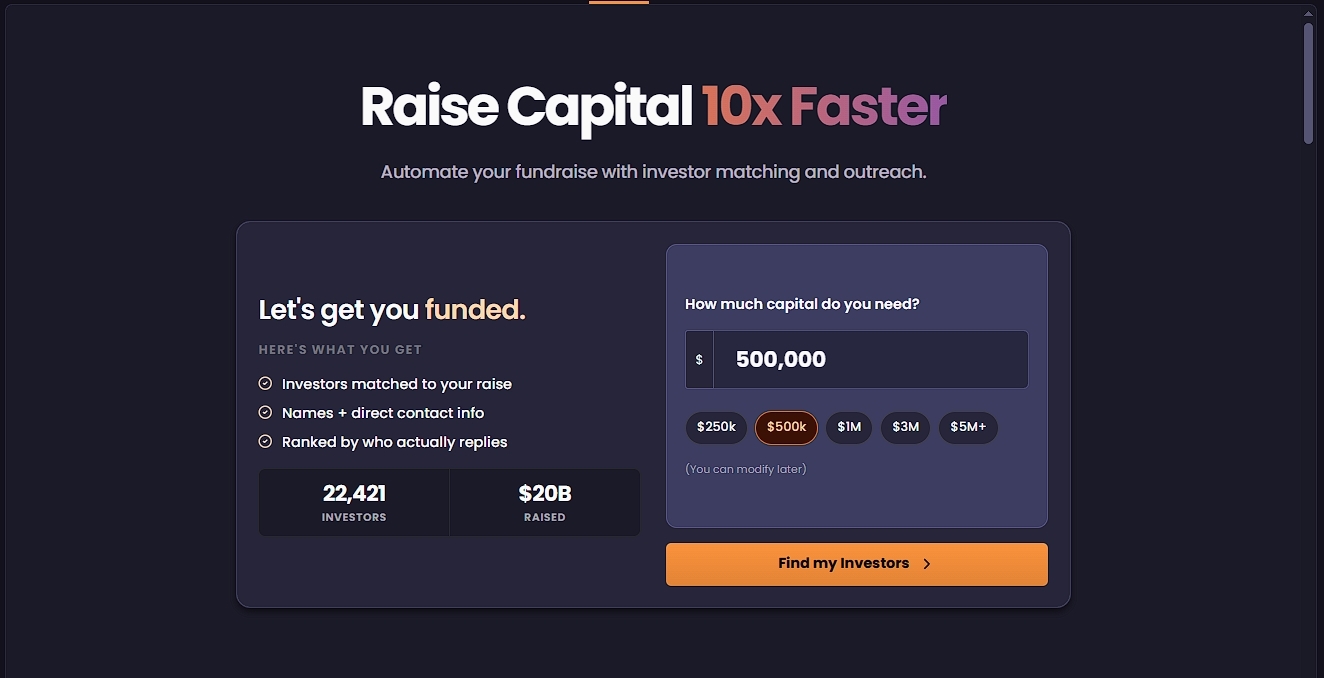
There is useful specificity here. The instructions describe individual messages rather than bulk sending. Engagement tools track opens and clicks; replies arrive in the founder’s connected inbox. The help center also says follow-ups use that email account rather than a built-in dashboard follow-up function. That distinction matters to anyone imagining an entirely unattended fundraising machine.
Even the measurement needs judgment. Startups.com’s tracking documentation explains that security filters can click a link and then block a message. A click may therefore describe software inspecting an email. A founder needs a conversation to discover whether a human investor is interested. The dashboard can help organize the work without settling that question.
The older tools address different kinds of uncertainty. Bizplan breaks a business plan into smaller sections and supplies financial tools for projections and reports. Launchrock helps put an idea in front of an audience through a landing page and signup capture. These are useful outputs to carry into an advisory conversation: a set of assumptions someone can challenge, or evidence that people have volunteered to hear more. The practical advantage of a suite depends on using those outputs together. Buying access alone leaves every assumption exactly where it was.
The price of getting unstuck
The current membership documentation gives this support a price. A free tier allows exploration and separately paid advisor bookings. Startups Pro costs $99 a month and combines courses, community, deck audits and investor matching, with up to three investor messages daily. Advisor Team costs $399 monthly, adding office hours, advisor-led sprints and a higher messaging allowance.
Preparation, software and support. Investment decisions remain with investors.
A separate Investor Matching Pro offer lists a $2,999 one-time payment for lifetime matching and outreach access, plus one year of Advisor Access. Those are different purchasing commitments. The business earns money by supplying tools and help to founders. Its customers’ funding totals should not be mistaken for its own revenue, or for cash the platform itself has invested.
The distinction from alternatives is the bundle. Y Combinator’s Startup School offers free startup education. SCORE offers free business mentoring. A founder can also assemble separate planning, landing-page and research tools. Startups.com’s case for payment depends on whether connecting those jobs, and adding direct assistance, helps a particular founder make progress.
The person behind the pitch

Some obstacles resist a template. Schroter and founding partner Ryan Rutan host Startup Therapy, a podcast about the practical and emotional demands of entrepreneurship. Episodes tackle burnout, personal finances, expectations and identity. It gives the relationship another dimension: the person searching for an investor can also be the person wondering whether the sacrifices still make sense.
The portfolio has changed, too. The company’s own timeline records selling Zirtual in 2024, KillerStartups in 2025 and Clarity in 2026. Older descriptions of a fixed family of five products miss that movement. Today’s emphasis on connected deck, investor and advisor tools is a more useful guide to what a new visitor encounters.
“The only thing I love more than building startups is helping a million Founders build theirs.”Wil Schroter / Founder + CEO
Copy the question before the product
The transferable idea is straightforward: examine what customers must accomplish before they can use what you sell. Fundable encountered people who wanted its outcome but lacked the prerequisites. The broader platform addressed that gap. Another business could investigate the same pattern through customer conversations, without buying a portfolio of companies.
For founders considering the service, the corresponding question is concrete: what will you finish with it this month? A tested assumption, a clearer pitch or a relevant investor conversation gives the subscription a job. A polished deck cannot manufacture customer demand, and a ranked list cannot make an unsuitable business fit an investor’s mandate. Startups.com is most interesting at that boundary, where another tool becomes useful only when someone does the next piece of work.