Before S.T. Rubaneswaran could sell a training course, he had to give himself one. After work in Bangsar, Kuala Lumpur, the engineering graduate would visit an MPH bookstore, read a chapter about sales and try its advice the following day. Buying the book had to wait for payday. His first customer took four months to arrive. A career in education was beginning with a conspicuously reluctant pupil: the salesman himself.
Rubaneswaran, known as Ruban, now runs BEYOND4, which connects talent development, enterprise innovation and startup support. The vocabulary has expanded considerably since those bookstore evenings. The underlying problem remains recognisable. Someone wants to do something difficult, has a gap in their knowledge and needs help that works outside the classroom.
His career offers an unusually practical education in that problem. There is an engineering degree, an MBA, a troubled training business, a corporate boardroom and a mountain. There are also people willing to interrupt their own work to explain something. For all the language about entrepreneurial independence, Ruban keeps returning to the usefulness of company.
A qualification, then a different education
He studied computing and electronics engineering at Nottingham Trent University and went on to earn an MBA from the University of Nottingham. Those qualifications sit neatly together on an executive biography. His route between them was rather less tidy. The first job he found was selling IT courses at ExecuTrain, far from the engineering work he had expected.
The bookstore routine was a modest arrangement: one chapter, one working day, another attempt. There was no grand reinvention ceremony. Eventually he sold a training package to MCIS Zurich Insurance. In his recollection, the company shut its office to put staff through the training. The young salesman had found a customer with enough conviction to rearrange its working day.
By 2004 he was at Knowledgecom, where corporate records list him as business development manager. In January 2008 he became CEO and managing director. Sales had led him into management; management would lead him into ownership. His professional education kept acquiring subjects that had never appeared in the original plan.
at Knowledgecom
and managing director
category winner, Malaysia
The business he chose to keep
Knowledgecom was in difficulty when he took charge. Ruban believed its technology training still had a future and persuaded the shareholders to let him try. His account of the turnaround is full of decisions that make less attractive dinner conversation than entrepreneurship usually promises: reduce costs, deliver programmes, win licences and put the proceeds towards old obligations.
In his 2018 telling, it took about three years to break even. By 2012, the company recorded a net profit of RM1 million. Censof acquired the business the following year. These are milestones with different meanings: surviving, earning and becoming part of something larger. None automatically teaches a manager how to handle the next.
The work also widened his ambitions for training. By 2018 he described a network of 26 Centres of Excellence and Technology across 11 Malaysian states, bringing together universities, polytechnics and state departments. He wanted employees and students to understand how emerging technologies could change their work. Access mattered alongside the subject being taught.
A training business has a particular accountability. Its customer eventually returns to a desk, a factory or a job interview. The certificate travels too, but the person has to do the work. Ruban’s later interest in startup execution belongs comfortably beside that older concern with what happens after a course ends.
Even the board can become a classroom
There is a revealing scene in Ruban’s own writing about his Censof years. During a board meeting, he asked a basic question about a balance sheet. The directors paused proceedings to explain the numbers until he understood. The question, he recalled, did not even concern Knowledgecom. The meeting nevertheless made room for it.
That is a useful small detail in a career often described through persistence. Sticking at something helps; admitting that someone else understands it better can help rather faster. Ruban included those directors in a wider circle of business owners, clients and partners whom he regarded as mentors.
His other circles were less corporate: badminton friends, hikers, childhood companions, family and people he worked with in temple service. He wrote about meeting his wife through that service. The picture is sociable and specific, with different people supplying different kinds of perspective. An advisory board is useful. So, apparently, are friends who knew you before there was anything to advise.
“I feel joy and happiness when I see others succeed.”
S.T. Rubaneswaran, 2016
He has also argued that leadership includes learning to follow. In a 2017 essay, he described changing out of his office role and taking direction while doing religious and social tasks at the temple. Authority could be left elsewhere for the evening. For a chief executive, that seems a sensible use of a change of clothes.
A birthday with quite a lot of uphill
In May 2016, Ruban and friends climbed Mount Kinabalu. The occasion was a friend’s fortieth birthday, an age that some people mark with dinner. Their choice required more preparation. He wrote that they trained on Bukit Gasing for over two months; what began with a few climbers grew into a larger group of friends.
His account makes room for miscalculation. Repeating a familiar training hill had not reproduced the demands of the mountain. The first stretch to Laban Rata took seven hours. The summit attempt began at 2.30 in the morning. He later used the climb to think about preparation, persistence and the difference between an apparent destination and the actual finish.
The mountain became a recurring reference in his writing. One essay was titled Get to the peak more than once! Its question was about sustaining success by developing skills beyond a founder’s main specialism. Reaching a summit once makes a splendid photograph. Working out how to prepare for another attempt is a more useful occupation.
What happens after the funding photograph?
By 2023, Ruban was applying that attention to the next stage of a journey at BEYOND4. He wanted support to continue from a startup’s early development through funding, expansion and eventual exit. His joke was that the “headache starts once funds are raised”. The cheque creates obligations as well as possibilities.
He described grouping businesses according to their stage, then choosing suitable interventions. A company preparing for one funding round needs different assistance from a company approaching another. Crossing a border adds another set of requirements: talent, investors, advisers and local resources. His ambition was to connect that support across countries.
Editorial illustration of his approach. No automatic progression implied.
In Pahang, that work acquired a local address through Rumah Pahang and programmes for both startups and talent. The Pahang Innovative Startup Accelerator targeted pre-seed and early-stage ventures, helping participants test ideas and business models with mentors. The accompanying talent programme addressed the people who would need to build the businesses.
There is an appealing practicality to placing those tasks together. A founder can have an idea before having a team. A prospective employee can have ability before finding a route into technology work. Connecting the two requires patient organisation, the kind of work that tends to disappear behind the photograph of a completed agreement.
Building a longer table
Ruban’s public work increasingly puts him between institutions. At the India-ASEAN Startup Summit in December 2023, he moderated discussions on storytelling and investor expectations. The participants included MDEC’s Mahadhir Aziz, T-Hub’s Srinivasan Rao Mahankali, Vynn Capital’s Victor Chua and PitchIN’s Sam Shafie. The conversations brought government, venture capital and crowdfunding into the same programme.
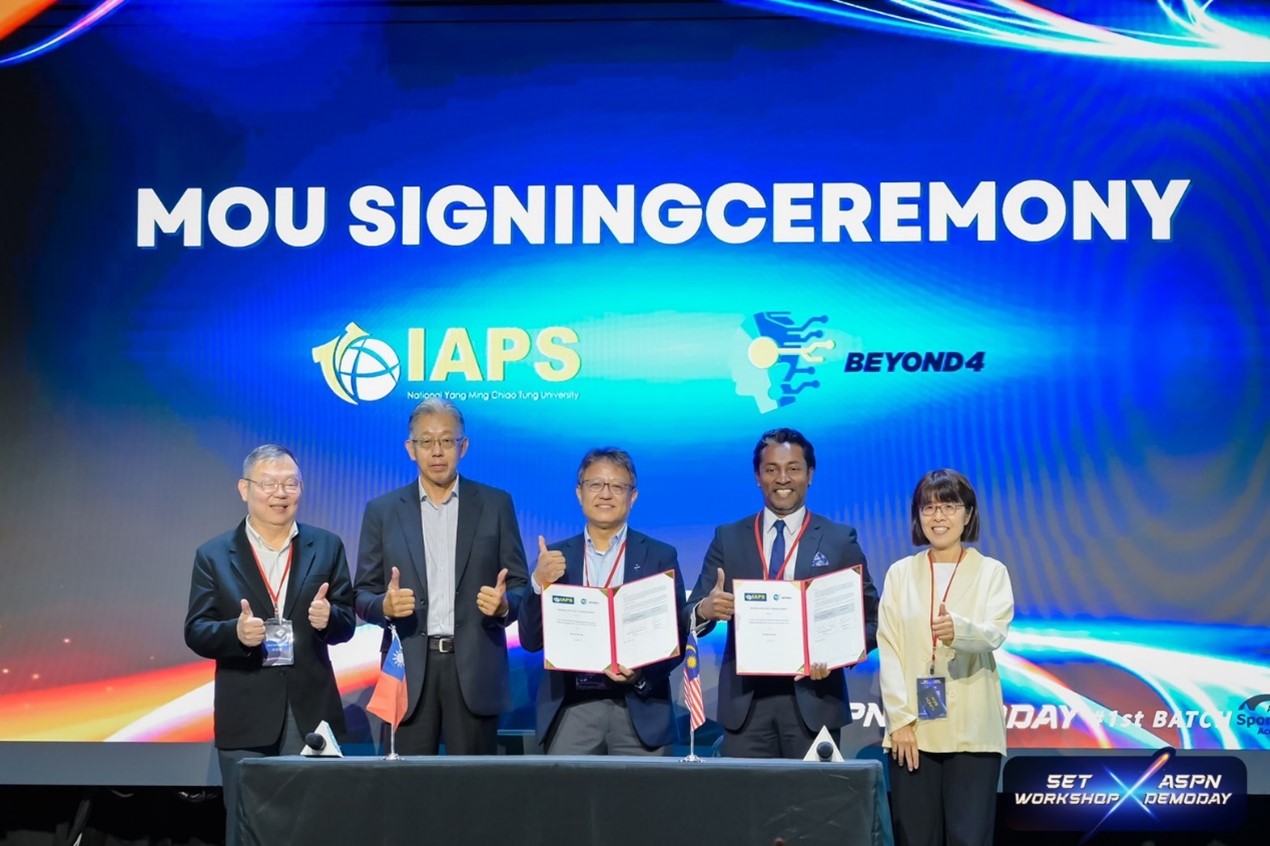
In Taipei in August 2024, he signed an agreement alongside National Yang Ming Chiao Tung University’s Professor Hank Huang at the ASPN Sports Tech Accelerator demo day. Twelve teams from seven economies were competing at the event. BEYOND4’s regional interests had reached a setting where universities, sports technology and entrepreneurship shared the stage.
The institutional relationships continued in Malaysia. On 12 February 2025, Ruban and MIDA chief executive Datuk Sikh Shamsul Ibrahim Sikh Abdul Majid formalised a partnership to support growing companies and talent development. Its scope included skills, industry connections and access to assistance for businesses adopting technology.
Another connection brought an earlier chapter of his career back into view. In August 2025, Censof and Decago announced B4Gov, a joint entity intended to support public-sector digital transformation. Ruban, identified as a Decago director, emphasised capacity building and the people needed to put policy into practice. Technology procurement and the ability to use technology are separate pieces of work.
The question travels to Pahang
On 29 January 2026, MIDA and BEYOND4 convened a startup strategy session in Kuala Lumpur. Ruban spoke about talent, innovation frameworks and partnerships. Yayasan Pahang also launched its Pahang Startup Blueprint 2030, developed with contributions from MIDA and BEYOND4. The discussion had moved beyond an individual cohort towards a state’s longer planning horizon.
Later in 2026, he returned publicly to a question: why not Pahang? He described the Pahang Startup Roadmap 2030 as a way to connect digital talent, investment, business digitalisation and market access. Its ambition included contributing 2% towards the state’s RM100 billion GDP target. That is a stated goal, with the work ahead still to be done.
Ruban’s route into this work began with a much smaller planning horizon: read a chapter tonight, try it tomorrow. The settings have changed from a bookstore to boardrooms and regional partnerships. The appeal of the original arrangement survives. Learn enough to attempt the next task. Find people who can explain the parts you have missed. Then return to work.