The venture-capital industry had a tidy explanation for the near absence of women in its deal flow at the turn of the millennium: it could not find them. Women founders had an equally tidy reply: they could not get through the door. Amy Millman and Kay Koplovitz decided to test which story survived contact with an application form.
The response was not subtle. Springboard’s first call, for a Silicon Valley forum in January 2000, drew 350 companies. Twenty-six were chosen for a bootcamp and a pitch before 250 investors at Oracle’s conference center. Twenty-two went on to attract nearly $200 million. Two similar software companies merged, one founder sold her business, and just one presenter did not land funding. The supposed pipeline problem had turned out to be a plumbing problem.
The first experiment / Silicon Valley, 2000
A policy report gets bored and becomes a company
Koplovitz, the founder of USA Network, and Millman had worked together on the National Women’s Business Council during the Clinton administration. The council’s mandate was to collect information and report to Congress. Koplovitz later described that as “a sleepy thing to do.” The data already contained the provocation: in 1999, only 1.7 percent of a $104 billion venture market had gone to women-led companies.
What changed their minds was not a clever curriculum. It was the gulf between what investors claimed and what founders experienced. So they stopped describing the gulf and built a bridge across it. The operating formula was direct: recruit high-growth women-led companies, vet the plans, teach founders to speak investor, then make investors decide on the merits. Springboard 2000 Enterprises, Inc. became a 501(c)(3), and a forum became a repeatable institution.
“We will find women entrepreneurs, vet their business plans, train them to speak your language and you will fund them.”Amy Millman, recalling the original proposition to investors
The first thing to fail, usefully, was the scarcity story. One presenter failed to attract capital, but the cohort succeeded so decisively that “women are not in the pipeline” became much harder to say with a straight face. The subtler failure was the idea that a single showcase would be enough. Money follows trust, timing and repeated contact. Springboard evolved from a sequence of venture forums into what it calls a “post-accelerator accelerator,” with advisory teams, sector councils, workshops and a network that keeps working after demo day.
Its product is the room
Springboard is often filed under “accelerator,” a word that can suggest seed cash, shared desks and a frantic twelve weeks. Its offer is different. The organization does not make a standard investment and says it takes no equity. It selects companies with traction, puts each founder around people who understand her immediate bottleneck, sharpens the story for institutional capital, and engineers introductions to investors, buyers and partners.
The customers are women in senior operating roles with meaningful ownership in venture-scale companies, especially in enterprise technology, life sciences and healthcare. The other side of the marketplace is less visible but equally important: investors hunting credible deal flow; corporate executives looking for pilots or acquisitions; lawyers and regulatory specialists who can prevent an expensive mistake; and alumnae who remember exactly which introduction mattered.
Selection, pitch discipline, tailored advisors, strategic introductions, sector credibility and an alumnae network.
Meaningful ownership, traction, coachability, a defensible opportunity and a plausible reason to seek institutional capital.
That distinction places Springboard somewhere between a fund, a professional network and a specialist advisory firm. A fund puts money at risk. A classroom transfers general knowledge. A network offers possible contacts. Springboard’s work is to turn the latter two into specific action: this regulatory adviser, that enterprise buyer, this investor meeting, that troublesome slide in the deck.
The Shark Tank joke with a serious mechanism
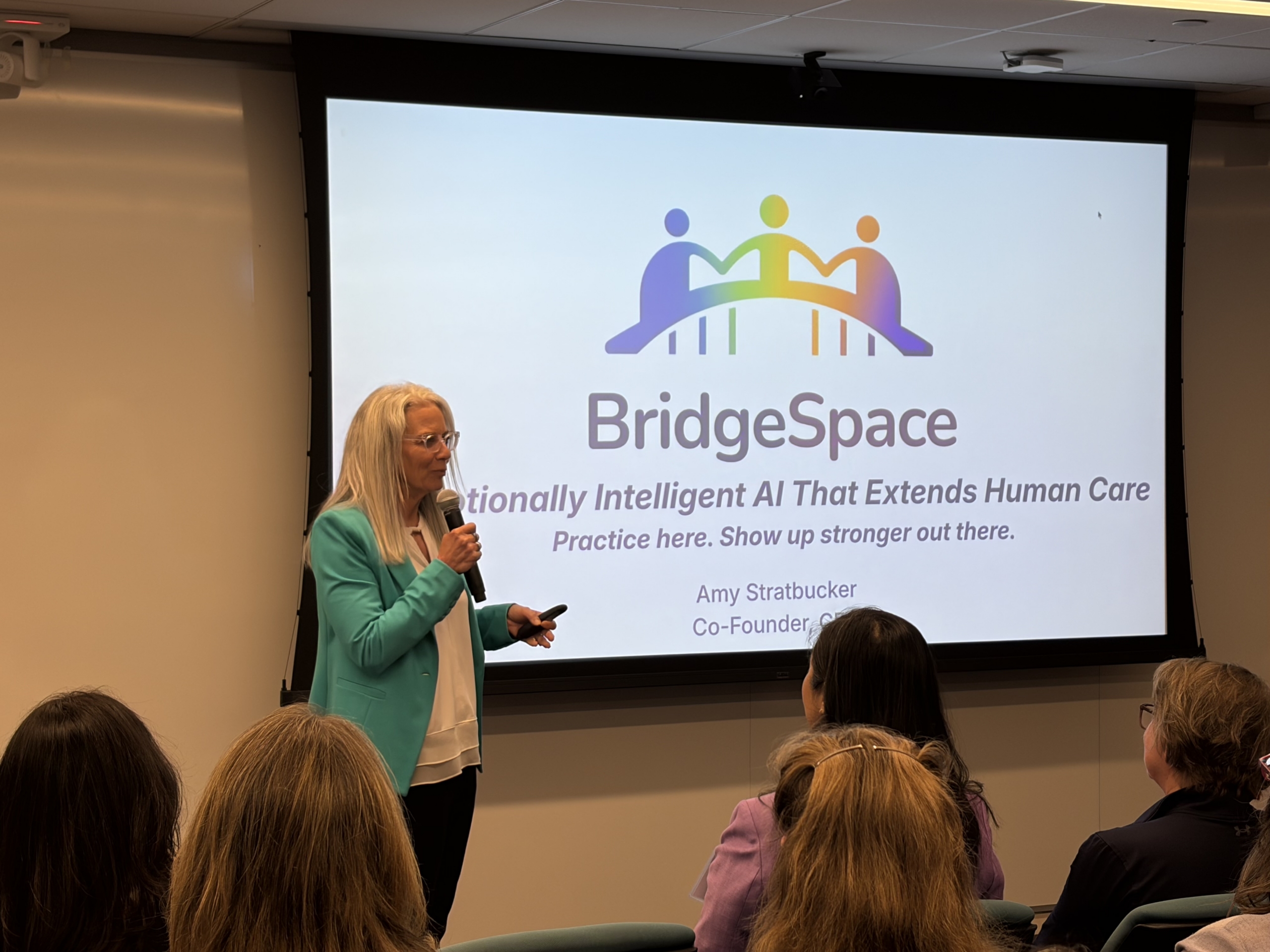
Dolphin Tank is Springboard at its most legible. A founder gets three minutes to name a challenge or opportunity. Then the audience crowdsources solutions, introductions, investment possibilities and candid advice. There are no winners, no elimination rounds and, as the organization likes to say, no sharks. The name is cute; the design is not frivolous. It converts spectators into participants and forces founders to make an ask compact enough for the right person to recognize it.
Springboard reports 800 presenting companies across 150 Dolphin Tank events, 42 cities and 14 countries, in front of 8,500 attendees. In June 2026, a Washington-area event featured startups working on AI testing, communication practice for neurodivergent children and postpartum monitoring. People stayed after the pitches to offer help. That after-room is the point. A polished deck without a next conversation is just theater.
The economics make the contrast with venture accelerators sharper. Springboard’s nonprofit engine is funded through program-service revenue, sponsors, fundraising and contributions. Its 2023 tax filing recorded about $1.51 million in revenue and $1.85 million in expenses. Historical program fees have varied: a 2016 healthcare cohort charged $2,500, while a later archived page listed $5,500. Current terms depend on the program and its sponsors. What remains consistent is the absence of an equity claim, a valuable feature when a founder’s cap table is already a small game of Jenga.
Women’s health was not a branding exercise
Springboard’s sector choices reveal how the system learns. Women’s health founders began appearing in meaningful numbers in its broader health and technology programs around 2014. They arrived with products shaped by personal experience, clinical observation and neglected patient needs - and with markets that many investors still struggled to price. Repetition changed the institution’s focus.
By 2024, Springboard had a dedicated Women’s Health Accelerator and a research partnership with Accenture. The reports drew on hundreds of patients, clinicians, founders, researchers, investors and policymakers across the United States, United Kingdom and Canada. By June 2026, the program had supported more than 65 companies. Its latest cohort included a non-hormonal contraceptive ring, an at-home test for preterm-birth risk, rural maternal-health infrastructure and other products that do not fit into a single “femtech” drawer.
The next expansion is longevity. A 2026 cohort of 10 Seed-to-Series A companies spans health, caregiving, housing and financial independence. The program moves from a virtual launch to advisory work, an in-person gathering at HLTH and a demo day during JPM Week in January 2027. Accenture, KKR, Eli Lilly and the Amplify Her Foundation are sponsors. The pattern is familiar: find a large market whose lived problems are being misread, recruit domain specialists, and construct the room.
“Springboard’s special sauce has always been the power of the room.”Kiki Federico, chief of staff
What a founder can steal without stealing the network
Springboard’s roster contains names that lend retrospective glamour - Zipcar, iRobot, Constant Contact, Everlywell, Medable and Canva among them. Its reported portfolio totals now stand at more than 950 companies, $77 billion in value, 240-plus exits, 28 IPOs and 10 unicorns. Those figures describe portfolio outcomes, not a controlled experiment. Springboard did not manufacture every win, and because it owns no equity, it does not cash in on them like a fund.
The more useful achievement is organizational. It has kept a selective network alive long enough for former recipients to become advisers, investors and introducers. In December 2025, it folded SBE Australia’s alumnae into the global community. In June 2025, Umbreen Bhatti arrived as CEO after leading Barnard College’s Athena Center for Leadership. The institution is now testing whether a 26-year reputation can become a more connected international utility rather than a scrapbook of famous graduates.
The copyable five-part version
- Choose for traction and coachability, not merely a polished application.
- Match each founder to her current constraint, not a generic mentor list.
- Make the ask small enough to act on: three minutes works wonders.
- Give the audience a job beyond applause.
- Design alumni participation as an obligation and a privilege.
There are conditions. This model works best for an ambitious company nearing an institutional raise, with evidence of demand and a problem the network understands. It is a poor fit for a local service business, a founder determined to bootstrap indefinitely, or a pre-traction idea that needs product discovery more than investor introductions. An equity-free accelerator that supplies no standard check also cannot solve a cash crisis by itself. And a selective program can widen one door while leaving many applicants outside it.
Still, Springboard’s founding experiment remains pleasingly hard to misunderstand. When a market says talent is absent, count the applications. When founders say a door is closed, inspect the hinges. Then invite the people on both sides into a room where vague goodwill has to become a name, a meeting or a check. The dolphins can keep the television drama. They have work to do.