Before Oana Craioveanu had an entrepreneurial community to run, there was the problem of everyone turning up at once. The pilot space in Bucharest’s Old Town measured 50 square metres. Two small rooms could accommodate an idea, and some of its enthusiasts. Accommodating all of them simultaneously was another matter. Sometimes the gathering spilled into the café downstairs. A business built around bringing people together had encountered a rather encouraging inconvenience.
Craioveanu would go on to co-found Impact Hub Bucharest, opening its doors in June 2012. Its subsequent history includes startup programmes, a digital education platform, partnerships and work on Romania’s innovation institutions. But those early rooms supply a useful opening scene. Before the programmes acquired names and the results acquired thousands, people had to find one another.
There is something pleasingly practical about this origin. An entrepreneurial community can sound abstract until it needs another chair. For Craioveanu, the work has repeatedly involved translating between those scales: a person with a question, an organisation with resources, a country in which the two might meet more often.
The long way home
She was born in Bucharest and spent her first seven years with her maternal grandparents in Oltenița, on the Danube. School brought her back to the capital. At Spiru Haret high school, she studied mathematics and computer science; university took her towards tourism at the Bucharest University of Economic Studies. The eventual career would make generous use of the mathematics and rather less conventional use of the tourism.
In her second university year, she encountered AIESEC. Student volunteering gave her experience of teamwork, projects and international exchange. It also provided relationships that lasted beyond the student organisation itself. This was an education conducted partly outside the timetable: responsibility arrived through doing something with other people.
Her professional route led to HP in France, then a year in Switzerland. In December 2006 she returned to Romania, just before the country joined the European Union. She subsequently worked as an interbank trader at Citigroup. The mathematical training now had a direct application. A career that might look like a series of changes of direction was accumulating different ways of understanding how organisations work.
Three friends, one unfinished question
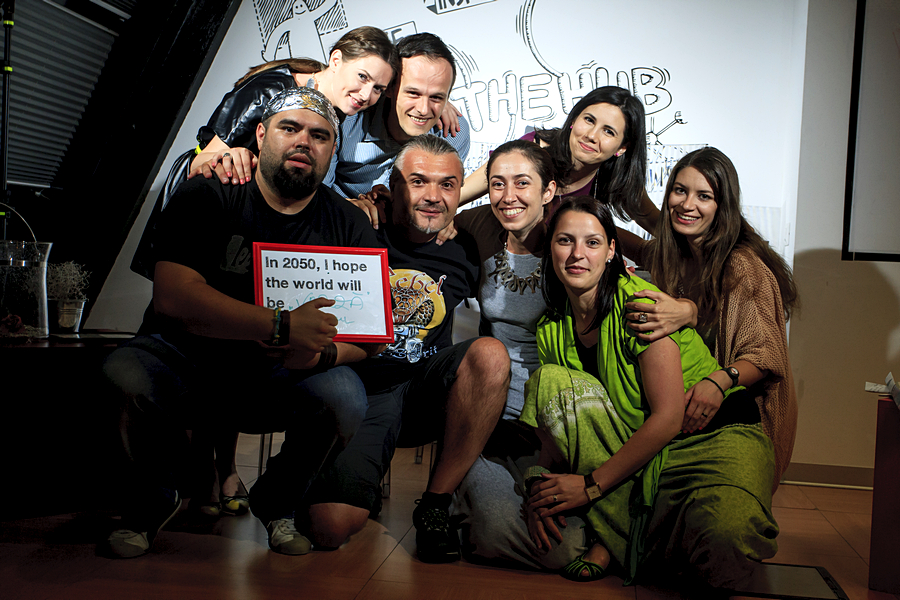
The founding conversation happened in December 2010, over mulled wine. Craioveanu, Vlad Craioveanu and Alexandra Pode knew one another through AIESEC. They wanted to help businesses with a social purpose get started. Between them were experience in finance, marketing and training. Their ambitions had company; their proposed organisation still needed a form.
They experimented before committing to a larger space. Meetings and a pilot preceded the opening. When it came to selling memberships, the founders were asking people to imagine a workplace that had yet to take shape. Advance subscriptions helped turn prospective members into participants in its creation. A shared office began with a shared willingness to take the proposal seriously.
The sequence matters. A community preceded the finished premises. The early members were helping establish the conditions they wanted to work in, rather than simply choosing a desk from a brochure. Craioveanu’s later work would keep returning to that relationship between participation and ownership: people invest more than money when they help something begin.
A village acquires a syllabus
In 2016, Impact Hub Bucharest and ING Romania launched Startarium. It extended support into a different kind of space: an online platform where entrepreneurs could learn, use business tools and find resources. A founder outside the room could now reach part of what the room offered.
The distinction between having a workplace and learning how to build a business is substantial. Entrepreneurs need to make decisions about customers, money, legal arrangements and colleagues. Those decisions do not become straightforward because a desk is available. Startarium addressed the education that accompanies the address.
By the organisation’s ten-year activity report, the platform had reached more than 60,000 aspiring innovators. That report also described an active coworking community of 500 members. These figures describe different kinds of participation, a useful reminder that a building’s occupancy and an educational platform’s audience answer different questions. Craioveanu’s work had expanded into both.
When collaboration becomes an operating decision
In 2019, Impact Hub Bucharest merged with 3House, the coworking project started by Vlad Craioveanu and Ilinca Păun. Oana’s account of that year describes an organisation examining its identity, its market and its next stage of growth, then finding that an opportunity had arrived sooner than expected.
By August, a second location at Universitate was operating. The questions became organisational: how to rearrange teams, improve members’ experience and communicate the combined offer. Collaboration had moved beyond a founding principle into the work of integrating businesses.
This part of the story is less picturesque than mulled wine and a room full of friends. It is also where a community enterprise has to demonstrate that it can manage its own ambitions. New space brings new coordination. A larger offer requires somebody to make it understandable. The practical work follows the agreement.
The meeting that continues at home
Oana and Vlad’s partnership began in business before it became a relationship. They became a couple in 2014 and married in 2015. In their account of working together, they describe changing roles as their businesses required, making use of different strengths rather than preserving a fixed division forever.
Disagreement had its own procedures. They would listen, assemble arguments, sometimes postpone a decision to gain perspective, and sometimes involve experienced colleagues. Eventually, one partner would take responsibility for carrying a decision through. The arrangement leaves room for persuasion, and for the less glamorous obligation to finish what has been decided.
They also described a boundary: after arriving home, work and its complications were supposed to stay out of the conversation. The morning drive could accommodate an exchange about their respective agendas. Entrepreneurship in a couple apparently requires both a joint calendar and an agreed closing time. Their public description of Oana was serious, dependable and balanced - qualities that make more sense in a working partnership than on a motivational poster.
A different kind of institution
In 2021, Craioveanu spent a year advising Romania’s Ministry of Research, Innovation and Digitalisation. It put someone accustomed to helping startups inside a public institution, where decisions operate within another set of constraints. The one-year advisory role extended her work connecting entrepreneurship and innovation into public service.
Innoteque, which she co-initiated with Andrei Roth and Roxana Voicu-Dorobanțu, brought another version of that task into a conference. Business, research and government could meet around the question of how innovation develops. She was also a 2012 fellow of the Aspen Institute Romania’s Young Leaders Program.
Her later World Bank work made the supporting organisations themselves an object of study. The acknowledgements to Enabling the Enablers credit her support in preparing the report and conducting interviews. A companion assessment toolkit credits her contributions to methodology and piloting. The experience of helping founders was feeding into an examination of how the helpers operate.
incubation programmes
supported
facilitated
Organisation-wide outcomes across 14 years. Funding access refers to founders supported, rather than Craioveanu’s personal investment.
For a mentor, this can be very ordinary work. Her Startarium profile lists coaching, business development, leadership, management and business modelling among her areas of expertise. These are the questions that persist after an introduction or an event ends. A programme can open a door; somebody still has to help a founder work through what comes next. Repeating that process across different businesses is part of the craft behind an entrepreneurial community.
What the gardener actually does
“A leader is a gardener.”Oana Craioveanu / translated from Romanian
Her description of leadership includes a small, memorable image: a leader is a gardener
. The Romanian phrase, un lider e un grădinar, places responsibility on the conditions for growth. The metaphor suits someone whose enterprise exists partly to help other enterprises develop.
In 2025, she described her own responsibilities as strategy, partnerships and organisational culture. The team has an “Easy Friday” on the last Friday of the month, with colleagues taking turns to propose activities such as painting mugs or exploring the city. Learning can arrive through an unfamiliar activity as readily as another presentation.
There is a useful modesty in that account of the chief executive’s job. It allows other people to choose an activity, offer feedback or carry responsibility. A founder who wants others to act needs to leave them something to decide. Even a carefully tended garden has to be allowed to grow beyond the gardener’s immediate reach.
Still making room
By June 2026, Craioveanu was discussing Impact Hub’s fourteenth anniversary on RFI 360. The conversation’s premise was the journey from a coworking space to a community where small businesses could find guidance. The current ClimAccelerator 2026-2027 programme also lists her among its mentors and jurors, continuing the hands-on connection to founders.
Other roles widen the circle. PurposeTech lists her as a venture partner. Her EIT biography identifies her as Romania’s EIT Food Hub contact point and a mentor to women founders in agrifood. These are different settings for a recurring piece of work: helping a promising venture reach people and resources beyond its immediate circle.
The 50-square-metre pilot could never have contained all of that. It did, however, establish the essential problem in an unusually clear form. People wanted to be in the room. Craioveanu has spent the years since helping decide what they might be able to do once they find each other there.
Keep the conversation going
Meet Oana’s work, hear her in conversation, or read further.
- Impact Hub Bucharest ↗
- Oana on LinkedIn ↗
- Her Startarium mentor profile ↗
- Watch: Oana on community, with Raiffeisen Bank ↗
- Listen: Florin Roșoga’s conversation with Oana ↗
- Listen: the fourteenth-anniversary RFI 360 episode ↗
- Read: the 2023 career interview ↗
- Read: Oana’s 2025 leadership interview ↗
- Her European Institute of Innovation and Technology profile ↗
- Read: Enabling the Enablers, World Bank report ↗