In February 2020, Diana Dumitrescu was in Redwood City, California, with a group of Romanian businesses and a very specific job. The companies had come to the Startup Grind conference to pitch, meet investors and find customers. She was the program manager helping the trip work. Around them was the spectacle of Silicon Valley. Her attention, in the interview she gave there, was on whether the visitors were ready to make use of it.
The preparation had started well before California. Companies in the InnovX-BCR scale-up cohort had worked through business intelligence, innovation courses and Blue Ocean Strategy, alongside mentoring. Allevo, Setrio Soft, iFactor and DocProcess were among the businesses making the journey. A conference ticket was only one item in a much longer sequence. The difficult part was arriving with something useful to say, and knowing whom to say it to.
That trip makes a revealing starting point for Dumitrescu's story. She works in an industry fond of speed, yet much of her work concerns the hours before the introduction: the workshop, the revision, the question that exposes a gap. An impressive destination can get a business onto a plane. It takes considerably more to get it into a market.
The banker behind the boarding pass
Before InnovX, there were banks. Dumitrescu began her banking career at ING and worked at institutions including CEC, EximBank and Volksbank. It is a useful background for someone whose current work requires conversations with entrepreneurs and financial institutions alike. Founders want movement. Banks want to understand what they are being asked to support. She has spent time on both sides of that conversation.
Her education followed the machinery of finance closely: a master's in banking-system management, then a doctorate at the Bucharest University of Economic Studies, completed between 2012 and 2015, focused on European financial instruments within cybernetics and economic statistics. Later came venture-finance study at VC University in 2022. The subject matter has a certain resistance to cocktail-party small talk. For a company trying to choose a financing route, its usefulness is rather easier to appreciate.
Her public career record places the founding of StartupsAlliance.EU in 2015 and her co-director role at Startup Grind Bucharest in 2018. InnovX followed in February 2019. Read together, those dates describe a gradual widening of her work: from financial institutions toward the people trying to build businesses, and then toward an organization designed to bring those worlds into regular contact.
Finance, founders, foreign markets
- 2015Starts StartupsAlliance.EU
- 2018Co-director, Startup Grind Bucharest
- 2019Co-founds InnovX
- 2020Takes InnovX companies to California
- 2024MoonShotX expands the remit to mid-corporates
A return ticket for the idea
At InnovX, Dumitrescu is co-founder and chief executive. Daniel Dumitrescu, also a co-founder, serves as chief innovation officer. The organization has described her contribution in operational terms, with responsibility for making its programs run. That distinction matters in an accelerator. A promise to connect people has to become a calendar, a prepared meeting and somebody who follows through.
Internationalization also runs in both directions. In spring 2024, InnovX worked with egg - enter.grow.go by Eurobank to bring five Greek startups into the Romanian market. Their introduction included a two-week online bootcamp, followed by four events over three days in Bucharest. Lawyers, corporate contacts and other participants helped make a new market legible. Romania was a destination, as well as a departure point.
The European program that spring added another dimension. InnovX brought together 23 European Innovation Council beneficiaries from 14 countries. Dumitrescu was among the mentors involved in selecting companies for progression. A cross-border network becomes more useful when participants have worked on the substance before the meeting. Otherwise, even a very international room can produce a remarkably local result: everyone leaves with the people they already knew.
What a ranking can buy
Recognition arrived quickly for a business founded in 2019. InnovX appeared in the Financial Times and Statista European startup-hub rankings in 2024 and again in 2025; in the latter year it placed 16th among 150 hubs. Dumitrescu described the consecutive appearances as a major success for the organization. Her explanation concentrated on their practical value: visibility, partnerships and greater confidence among prospective collaborators.
The more revealing part of her assessment concerned money. In a 2025 discussion of lessons learned at InnovX, she stressed that financing alone cannot compensate for a lack of customers, strategic partners and a sound business model. It is an argument with a banker's attention to what happens after funds arrive. An investment announcement makes a satisfying headline. The business still has to sell something on Monday.
That emphasis helps explain the work surrounding the accelerator's public moments. The pitch is visible. The relationships that make a pitch worth delivering take longer. For Dumitrescu, the organization needs to give companies access to markets and partners alongside financing. The ranking can help open a conversation; what follows has to justify the other person's time.
Three parts of market preparation
Twenty-one companies, one working week
MoonShotX extended this approach to Romanian mid-corporate businesses. Developed with Raiffeisen Bank Romania, it serves companies with annual turnover between €5 million and €50 million that are preparing to expand internationally. These businesses have already built something substantial. Their next problem can be finding out how much of what works at home will travel.
By January 2026, Dumitrescu was discussing changes made after the first edition. The second cohort included 21 companies. Its bootcamp brought more than 60 speakers and more than 40 experts into a week of work. InnovX had revised the program's architecture and introduced more competition among participants. Her account was refreshingly specific about revision: running a program once had given the team reasons to change it.
The scale of that week matters less than the work it was intended to enable. Dumitrescu described access to people who could explain a market in ways that a company would struggle to discover through public information alone. A website can tell you where an organization is based. It rarely tells you how to earn a consequential appointment there.
Annual turnover of the Romanian companies MoonShotX is designed to support.
Program eligibility, not a measure of resultsMore than one way to finance a journey
In a February 2026 conversation alongside Raiffeisen's Cristian Sporiş, Dumitrescu also explained the range of financing introduced through MoonShotX: private equity, lending and European grants. Some participants, she said, encountered options or contacts they had not previously considered. Her financial background becomes especially relevant here. A company's expansion plans and its route to paying for them have to be discussed together.
There is a pleasing practicality to this part of the work. International ambition needs translation into decisions: which market to investigate, which partner to approach, which form of capital might fit. Those decisions rarely arrive in the same order for every company. The value of the program lies partly in putting several kinds of expertise within reach while the questions are still being formed.
The first edition's UK activities concluded in June 2025 with a ceremony at the London Stock Exchange. Later, a garden-party gathering brought teams, partners and alumni together. Dumitrescu's own account gave credit across the group, naming the people responsible for strategy, communication and project management. In her formulation, “The team is everything.” It is an unusually compact sentence for an industry with such an extensive vocabulary for collaboration.
“The team is everything.”
Diana Dumitrescu · on the first MoonShotX cohort, 2025
A microphone in Baku
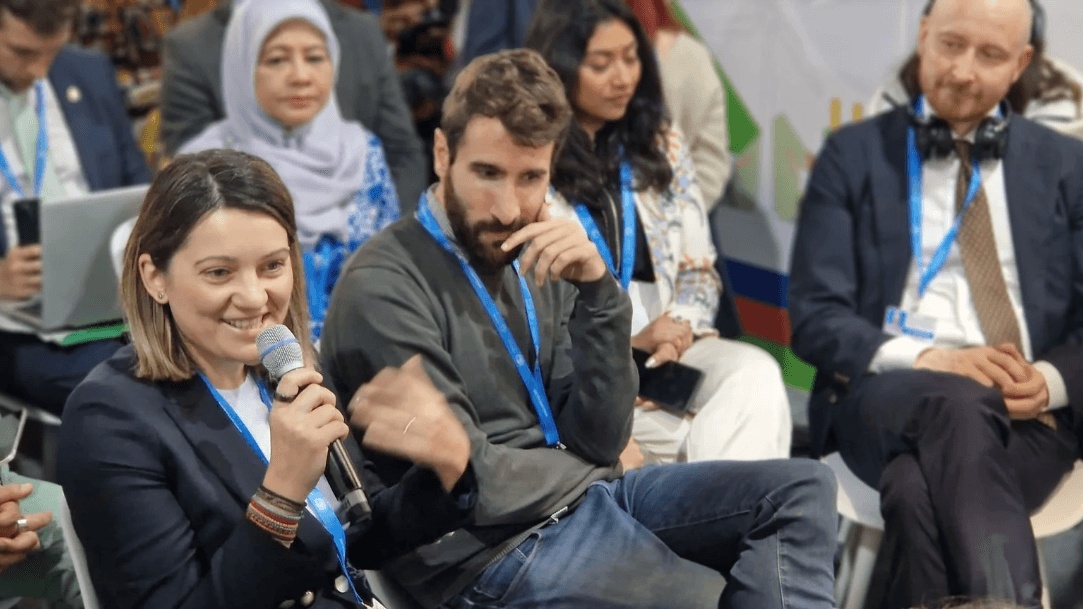
The same attention to the structures around a company has taken Dumitrescu beyond conventional startup events. At COP29 in Baku in 2024, she participated in a UNIDO discussion on cleantech innovation ecosystems. Her contribution set out five areas of support: mentoring, community, corporate networks, marketing and commercialization. The final word is especially telling. An invention still needs a route to a buyer.
Earlier that year, Diana and Daniel Dumitrescu had also served as judges in the Cleantech Days pitching competition, which involved 22 teams. Such events place the accelerator's work amid very different products and technical challenges. The practical questions remain familiar: who will use the idea, who will help develop it, and how will it reach a market?
By 2025, her schedule included representing InnovX at the EGG Investor Day in Athens, a gathering of startup teams and international investors. The geography changes; the recurring task is to make an unfamiliar commercial setting easier to enter. Her career has become international through this repeated work with particular companies, institutions and people.
The next conversation
In an interview published in October 2026, Dumitrescu returned to the American market. She argued that Romanian companies had the ambition and capabilities to enter it, while access to suitable people and partners remained essential. Her emphasis was on preparation before departure: the team's roles, the messages it would deliver and the presentations it would make. An opportunity, in this account, has a considerable amount of homework attached.
She also described what she herself gained from the delegation: friendships, information and a better understanding of industries and mature businesses outside the startup world. That admission gives the story a welcome sense of proportion. The person organizing access is learning through it too. A useful exchange allows expertise to travel in more than one direction.
Six years after the Redwood City trip, the thread is recognizable. Dumitrescu is still working on the distance between a company with something to offer and a person who might help it grow. There are now more programs, more destinations and larger businesses in the conversation. The basic work remains wonderfully resistant to abbreviation: prepare the people, arrange the meeting, and give both sides a reason to keep talking.