Somewhere between discussing a company name and finding someone to draw it, the Spiceworks founders noticed an advertisement in Gmail. It pointed them toward a design firm. They spent $200 on a logo. An ordinary purchase, except for the question it left behind: could an advertisement help someone get a job done? That question would eventually connect an IT management tool to a business selling access to technology buyers.
- The customer: technology vendors trying to reach business buyers.
- The offer: intent data, targeted campaigns, content and demand generation.
- The advantage: a community and media network where IT work already happens.
A useful thing to give away
Spiceworks began in 2006 with Scott Abel, Jay Hallberg, Francis Sullivan and Greg Kattawar. Their audience was the overworked IT administrator. A network needed understanding; machines needed tracking; somebody needed help. The original software offered a practical way into that working day. Advertising was not the founders’ first business-model assumption. Its appeal became clearer when they experienced a useful ad themselves.
The company’s own origin story describes another useful accident. Discussions in its feature-request forum wandered beyond the software into wider technology questions. A support conversation had become a gathering place. The people who arrived to fix something now had reasons to stay, ask questions and help one another. Vendors had a reason to show up, too.

In a 2007 interview, Abel described two conditions for advertising-supported business software: people needed to spend time using it, and those people needed purchasing power. This was a narrower proposition than attracting everybody. An administrator managing a network was a particularly relevant audience for a company selling network equipment.
“This model will not work if people don’t love the software.”
Scott Abel, InformationWeek, 2007
Two birthdays, one business
Today’s Spiceworks Ziff Davis, or SWZD, dates to 2020. Its predecessor has a longer history. Ziff Davis acquired Spiceworks in 2019, combining the community and product operation with its B2B content, data and performance-marketing business. The resulting proposition was broader: help buyers understand technology, then help technology sellers find people with a reason to care.
Calling it a marketplace can suggest shopping carts and a checkout. Here, the exchange often happens earlier. An IT professional researches a problem, reads an article or discusses an approach. A vendor wants to understand which organizations might need its product. SWZD sells services that connect those activities: account intelligence, audience targeting and campaigns designed to turn interest into a sales conversation.
+ research↓02Engagement signals
+ business context↓03Account selection
+ relevant outreach
“Intent” is the industry word for clues that an organization may be considering a purchase. Company information describes the business; installed-technology information describes what it uses; behavioral signals suggest what has its attention. Combining them can make a target list more useful. It still leaves an important question for the salesperson: what, exactly, does this organization need?
The audience is only half the offer
SWZD’s Intelligent Account-Based Marketing offering launched in June 2020. By January 2021, the company named Ekahau, NEC, Vipre and VMware as customers. The announcement described using intent and installed-technology data to prioritize accounts, reach them with display advertising and support lead generation. Buying information and putting it to work were parts of the same pitch.
Aberdeen, acquired in 2020, added behavioral marketing and research capabilities. SWZD also offers content, email and performance-marketing programs. This places it between a publisher, a data provider and a campaign-services business. A marketing team can seek help reaching buyers rather than simply take delivery of another dataset.
There are alternatives. Informa TechTarget also turns technology-content consumption into purchase-intent offerings. Bombora draws signals from a data cooperative. SWZD’s distinctive mix includes its own community, tools and media properties alongside outside signals. That gives customers different observation points; it does not make every observation equally useful.
Free still has a bill
There are two prices to keep separate. IT professionals can start with a free Spiceworks Cloud Help Desk Core plan covering one to five technician or administrator seats. Its Premium plan advertises $6 per seat per month when billed annually, with an ad-free experience and additional features. Vendor marketing campaigns are a separate commercial purchase.
Building the original audience required capital. In 2014, predecessor Spiceworks announced a $57 million Series E led by Goldman Sachs, bringing disclosed funding to $111 million. Scale also brought uncomfortable decisions. Contemporary reporting records a 12% workforce cut in 2016 and 59 layoffs associated with the 2019 acquisition. A popular community did not remove the need to make the business work.
For a prospective customer, the sensible starting point is a defined audience and a specific problem. A security vendor, for example, could ask which relevant accounts appear to be researching its category, then offer material that answers those questions. That is an illustrative workflow, not a reported customer result. Success would mean better qualified conversations and eventual revenue; a busy campaign dashboard alone would say little about whether the targeting worked.
The part you can copy
The transferable idea is to become useful before selling access. Solve a recurring problem for a particular group, give that group a place to compare notes, and understand which commercial introductions improve the experience. Copying the advertising layer without the reason to return would miss the hard part.
Customers need their own capabilities, too. Forrester’s 2025 evaluation recognized SWZD’s variety of signals while identifying shortcomings in productization, integrations and reporting. It saw particular value for technology-focused clients with internal marketing and analytics resources. A team unable to interpret signals or follow up with relevant content should treat the data purchase cautiously.
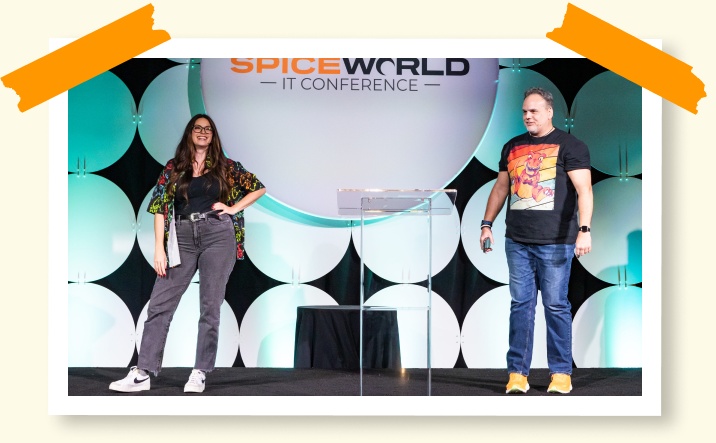
The relationship also has an offline address for two days. SpiceWorld returns to Austin on November 12-13, 2026, bringing practitioners and vendors together. Behind the account lists and campaign language, that remains the company’s useful proposition: put people with technology problems closer to people who might help solve them.