The first version of Sourjyendu Medda’s ecommerce business had no app. Orders arrived through WhatsApp groups. The company gathered them during the week and delivered at the weekend. A venture that would eventually command a billion-dollar valuation began by accepting a fairly ordinary fact: its customers already knew how to send a message. Asking them to learn something else could wait.
That small decision makes a useful introduction to Medda. Before co-founding DealShare in 2018, he had spent years in consumer businesses, dealing with the practical matters of sales, prices and distribution. He approached online shopping from the customer’s end of the transaction. What would make someone try it? What would make the purchase worth the bother?
Today he is asking a different household to make a different commitment. As co-founder and CEO of Sports For Life, he is building a business around children’s coaching and competition. The shopping basket has given way to the training session. Parents still have to decide whether the service deserves their money, their time and another entry in the family calendar.
The education before the startup
Medda studied computer science engineering at the National Institute of Technology, Jamshedpur, and completed his management education at NITIE in Mumbai, now IIM Mumbai. He graduated with a gold medal. The institute identifies him with its class of 2005. The academic distinction is tidy; the work that followed was considerably more concerned with the untidy business of selling.
His corporate career included Britannia and Citibank, followed by Metro Cash & Carry and Raymond’s consumer business. At Metro, his responsibilities covered customer relationship management, pricing and the reseller business. He later led sales at Raymond Consumer Care. These jobs put him close to the machinery that connects a manufacturer to the person who eventually pays for a product.
The combination matters. A computer science background can help someone imagine a platform. A career in sales exposes the distance between a platform and a purchase. Medda’s later explanations of DealShare keep returning to that distance: the unfamiliar interface, the unnecessary choice, the cost hidden inside a familiar brand. His subject was often the friction that an enthusiastic product presentation might politely overlook.
A school friend, four months, and Jaipur
The idea of starting something with Vineet Rao had a long history. They were school friends. In 2014, they returned to a shared ambition to build a business together. By 2018, they were in Jaipur researching an approach to social commerce. Four months of groundwork preceded the launch. The friendship supplied continuity; the fieldwork supplied a customer.
Medda’s observation was straightforward. Daily necessities passed through expensive systems of advertising and selling, while the people buying them watched their budgets closely. Could a business connect local manufacturing capacity to those households with fewer costs along the way? The opportunity lay in making the weekly bill easier to bear.
DealShare’s founding group brought different experience to that question. Alongside Medda and Rao were Sankar Bora and Rajat Shikhar. Rao had worked at Microsoft; Bora brought experience from Myntra; Shikhar had worked at Foodpanda. Medda supplied years spent in retail and consumer sales. Their backgrounds covered several of the difficult jobs concealed inside the deceptively simple instruction to sell groceries online.
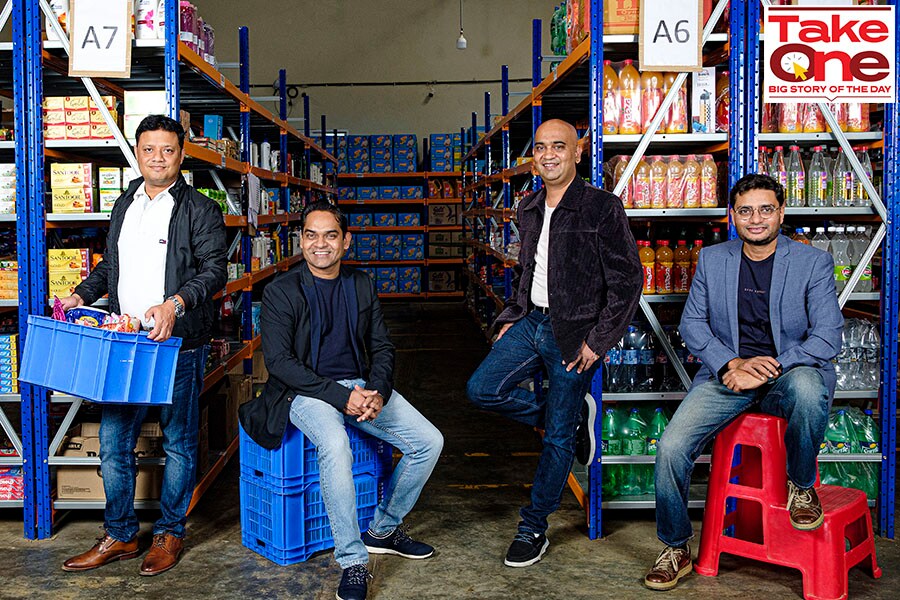
“You need multiple experiences to make a business work,” Medda said. The early operation made room for experimentation. Employees, friends and acquaintances formed an initial group of roughly 100 to 150 people. WhatsApp carried the offers. The company could learn whether anyone wanted the goods before investing the customer’s patience in a new shopping routine.
The appeal of a shorter shelf
A familiar ecommerce promise is abundance. Medda’s argument placed value on restraint. For a shopper accustomed to a neighbourhood kirana, an enormous digital aisle could become an obstacle. Finding something suitable required work. DealShare’s early model used a limited assortment, regional suppliers and an interface intended to keep ordering simple.
The company also developed DealShare Dost, a network of local entrepreneurs who helped with delivery. Some partners in smaller cities supplied storage as well. The arrangement gave the business access to people who already understood their locality. The Hindi word for friend was doing practical work: familiarity could help move a parcel the last stretch to a customer.
By 2021, Medda was discussing more than three million customers and a $200 million gross merchandise value run rate. Those were measures of the business at that time, with GMV describing merchandise transacted rather than the company’s own revenue. The scale had changed considerably since the weekly WhatsApp collection. The original question about making a purchase feel worthwhile remained.
More value for their money.
Medda’s description of the customer’s priority
He also paid attention to how the service spoke. Local language needed local tone, with writers who understood the states they were addressing. Translation alone did not finish the job. A sentence can be grammatically correct and still sound as though it has wandered into the wrong neighbourhood.
His public writing offers another view of this habit. In an essay about entering crowded digital markets, he examined how startups could establish a distinct position. On a podcast about DealShare, the discussion covered simple communication, community leaders and building a minimum viable product. The recurring interest was getting an idea into usable form, then making its purpose intelligible.
The valuation, and the harder arithmetic
DealShare reached a $1.7 billion valuation in 2022. A February financing announcement put its cumulative funding at $393 million after an additional $45 million from an Abu Dhabi Investment Authority subsidiary. It was a substantial financial milestone for a company founded four years earlier. It also created a conspicuous number around which the company’s public story could assemble.
The following year complicated that story. DealShare closed its B2B operation, cut jobs and concentrated on fewer markets. In November 2023, Medda discussed the retreat publicly. Traditional distribution remained difficult to displace. On the consumer side, retention and the mix of margins had fallen short of what the business needed. The company was also testing neighbourhood stores.
His explanation was concerned with the terms on which growth could continue. Adoption had not settled the question of sustainability. A shopper could try a service without returning often enough to make its economics work. For an operator, that is an awkward distinction with very real consequences. The business had to narrow its efforts and establish a stronger basis for expansion.
In January 2024, Medda stepped down from his executive position as Kamaldeep Singh became CEO. DealShare said he would remain a key shareholder. His departure followed those of Rao and Bora. The co-founder’s association with the company continued, but responsibility for running it had passed to a new leadership arrangement.
NITIE graduating class
DealShare founded
A new start in youth sports
The parent enters the picture
Sports For Life was founded in 2024 with Armaan Tandon, who serves as COO. In announcing the venture, Medda described an ambition to make coaching, infrastructure and sports technology accessible to children. His own role as a father is part of the company’s account of its origins. He wants a stronger foundation for young people learning to play.
There is a personal contrast in his descriptions of family life. He grew up in a middle-income, academically focused household. As a parent, he talks about encouraging children to explore their interests and possible vocations. That gives the sports business a question with an audience well beyond aspiring professionals: how does a family give an interest enough room to develop?

SFL’s answer combines academies, organised competition and technology. Its leadership network includes football mentor Heimir Hallgrímsson and specialists across other sports. The work depends on coaches as well as software. An app can organise a session, preserve a record and help a parent follow progress. Someone still has to teach the child standing on the court.
In November 2025, the company announced ₹21.57 crore in Series A funding led by Fireside Ventures and Genesia Ventures. At that point it reported more than 1,500 children in coaching and more than 2,000 tournament participants. Its football league’s second season had attracted over 100 teams. These were company-reported measures of an operation centred on Mumbai and Pune.
A report card for the playing field
By March 2026, Medda was describing a curriculum with attendance, assessments and report cards. SFL charged annual academy fees of ₹50,000 to ₹60,000. Parents could use its app to follow sessions and communicate with coaches. Expansion into Bengaluru and the National Capital Region remained part of its stated plans.
The fee makes the immediate audience clear. This is a paid commitment for households able to devote a meaningful budget to coaching. The broader ambition of reaching more children will have to be achieved through the particulars of locations, prices and delivery. Medda has set out plans for a network across 30 cities, with centres close to families’ homes.
The two ventures invite comparison, although their customers and economics differ. DealShare simplified a transaction that some households had never attempted online. SFL adds structure to an activity that many families already arrange informally. In each case, the proposal asks people to trust a new organisation with something ordinary and important. Dinner arrives regularly. So does Saturday practice.
Medda’s second venture will earn its standing in those repeated appointments. A funding announcement can explain the ambition. A curriculum can describe the intended progress. For the child, the next session has to make sense; for the parent, the next payment has to make sense too. After years spent studying what households buy, Medda is working on what they choose to practise.
Continue the conversation