A wallet is usually something you decide to open. In Community’s HUT proposition, it is something that comes with joining. Become a user of the social platform, and a wallet is supposed to arrive automatically, connected to the services around you. That small reversal explains more about the company’s idea than the long string of crypto abbreviations in its description.
- Community’s public pitch centers on Humanity Utility Token, or HUT.
- Social media, software services, and a marketplace share a proposed wallet and payment layer.
- The intended benefit: fewer handoffs between participating, receiving rewards, and spending.
Community describes a platform combining decentralized finance, decentralized social media, and software as a service. HUT is intended to be its native currency. The wallet connects the pieces. Think of the difference between putting a cash machine beside a market and building payments into the act of shopping. The second arrangement asks less of the customer.
That is an interpretation of the design, rather than a measured result. But it is the useful question at the center of Community’s proposition: can crypto become easier when people encounter it through something they already want to do?
A currency needs somewhere to go
The project’s description gives HUT several jobs. Users are meant to buy, sell, and trade cryptocurrency, send and receive payments, earn rewards for engagement, and purchase through a decentralized marketplace. These are presented as connected activities inside one environment. Social participation supplies an entry point; the marketplace supplies a destination for spending.
For an individual, the appeal would be continuity. A person could participate socially and use financial functions without treating each action as a separate expedition. For a seller, the corresponding attraction would be access to people already present in that environment. Both are proposed benefits, dependent on the platform making those transitions useful.
The distinction matters because a token can move without doing much for its owner. Community’s idea gives movement a context: people, services, purchases. The interesting unit of analysis is the whole trip. Does the social interaction lead to a useful transaction? Does that transaction make the next visit more worthwhile?
The poster that wanted to do everything
A HUT promotional image posted to Pinterest in July 2022 offers a revealing snapshot of the ambition. Alongside a trading-screen photograph and a token illustration, it advertises remittances for overseas Filipino workers, a decentralized marketplace, NFT markets, event tools, staking, farming, loans, and social profiles with website creation. It is a remarkably crowded shopping list.
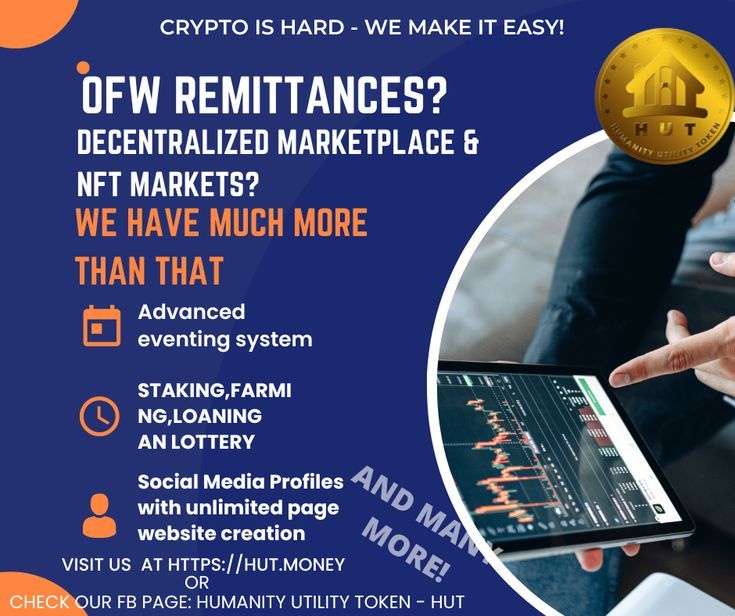
The image helps explain why Community resists a neat single-product description. Its pitch crosses consumer finance, business software, social networking, and commerce. The proposed audience includes enterprises and individuals. The remittance reference adds a specific human use case to an otherwise abstract platform story: money moving between people, rather than merely between trading screens.
Read the poster as a statement of scope. It records what the project advertised. The advertised breadth makes the design challenge visible, too. Each extra activity creates another transition for the wallet to handle. A service promising simplicity has to make all those adjoining rooms easy to navigate.
The quiet work inside “easy”
Community’s slogan is “Crypto Is Hard - We make it Easy!” The automatic wallet is the most concrete expression of that promise. Instead of beginning with a separate financial setup, the user is meant to receive financial access as part of joining the social environment. The company identifies difficulty of use as a barrier to adoption.
There is also a small implementation detail outside the company pitch. Developer Mareeswaran A lists Hut Money among his projects on LinkedIn, describing deposits, withdrawals, and HUT allocations associated with presale rounds and transaction activity. It is a self-reported portfolio entry, but it brings the discussion down from ecosystem language to specific financial workflows.
“Crypto Is Hard - We make it Easy!”
HUT’s public company slogan
Those workflows are where a simplicity claim would be tested. A clean social experience helps only if the next action remains understandable. For this design to deliver its intended benefit, receiving value, deciding where to use it, and completing a payment would need to feel like parts of the same task. That is a product requirement implied by the promise.
Three businesses, one set of handoffs
Community sits at the intersection of financial services and social commerce. Its proposed difference is the combination: software and social activity on one side, financial functions and a marketplace on the other. The alternative is a collection of separate services, with the customer responsible for carrying context between them.
The commercial logic is similarly connected. HUT is intended to support payments and participation across the environment. For business users, the software and marketplace would need to justify their place in ordinary work. For consumers, participation would need to be worthwhile before the payment mechanism becomes interesting. Those are different customers with overlapping needs.
A useful way to judge the concept is to follow one modest transaction rather than count the features. Could a seller attract a customer, receive payment, and have a reason to return? Could a social user find a reward worth using? These are illustrative tests, not reports of customer behavior. They make the intended benefits concrete.
The part worth borrowing
The portable lesson is the order of operations. Start with an activity someone values. Put the supporting capability close to that activity. Make the next useful step easy to recognize. Community’s proposed wallet does that conceptually by arriving with the social account instead of asking the user to begin somewhere else.
The approach depends on the surrounding experience earning its keep. A wallet cannot supply interesting people, useful inventory, or a reason to buy again. Rewards need somewhere desirable to go. Community’s ambition brings those dependencies into the same frame. Its most interesting idea is the connection between them: a financial tool introduced at the moment a person might have a reason to use it.