A college timetable is an unglamorous place to begin a technology career. Yet it belongs near the beginning of Kunal Shah’s story. He studied philosophy at Mumbai’s Wilson College because its early classes could fit around work. Before the theories about human behaviour, before the investment rounds, there was the practical business of getting through the day.
Years later, Shah would become known for a framework about efficiency: how much better a new product must be before somebody abandons an old habit. His own education had started with a similar calculation. A course could be interesting and useful, but it also had to leave room for a job. The timetable had a vote.
In June 2026, his appointment to lead WhatsApp gave that interest in everyday behaviour a much larger setting. He had co-founded Freecharge, then founded CRED. Now he was taking responsibility for a service woven into conversations around the world. The distance between those jobs is considerable. The recurring subject is the small action people repeat.
A timetable before a theory
Shah began earning while still a teenager, as his family faced financial difficulties. Data entry and small ventures supplied an education alongside college. He sold CDs and henna cones, among other things. These are modest entries beside the eventual executive title, but they put a young person close to the fundamental question of commerce: will somebody pay?
The philosophy degree became part of his public identity. It is an appealing detail in an industry often introduced through engineering credentials. The practical explanation makes it more interesting. There was no need for an elaborate plan connecting a classroom to a future payments company. Work and study had to coexist; the intellectual connections could develop afterward.
He later entered a part-time MBA programme at NMIMS and left without finishing. His scepticism about conventional education has since been delivered with some relish. Asked about dismissing a general MBA as poor value, he acknowledged the awkwardness, then added: “I wasn’t looking for admission there so it was fine.” An admissions committee, mercifully, had no further leverage.
What he continued to study was consumer behaviour. The distinction matters in his career: qualifications have an end date, while customers retain the right to surprise you. Shah’s public explanations tend to begin with how people behave, what they value and which inconvenience they are willing to tolerate.
A small transaction, repeated
In 2010, Shah and Sandeep Tandon co-founded Freecharge. The proposition attached rewards to mobile recharges. Customers could top up a connection and receive coupons. It brought an incentive to a transaction that people already understood, instead of asking them to acquire an entirely new appetite.
Consider the difference between persuading someone to want a product and persuading them to move an existing task online. With a recharge, the demand arrives before the sales pitch. A phone needs credit. The customer knows what success looks like. That gives a business something solid to work with, even when the wider market is still learning to transact digitally.
“I saw recharge as the gateway to a transacting India.”
Kunal Shah, in a conversation with Accel
In April 2015, Snapdeal announced its acquisition of Freecharge. The terms were undisclosed at announcement; contemporary reports put the cash-and-stock transaction at roughly $400 million to $450 million. The deal gave Shah a conspicuous early success. It also left a more durable idea to examine: an ordinary, frequently repeated task could provide an opening into a much broader business.
The four-point question
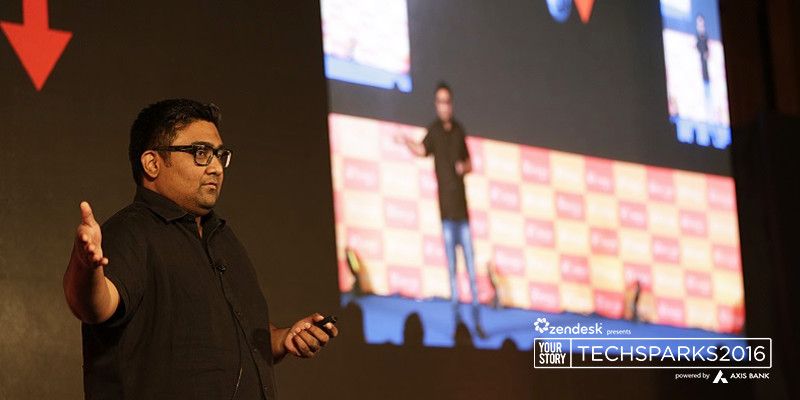
At TechSparks in 2016, Shah discussed a question that would become associated with him: what inefficiency is a startup actually solving? His Delta 4 framework gives the discussion a memorable number. Ask people to rate an existing solution and its replacement for efficiency on a ten-point scale. Look for a difference of at least four.
The attraction is the comparison. Teams can spend months admiring their own work. A customer carries around an alternative, which may be a rival app, a familiar shop or the decision to do nothing. Shah’s framework asks the builder to put that alternative beside the new product and take the gap seriously.
It is a heuristic, with the subjectivity that implies. A ten-point score is a way to start a conversation, not a scientific instrument. Its value lies in forcing an uncomfortable question: has the experience improved enough to justify changing behaviour? A modest improvement can still leave the familiar option comfortably in place.
Shah illustrated the idea through changes such as booking railway tickets online rather than going to a counter. The useful observation is what happens after adoption. Does the person want to go back? A good answer can tell a founder more than a polished explanation of how much effort went into building the product.
A club built around a bill
When Shah founded CRED in 2018, he changed the audience. Freecharge had used a widely familiar purchase. CRED began with creditworthy customers paying credit card bills and earning rewards. It was a narrower front door, built around an obligation that hardly needed more publicity. Nobody has ever required a billboard to remember that a bill exists.
His larger interest was the community that could form behind that door. Creditworthiness could help identify customers for other services. The payment supplied a recurring occasion to meet them. From there, the business could explore what else those members needed. The bill was an entry point into a relationship.
This brought a tension worth keeping in view. A customer can enjoy rewards without assigning the same value to the company’s larger vision. A company can assemble an audience without immediately proving how much that audience will pay. The work involves turning the relationship into useful services and a sustainable business.
CRED subsequently broadened its financial offerings, including lending and tools for managing money. Its FY25 operating revenue reached ₹2,735 crore, while total losses were ₹1,457 crore. Those figures describe a business generating substantial revenue and still carrying a substantial loss. The arithmetic is a useful companion to any discussion of trust.
Different measures, shown separately. Revenue does not establish profitability.
Shah’s second company also complicates a convenient founder narrative: that success produces a formula to be repeated. He carried an interest in behaviour into a different market segment. The customer changed. The incentive changed. The method still began with asking what people would find valuable enough to return for.
Curiosity with an audience
Alongside building companies, Shah became an active angel investor. By a November 2022 podcast appearance, his record included more than 200 investments in Indian startups. That put him in conversation with other founders as a backer as well as a peer. An investment creates another opportunity to watch a business hypothesis encounter actual customers.
His public conversations range across motivation, trust, decision-making and the economics of the Indian market. On The Knowledge Project, he discussed how observing people informs business. On Lenny’s Podcast in 2024, he explored curiosity, second-order thinking and the difference between accumulating users and earning revenue from them.
There is a recognisable pleasure in taking a large subject and giving it a compact form. Delta 4 travels easily because people can remember it, argue with it and try it against their own experience. A public framework has that advantage over private conviction: other people can push back.
For a reader following Shah’s career, the interviews provide something the milestones cannot. They show the questions between the companies. Why does somebody switch? What does trust make possible? When does convenience become worth paying for? None comes with a permanent answer. That leaves plenty of work for a curious founder.
These questions also help explain why his background in philosophy remains relevant to the public story. A business has to turn a view of people into something they can actually use. The view can be discussed at length; the product gets judged in a moment. That distance between an explanation and an experience gives his career its continuing tension. A memorable idea earns attention. An everyday service has to keep working after the conversation ends.
Inheriting the habit
The WhatsApp appointment changed the starting conditions. Shah succeeded Will Cathcart in 2026; Meta confirmed his arrival on its July earnings call. The announcement came alongside a roughly $900 million Meta investment in CRED. The founder was moving from a company he had started to an established global service inside Meta.
At Freecharge, an important task had been encouraging a transaction to move online. At CRED, it had been building a community around a particular kind of customer. WhatsApp brings a different obligation. The habit already exists. People arrive with expectations formed through years of use, and a change can affect conversations far beyond the product team’s office.
That makes the next chapter interesting without requiring a prediction about features. There is commercial opportunity in messaging, and there is the ordinary expectation that a conversation will remain straightforward. Leadership has to work within both realities. The daily experience is where any ambitious plan eventually meets its verdict.
Shah’s career began with the constraints of a working student’s day and grew through close attention to small transactions. WhatsApp gives that attention a global setting. Somewhere, somebody simply wants to send a message and get on with life. For a product thinker interested in efficiency, that person is a demanding audience.