A rental-car surcharge is a small thing to build a career around. It arrives in the fine print, somewhere between choosing a vehicle and discovering that being young has become an optional extra. Josh Mangel had encountered it himself. In 2016, at 23, he described the problem plainly: “If we wanted to rent a car, we’d have to pay a crazy underage fee.”
The response was Skurt, a company he co-founded with Harry Hurst and Aaron Peck. Customers booked cars through an app and had them delivered. Drivers as young as 21 could use the service without the customary underage surcharge. A rental could begin where the customer was, rather than wherever the rental company had put its desk.
Years later, Mangel would help build Pipe around a different inconvenience. A company could earn recurring revenue and still wait months for the cash. Between the car keys and the cash flow lies an interesting career: a founder repeatedly working on the distance between something useful and the person who needs it.
The surcharge that became a company
Skurt’s early appeal was easy to understand in Los Angeles. A car is useful there; collecting a rental car can consume an unreasonable portion of the day you intended to use it. The product moved that errand off the customer’s calendar. Its customers included young adults treating rentals as an alternative to owning a vehicle.
The company’s advertising was less restrained than its logistics. One Los Angeles billboard paired a suggestive pocket bulge with the line “A car in your pocket.” The joke did the work of a product demonstration, provided you were prepared to explain it to anyone else in the car.
By February 2017, Skurt was operating in Los Angeles, San Diego and Miami. It announced a $10 million Series A led by Upfront Ventures, with BMW and Magic Johnson among the investors. The ambition extended beyond a nicer airport experience: a delivered car could make occasional access more attractive than permanent ownership.
Before the car keys, a music dashboard
Mangel had already tried making another industry easier to read. In January 2013, he and Avi Zolty founded BeatDeck at Y Combinator in Mountain View. The company joined the accelerator’s Winter 2013 batch, several years before Pipe would put his name in financial technology coverage.
BeatDeck was a music analytics platform. It brought together performance measures and social signals in a dashboard for the music industry. The company’s own slogan put the ambition in three beats: “Music, Metrics... Meritocracy.” A business concerned with songs had chosen a decidedly numerical instrument.
The distinction is useful when looking at Mangel’s later work. His first documented startup already dealt with making information usable. An artist’s audience, a rental request and a stream of subscription receipts are very different raw materials. Each can nevertheless become the subject of a product that helps someone make a decision.
That is a reading of the career, rather than a claim that the entire route was planned in 2013. The actual sequence includes a music company that Y Combinator now lists as inactive, a delivery company that was acquired, and a financial company whose leadership and product subsequently changed. A tidy origin myth would have to edit rather aggressively.
The useful part survives the sale
In February 2018, Fair acquired Skurt. The standalone service was to close, while the technology and team moved into Fair. Mangel subsequently served as Fair’s head of product. The shift took him from running an independent company to working on a product inside somebody else’s.
There is an important distinction inside that transaction. The customer-facing name could disappear while the people and the underlying capability continued. Delivery had required software, coordination and an organization capable of getting actual cars to actual places. Those were useful things to carry into a larger vehicle business.
Another thing survived: relationships. Yasmin Moaven, who worked on the acquisition at Fair and later joined Pipe, remembered how Mangel and Hurst worried about the consequences for their team. She described the founders as humble and hungry, with their attention on the employees affected by the deal.
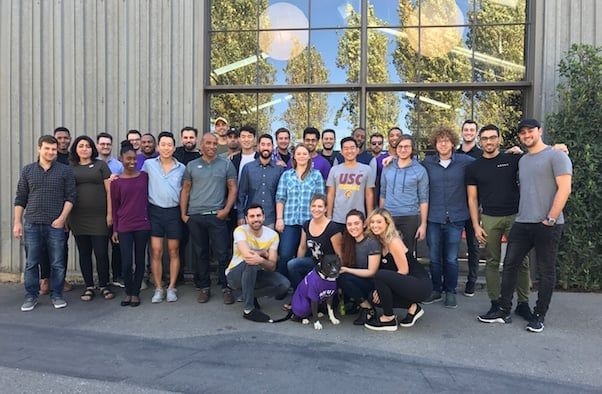
It is a more revealing detail than an acquisition price. Deals are usually described from the perspective of the people signing them. Moaven’s recollection puts everyone else back into the frame. The team photograph acquires a little more weight when the question becomes where those people will work next.
A subscription is also a calendar problem
In 2019, Mangel and Hurst started Pipe with Zain Allarakhia. Its original proposition concerned a familiar mismatch in subscription businesses: customers pay over time, while the company’s plans can require money now. Dependable future receipts do not automatically settle today’s bill.
Pipe offered a marketplace through which businesses could exchange recurring revenue streams for upfront capital from investors. The company began with software businesses and expanded beyond them. For founders, the attraction included obtaining cash without selling another slice of ownership. The mechanics turned the payment schedule itself into something a product could address.
Consider a deliberately simplified subscription paying $1,000 a month. Twelve payments add up to $12,000 over a year, but they arrive on twelve separate dates. Receiving capital against that stream changes when the business can spend, with the amount and economics depending on the transaction. The calendar has become part of the product.
Investors responded. In May 2021, Pipe announced $250 million in equity funding led by Greenspring Associates at a $2 billion valuation. At that point it reported more than 4,000 company sign-ups since its June 2020 public launch. Those figures describe the company and its financing round; they say nothing about Mangel’s personal wealth.
By June 2022, Pipe counted more than 12,000 sellers across software, subscription and streaming businesses. The platform had expanded into the United Kingdom in September 2021. The idea had acquired both an audience and a larger operating territory.
The spreadsheet gets an early seat
There is a less glamorous detail in the early Pipe story. Hurst wrote in August 2022 that the company’s second hire was Lukas Wagner, initially its VP of Finance and later CFO. Financial modeling and unit economics entered the organization near the beginning, alongside the programming and conversations with potential customers.
Wagner worked from Germany while the company built remotely. His responsibilities included payroll and paperwork across several states. It is a useful corrective to the image of a financial startup consisting chiefly of clever founders and an attractive dashboard. Someone still has to make sure the business understands its own money.
The engineering team also worked on reducing the effort behind the interface. Early Pipe engineers adopted Hasura to simplify access between their database and web application. Engineering director Peter Downs described faster feature development and fewer boundaries between frontend and backend work. Those were team achievements, and they belong in a founder’s story without being assigned to the founder personally.
A colleague’s recommendation supplies a small view of Mangel’s own working style. NHM Tanveer Hossain Khan describes a proactive, calm colleague, attentive to simplicity and detail. It is one colleague’s assessment, but it makes a useful pairing: a simpler experience on screen can require considerable precision behind it.
A different chair, the same verb
In November 2022, Pipe announced a search for an experienced operational CEO. Hurst moved toward a vice-chairman role; Mangel took the CEO position during the search. The plan was for Mangel to become executive chairman once a successor arrived, with continued attention to product and strategy.
The handoff became concrete in February 2023. Pipe named Luke Voiles, previously responsible for Square Banking and earlier QuickBooks Capital, as CEO effective February 20. Mangel was identified as co-founder and executive chairman. His description of the new job began with the work: “I will focus on what I do best: building and driving strategy”.
It was a change in responsibility at a company that had already moved beyond its original software niche. Bringing in an executive with experience running substantial financial operations made the next phase a different assignment from getting the first product into use. Starting and scaling sit on the same timeline, but fill very different working days.
“Realized I like building more.”
Josh Mangel · personal website
Mangel’s own website handles the biography with unusual economy. He has built companies, invested in some, and reached a preference. The presentation even makes room for vintage browser imagery. Having worked on modern financial infrastructure, he has allowed himself a little old internet.
The sentence about building is modest enough to bear the weight of the preceding career. Music analytics, cars delivered to a doorstep, subscription revenue converted into earlier cash: each required a product, a team and decisions that survived contact with customers. His most concise account of himself returns to the part he wants to keep doing. There is still something to build.