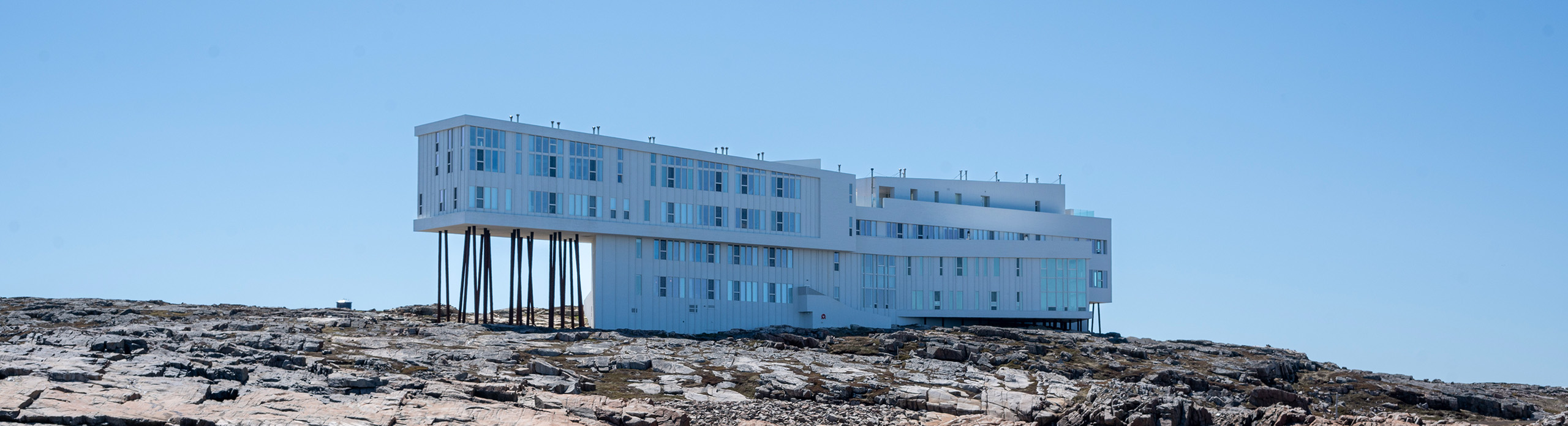
A traveller can reach Fogo Island Inn only after making a series of choices. First Newfoundland. Then the northeast coast. Then a ferry or small plane. Then a road across an island where the North Atlantic keeps appearing at the edge of things. By the time the long white building comes into view, balanced on dark stilts above rock, the usual hotel language feels inadequate. The room is part of the purchase. So are the meals, the landscape, the local knowledge and the question sitting quietly beneath the whole experience: what should a visitor’s money do after the visitor leaves?
That question is where Sorya Gaulin’s job gets interesting. As chief marketing officer of Fogo Island Inn and Shorefast, she is responsible for bringing a remote, 29-room property into a global travel conversation. But the Inn is also a community asset whose operating surpluses are reinvested in the community. Its owner, Shorefast, is a Canadian charity working across business, art, culture and local economic development. Gaulin is not merely filling rooms. She is explaining a system.
Her public career makes her unusually prepared for that assignment. It begins with reporting, moves into the campaign-minded culture of The Body Shop, passes through bookselling and philanthropy at Indigo, then spends a decade inside the machinery of Four Seasons. Each stop adds a layer: find the story, connect commerce to values, build an institution, protect a global brand. On Fogo Island, all four disciplines meet.
Chapter oneThe reporter learns to market
Gaulin studied political science and history at McGill University from 1987 to 1990, after attending Collège Jean-de-Brébeuf. Her early professional work was in journalism. It is a useful origin story for a marketer because reporting trains the eye toward particulars. Institutions speak in abstractions; people remember an object, a sentence, a choice. Fogo Island Inn has no shortage of those particulars: handmade quilts, locally designed furniture, food that follows what can be fished, farmed and foraged, and guest orientations led by people who live on the island.
In 1993, Gaulin joined The Body Shop, serving for eight years in marketing. The company was known for placing social campaigns beside commercial products. In Canada, she had a public role in its campaign against violence toward women, articulating why a retailer could not treat the issue as unrelated to its customers or values. That experience matters to the arc of her career. Long before “purpose” became a standard corporate slide, she worked inside a business that asked marketing to carry an argument about social responsibility.
Next came Indigo Books & Music. From 2001 to 2007, Gaulin held leadership responsibilities across marketing, public relations and corporate giving. She also served on the board of the Indigo Love of Reading Foundation and as its director of marketing during the foundation’s launch. The project connected a retailer’s cultural position to a specific need: books for school libraries. It was another lesson in making contribution operational. The mission did not sit outside the brand. It grew from what the company sold and knew.
Chapter twoLuxury gets a wider lens
At Four Seasons, beginning in 2007, Gaulin moved fully into global hospitality. She led corporate public relations, digital work, email marketing and social media, later taking responsibility for marketing communications across the Americas. The timing was instructive. Luxury brands were learning how to behave on social platforms without sounding like they had wandered into the wrong room. Hotels were no longer speaking only through travel editors and glossy campaigns; guests were making and distributing their own images in real time.
Gaulin treated that shift as a field for disciplined experimentation. Discussing social media in the hotel industry, she said Four Seasons was monitoring new platforms and conducting pilot studies. That operating preference shows up elsewhere in her record: experiment, learn, measure, keep the team focused. In a 2015 profile, she described her challenge as moving between creative thinking and results-oriented prioritization. She also took pride in building a team and contributing to its career growth. The marketer in this telling is less solitary genius than editor of attention - deciding which ideas deserve resources and which moments are too useful to miss.
“I am constantly learning and exposed to new approaches which keeps me interested.”Sorya Gaulin, 2015
There is a productive tension in that sentence. Luxury marketing depends on consistency, while media habits keep changing. The brand must be recognizable, but never inert. Gaulin’s answer was not novelty for its own sake. It was to use new channels in ways that added value for guests and other stakeholders, with data and insight keeping experimentation attached to an objective.
A mission becomes more credible when customers can trace it through the product, the ownership and the movement of money.
Chapter threeThe hotel as an economic argument
Gaulin joined Fogo Island Inn in 2019 as vice president of marketing and social business development. In 2024, her role expanded to chief marketing officer across the Inn and Shorefast. The move brought her from a large international hotel company to a property that is deliberately inseparable from one small place. Fogo Island Inn opened in 2013 in Joe Batt’s Arm, on an island shaped by fishing, the cod moratorium and the long work of building economic resilience. Its architecture is dramatic enough to become the entire story. Gaulin’s task is to keep the architecture as an invitation rather than an endpoint.
The larger proposition is that hospitality can help a place retain more of the value it creates. A conventional resort may use landscape as the setting for a transaction whose profits travel elsewhere. Fogo Island Inn is structured as a social business owned by a charity. The building draws from local forms. The interiors carry the work of local makers. Food, art and guiding connect a guest to knowledge held on the island. The surplus returns to community work. The distinctiveness and the economics are related.
For marketing, this loop is valuable because it replaces a vague declaration with a sequence a person can understand. “Regenerative travel” can otherwise become soft language. Here the claim has mechanics. The guest is not asked to admire an aspiration floating above the business. The guest can see how the business is owned, what local inputs shape the stay and where operating surpluses go.
Gaulin’s recent public posts show how carefully she links the commercial and civic sides. When encouraging votes in travel readers’ awards, she has described media coverage as a decision aid for travellers, then connected that visibility to the wider work of Fogo Island and Shorefast. In promoting a travel story, she highlighted its treatment of the Inn’s “radical tourism vision.” When Shorefast launched its Institute for Place-Based Economies, she served as a media contact for work intended to share tools beyond the island. Attention is never presented as the final outcome. Attention is useful because it can move people and resources toward the model.
Chapter fourSpecificity is what travels
A remote hotel faces an obvious marketing problem: distance creates fascination and friction at the same time. Yet distance also protects the thing that generic luxury often removes - an address. Fogo Island Inn cannot plausibly be separated from its wind, rock, ocean, furniture, foodways and neighbours. The harder the brand leans into those particulars, the less interchangeable it becomes.
This may be Gaulin’s most transferable insight. A global audience does not require a generic message. Often the local detail is the part capable of travelling furthest. A quilt made within a living craft tradition carries more information than a dozen adjectives about comfort. A community host offers something no loyalty program can manufacture. A visible reinvestment model gives “purpose” a destination.
Her career also complicates the familiar split between commerce and contribution. At The Body Shop, public advocacy sat inside retail. At Indigo, literacy philanthropy grew from bookselling. At Four Seasons, storytelling and service were mutually reinforcing. At Fogo Island Inn, the room sale helps finance a community asset. None of this makes marketing neutral or effortless. It gives the work a sharper standard: the story must remain accurate to the system underneath it.
The brand travels globally. The asset stays rooted. The value has a way home.
Gaulin’s colleagues have publicly described her as calm, positive, collaborative and able to translate strategy into execution. Her own record adds curiosity and focus. She has volunteered with a Toronto community meal program and coached leaders of employment social enterprises through United Way Greater Toronto. Those activities fit the wider pattern without needing to become a grand personal theory. She seems drawn to institutions that connect what they sell, what they know and what they owe.
The work ahead is larger than keeping one inn visible. Shorefast is now formalizing and sharing its thinking through the Institute for Place-Based Economies. The premise is that communities can identify their distinctive assets, build institutions around them and keep more value circulating locally. Fogo Island is the proof point, not a template to photocopy. Every place has different raw material. The transferable part is the discipline of looking closely.
That brings the story back to the reporter’s instinct. Look for the detail that reveals the system. Ask who owns the asset. Follow the money. Notice whose knowledge shaped the product. Find the sentence that a stranger will remember. Sorya Gaulin has spent three decades moving those habits across industries. On Fogo Island, they have become a way to market a stay without reducing the place to scenery.