The useful clue was sitting on the floor. Hair, mostly. Songe LaRon and Dave Salvant had bought the license to a fading Manhattan barbershop, and the two founders were doing everything a pair of non-barbers safely could: working the desk, watching the register, talking with customers, studying appointments, and sweeping up after cuts. They had begun with an elegant idea about booking. The shop answered with a messier, better idea about running a business.
LaRon had already made one improbable trade. He held a bachelor's degree from UCLA and a law degree from Yale, then practiced mergers and acquisitions and corporate finance at Skadden. The work was polished, exacting, and busy enough to make an hour in a waiting room feel especially expensive. Getting a haircut still meant a chain of texts, a possible wait, and cash at the end. In a city trained to summon dinner and cars with a tap, the barbershop remained magnificently analog.
The annoyance was personal, which LaRon considers a useful test. He had visited barbershops with his father since he was six or seven. Two decades passed, but the customer experience had barely moved. He and Salvant, then a banker, talked with friends and surveyed roughly 300 people. The irritation traveled across backgrounds. Their problem was not merely theirs.
01 / The first cutAn app meets an institution
SQUIRE launched in 2015 with the tidy promise of finding a barber, booking an appointment, paying, tipping, and leaving without the familiar search for cash. LaRon described it then as making a haircut as easy as humanly possible. For a customer, the comparison to ride-hailing was irresistible. For a shop owner, the analogy did not pay commissions, organize chairs, or reconcile the day.
Barbershop owners were cautious. LaRon and Salvant responded with physical comedy disguised as distribution: they hauled a heavy barber chair into coworking offices and brought barbers to customers. They also walked into shops to ask questions. Sometimes they bought a cut simply for the conversation. Sometimes they were invited to leave. Startup advice rarely mentions the diplomatic value of knowing when to stop interrogating someone holding clippers.
The resistance contained information. A marketplace asks a merchant to believe in future demand; an operating tool must earn trust on the first busy Saturday. The owner is often also a barber, which means every minute spent configuring software is a minute away from the chair. LaRon and Salvant could not sell abstraction. They had to show that a tap would remove work, protect a customer relationship, or put another paid appointment on the calendar.
“I like to base these things as much as possible on my own experience.”Songe LaRon
One coworking experiment became the company's first financing story. The founders were bootstrapping from a single shared hot desk at WeWork. They pitched executives on pop-up haircuts for members, arrived with research, and won approval. Then came a plain extra question: if the executives liked SQUIRE, would they invest? A syndicate of WeWork executives became the first angel backers. The lesson had a certain New York efficiency. Show the thing working, then ask.
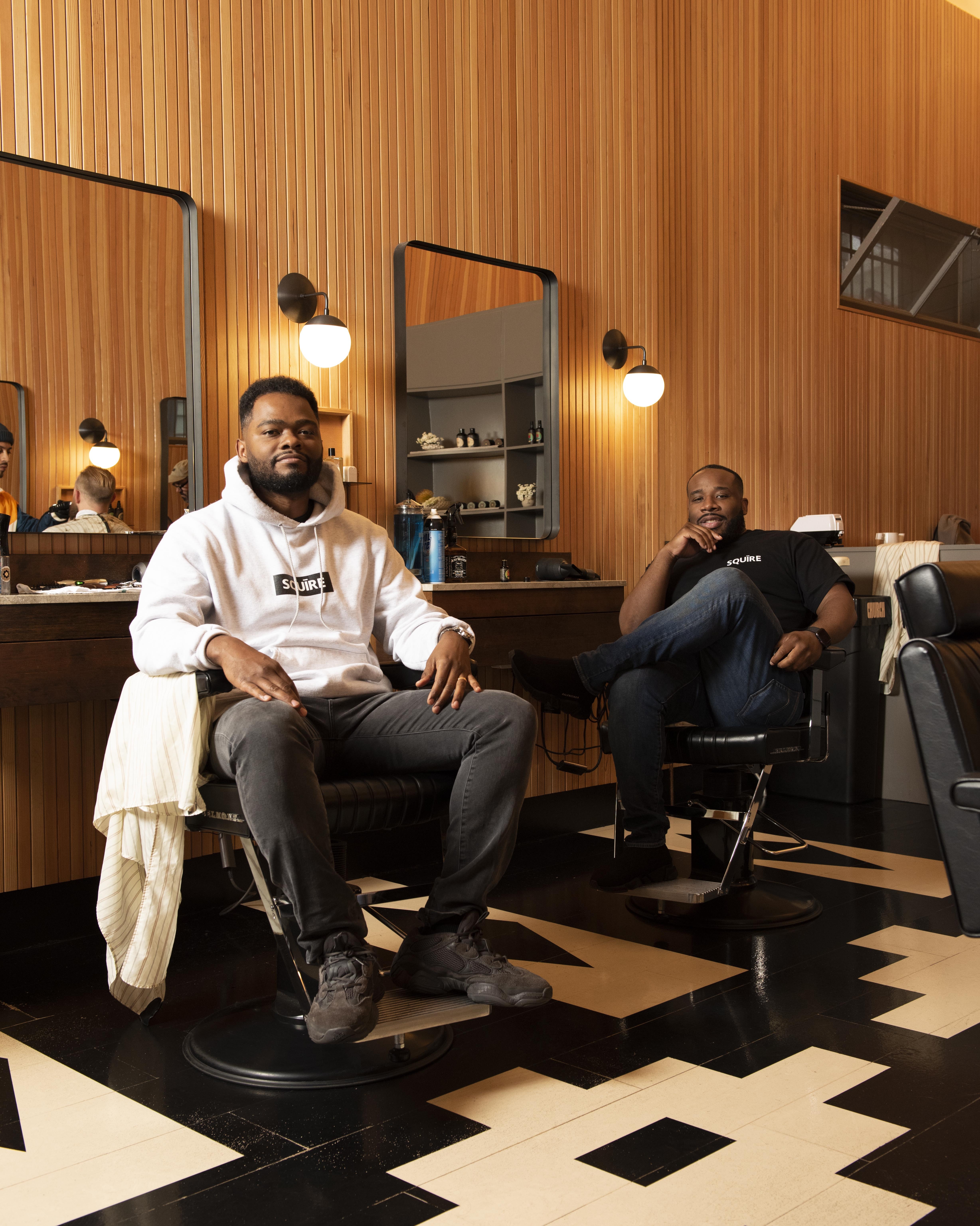
02 / The shop floorThe product hiding behind the appointment
The mobile app worked for independent barbers, but a larger shop had another anatomy. A front-desk manager needed to see every barber. The owner needed schedules, commissions, payments, customer records, marketing, and a clean view of the business. Generic salon tools could be bent into service, but bending software becomes another unpaid job.
So the founders went deeper. In 2016 they spent $20,000 on a Manhattan barbershop license and operated the shop for about a year. It was a live laboratory with rent. They watched where the day snagged and where money moved. The crucial insight was payments. Control the flow of funds, LaRon later explained, and the software could become the centerpiece of operations rather than an app a customer opened every few weeks.
The useful pivot, in four chairs
waiting, texting, cash
find, book, pay
watch the whole day
payments plus workflow
That shift changed the unit of value. The customer still wanted a painless haircut. The shop owner wanted the Tuesday afternoon to make sense. SQUIRE's management product, called Commander in its early form, could process all of a shop's transactions. The software became less visible to the person in the chair and more essential to the person paying the rent.
It also clarified the difference between a feature and a foundation. Booking can be copied. A system woven through the register, staff schedule, commissions, reminders, and repeat visits is harder to dislodge because it remembers how the shop works. The founders had started by selling time to the customer. Behind the counter, they found another inventory of minutes: the unpaid hours an owner spent adding totals, chasing confirmations, and reconstructing the week.
LaRon and Salvant joined Y Combinator's Summer 2016 batch while still running the shop, shuttling between New York and the Bay Area. The itinerary sounds exhausting because it was. It also forced their consumer intuition, operating evidence, and software thesis into the same conversation.
03 / Depth over widthA narrow market with a long ledger
Investors suggested broadening the product into salons and spas. The founders resisted. A barbershop was not a generic appointment business with different decor. It carried its own economics, culture, loyalties, and conversations. A client might keep the same barber for years. The transaction mattered, but LaRon understood that its removal could improve the human exchange. Let the software handle payment so the people can talk.
That relationship explains why convenience alone was an incomplete pitch. The best customer did not necessarily want a new barber every month; he wanted his barber, reliably. Discovery could help fill an empty chair, but retention paid the bills. SQUIRE therefore had to strengthen an existing bond without inserting itself noisily between the people who made it valuable. Good infrastructure is present in the result and pleasantly absent from the conversation.
This focus became a practical argument for vertical software. Go narrow enough to understand the awkward exceptions. Then build wide enough inside the category to handle the whole day. Booking led to point of sale, customer management, payroll, analytics, marketing, memberships, and tools for multiple locations. The niche expanded downward.
“Software is eating the world, but it hasn't eaten the whole world yet, so there are still a lot of opportunities.”Songe LaRon
SQUIRE received the $650,000 runner-up prize at 43North in 2017. In 2018, LaRon said the business was processing more than $2 million in customer payments each month. The company raised successive rounds, including a $34 million financing package in 2020 and a 2021 round that placed its reported valuation at $750 million. The growth arrived with prominent backers, but it also arrived because shop owners suddenly saw digital scheduling and cashless operations as necessary rather than decorative.
When shops closed in 2020, SQUIRE helped customers prepare to reopen. Appointment systems, contactless payments, and digital customer records took on fresh importance. LaRon later described the reopening as a surge in demand. SQUIRE's valuation moved from a reported $85 million in March 2021 to $750 million by August, a jump he discussed with unusual sobriety: customer growth met a zero-interest-rate market full of capital. Timing was part of the story.
04 / The operator's eyeWhat the lawyer kept
Leaving law did not erase LaRon's legal training. Contracts, fundraising, governance, and the patience for fine print all travel well. Yet SQUIRE's decisive education was tactile. A former corporate lawyer had to accept that a barber understood the product's world better than he did. Curiosity became an operating skill.
There is an appealing symmetry in the move from transactions between corporations to transactions inside neighborhood shops. Both reward precision. Both punish a missing detail. Only one leaves evidence on the floor. LaRon's career turn was dramatic on paper, but the habits underneath it were continuous: examine the system, find the friction, understand where value changes hands, and make the agreement usable.
His public advice is compact: take risk, solve a problem you know, and remain close to the customer. His behavior adds the footnotes. Survey before building. Put a service in front of people. If adoption stalls, inspect the workflow rather than polishing the pitch. When a market seems too small, count every essential job inside it before wandering elsewhere.
The company says its system now serves 3,000 shops and processes more than $1 billion in payments in over a thousand cities. In November 2024, Silicon Valley Bank provided SQUIRE with $35 million in debt financing intended for continued product development and growth. The original irritation about waiting has become infrastructure for owners.
LaRon has also become an angel investor and a regular startup speaker, extending the lesson beyond barbering. His personal biography describes life in New York with his wife and two children. The formal résumé now reads entrepreneur, executive, and investor. The more revealing line remains the informal one: he was willing to sweep the floor of a business he did not yet understand.
Software founders like clean diagrams. Real businesses contain stray hairs. SQUIRE found its shape when LaRon and Salvant studied both.