A car wash is an odd place to find a software thesis. It smells of detergent and hot machinery. It runs on water, conveyor belts and the minor optimism of a driver who has finally decided the pollen cannot be ignored. Yet beneath the foam sits a recurring-revenue business. Monthly memberships turned an occasional errand into a subscription, and subscriptions introduced the usual complications: acquisition, activation, retention, failed payments, support and the delicate art of persuading someone not to cancel.
Austin Esecson saw the mismatch. The economics had modernized faster than the software. Operators had point-of-sale systems built to open gates and process transactions, but the ongoing relationship with the driver was scattered across payment records, inboxes, text messages and local routines. A generic CRM could recognize a lead. It did not naturally understand a license plate, a wash visit, a family plan or the small financial calamity of an expired card.
In 2019, Esecson founded Rinsed with Sam Logan and Nic Hippenmeyer. The company would build customer software specifically for car washes. The pitch sounds almost comic in its precision until one considers what precision buys: a clear user, a repeatable problem and permission to learn the peculiar language of a trade. The result is a founder story less about chasing novelty than noticing an industry whose business model had outrun its tools.
A finance mind meets a foamy market
Esecson came to the category by way of economics and finance. He studied economics at Duke University from 2006 to 2010, then built a career that included becoming a senior vice president at Macquarie Group. The move from finance to car wash software is less eccentric than it first appears. A membership wash is a compact study in unit economics: customer acquisition has a price, recurring revenue has a duration, churn has causes, and each operational improvement can be measured.
Rinsed began with the digital gaps around that model. It connected to existing point-of-sale hardware, automated email and text campaigns, helped recover declined cards and gave operators mobile checkout forms for online membership sales. The company said those forms could lift conversion by ten times. The useful detail is that Rinsed did not ask operators to rip out the machinery already running the business. It learned to sit above it, making old systems more legible and the customer relationship more active.
That approach helped Rinsed enter Y Combinator's Winter 2021 batch. In May 2022, the company announced a $12 million Series A led by Bedrock Capital and Founders Fund, after an earlier $3 million seed round. In April 2023 came a $20 million Series B led by VMG Technology. At the time, Rinsed said it served more than 1,300 washes, up more than 400 percent in a year, and helped manage over four million active memberships.
“As the car wash market shifts to a subscription model, the problems faced by operators now extend beyond the driveway.”Austin Esecson, 2022
That sentence contains the map. The subscription does not end when the gate rises. It creates a relationship that continues through the next visit, the next charge and the next moment a driver wonders whether the plan is still worth keeping. Esecson's ambition became to connect those moments, then give an operator a practical way to act on them.
The membership journey Rinsed keeps following
The customer journey walks back onto the driveway
The first version of a vertical product is often a wedge. The revealing part is what the company does once the wedge holds. Rinsed moved from member marketing toward retail customers, loyalty, family and fleet plans, analytics and customer support. Then it moved physically closer to the sale.
In 2024, Rinsed acquired Ignite Wash, a salesperson-management platform. Ignite measured the moment most CRMs never see: the conversation between an employee and a driver waiting at the wash. It tracked whether a pitch happened, how a salesperson converted and how locations compared. It added call recordings, coaching, leaderboards and gamification to a business that had often managed driveway sales with observation and instinct.
The relationship behind the deal had an appealing circularity. Esecson and his team first knew Ignite CEO Kyle Doyle as a Rinsed customer, when Doyle led marketing and customer experience for a growing wash group. They were impressed by his attention to customers. When Doyle and CTO Craig Vella later built Ignite, conversations about connecting it to Rinsed exposed a shared vision. Customer became collaborator; collaborator became colleague.
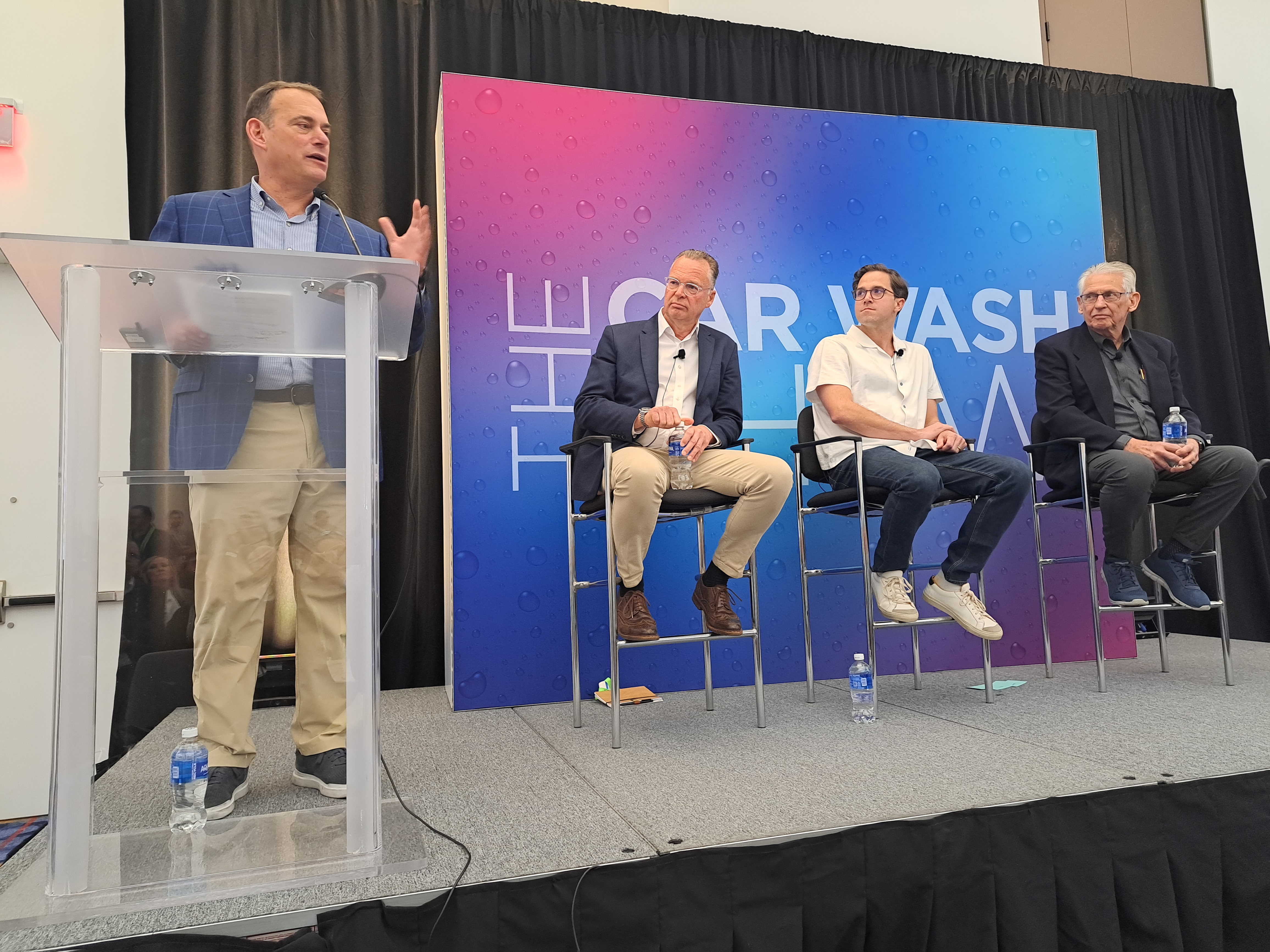
At that 2025 panel, Esecson described car wash operators as inventors, innovators, entrepreneurs and tinkerers. The phrase explains why Rinsed invites its entire team to the annual industry show. A programmer who sees an operator juggling a tablet, a payment terminal and a line of impatient cars understands the product problem differently from one reading a ticket in New York.
By February 2026, Rinsed and NXT Wash had turned that observation into a tighter workflow. Salespath, the renamed Ignite product, could run on the same tablet as NXT's point of sale. A salesperson could present a membership, accept the purchase and enqueue the car without changing devices. When a returning driver arrived, customer data could appear in Rinsed instantly. The software was no longer merely reporting what happened. It was present while it happened.
“Operators don't want to think about how their systems talk to each other. They just want to deliver the best customer experience.”Austin Esecson, 2026
Churn is a thousand small leaks
Subscription businesses often speak of churn as though it were weather. It arrives, gets charted and prompts a worried meeting. Rinsed's products treat it as a collection of events. A payment fails. A member phones after hours. A driver never receives a useful offer. A retail customer visits repeatedly but no one asks them to join. Each event is mundane. Together they decide whether recurring revenue recurs.
Rinsed's quarterly reports have made that arithmetic part of its public voice. In a post about the third quarter of 2025, Esecson highlighted 5.7 percent year-over-year same-store sales growth and 10 percent membership revenue growth across data from more than 3,500 washes. He also contrasted estimated value over the first 36 months: $444 for a typical member, $104 for a repeat retail customer and $64 across all retail customers, including one-time visitors.
Figures Esecson shared from Rinsed's Q3 2025 industry analysis. Bars are scaled to the member figure.
The numbers make the company's fixation on memberships look less like fashion and more like gravity. A member relationship is worth protecting because it contains many future transactions. Yet Esecson has also argued that the industry's enthusiasm for subscriptions left the ordinary retail customer neglected. Rinsed expanded its CRM to include both groups, aiming to recognize the visitor before the visitor becomes a member.
The support call becomes software
In January 2025, Rinsed introduced an automated phone Support Agent. The product could answer common questions, process cancellations, update billing details, change plans and create tickets for requests it could not finish. It supported 16 languages and ran around the clock. The business case was plain: every call answered by an employee pulled that person away from running the wash or selling a membership.
The launch also revealed Esecson's preferred unit of product thinking: the interaction. His stated view was that every exchange between a wash and its customer could reinforce the brand and improve the experience. This sounds broad, but Rinsed keeps translating it into narrow acts: recognize the caller, resolve the request, record the result. Ambition becomes useful when it can survive contact with a billing update.
A founder with a payment patent
Esecson and Sam Logan are named inventors on U.S. Patent No. 11,334,906, granted in 2022 for device-agnostic digital payment processing at a brick-and-mortar point of sale. The paperwork is dense; the theme is familiar: make old terminals work with a newer customer experience.
There is another, quieter line in Esecson's record. Since 2018, he has served on the board of La Casa de las Madres, a San Francisco nonprofit supporting people affected by domestic violence. His LinkedIn profile lists service as treasurer and chair of the finance committee. The role sits outside the car wash story, but it fits the pattern of a person willing to take responsibility for systems that must work reliably for others.
The virtue of being specific
By October 2024, Rinsed said it supported more than 3,000 car washes across the United States and Canada. The count matters, but the more transferable achievement is the method. Esecson and his co-founders chose a category with complicated physical operations, recurring payments and fragmented technology. They integrated rather than demanded replacement. They began with a painful digital wedge, watched customers use it and expanded along the path of the relationship.
They also learned the parts of building that do not arrive automatically with a good product. In a testimonial for founder-sales coach Darren McKee, Esecson said the Rinsed team had lacked a sales and qualification process before adopting a repeatable framework. It is a refreshingly ordinary confession. A company selling process had to build its own. Founders are forever becoming customers of the discipline they preach.
Esecson's public remarks are rarely about disruption. He talks about reducing burden, improving consistency and putting data where an operator needs it. The rhetoric suits the market. A car wash manager does not require a software sermon while a Saturday queue grows. The gate must rise. The card must work. The customer must know whom to call.
In 2026, Esecson sat down at The Car Wash Show with Netflix co-founder Marc Randolph for a conversation about growth and scaling. The pairing was almost too neat: one founder helped make subscriptions a global habit; the other built tools for an industry applying that habit to clean cars. Yet Rinsed's story is not a miniature Netflix story. Its charm lies in refusing that costume. The company is about car washes, in all their wet, mechanical specificity.
That specificity is the lesson worth stealing. A market does not need to look like the future to contain one. Sometimes the future is already in the driveway, waiting behind three cars, holding a credit card with an expiration date and wondering whether the family plan covers the SUV.