Company Profile / Advanced Materials
The Ski Bum Who Put NASA's Coldest Material Into Your Winter Boots
Michael Markesbery took $10,000 from an astronaut scholarship and a material NASA uses to insulate spacecraft, and spent a decade figuring out how to make it bend. Now Solarcore® sells that trick to boot brands, the Air Force, and battery makers.
Michael Markesbery had a problem that most 24-year-olds never get to have: he was holding a chunk of the best insulator on Earth, and it kept crumbling in his hands. The material was aerogel, a NASA-developed solid that is 95 to 98 percent air and thin enough to be nicknamed "frozen smoke." NASA uses it to keep spacecraft alive in the roughly -450°F vacuum of space. On a lab bench, it is a miracle. In a jacket, it sheds, cracks, and falls apart the first time you fold it. That gap - between what aerogel can do and what it will survive - is the entire story of Solarcore®.
The origin is almost too neat. As an undergraduate, Markesbery won an Astronaut Scholarship Foundation grant, learned how aerogel insulates astronauts and the Mars Rover, and wondered why the coat he wore mountaineering felt like decades-old technology. He took roughly $10,000 of that scholarship money and started cold-emailing aerogel manufacturers. He pitched the idea to a college friend, Rithvik Venna - a zoology major, not a materials scientist - who made the leap that mattered: put it in outerwear. In 2015 the two launched a jacket startup (first Lukla, then Oros) on Kickstarter and hit their funding goal within an hour.
01 / The PivotThey stopped selling coats and started selling the science
Here is the counterintuitive move. Oros could have kept selling jackets, chasing North Face and Patagonia one SKU at a time. Instead, around 2022, the company flipped: it became a B2B materials business and, in 2023, launched Solarcore® as a standalone brand. The logic is the "ingredient brand" playbook - Intel Inside, but for warmth. One material, sold into many companies, across many industries, instead of one product fighting for one margin.
The pivot only works because of what Markesbery's team spent nine years building: a way to infuse aerogel "slurry" into flexible, closed-cell foam so it stays put. Earlier attempts to put aerogel in soft goods failed because the material was brittle and would shed. Solarcore®'s patented process, marketed as Sc_Foam, keeps the thermal performance while making the material bend, compress, and get sat on without losing its insulating power. Crucially, it is engineered to drop into production lines that factories already run - no new machinery required.
That last point is easy to skim past and impossible to overstate. A brilliant material that requires a brand to rebuild its factory is, commercially, a non-starter. Most "revolutionary" lab materials die in exactly that gap, priced out by the retooling they demand. By shaping its aerogel foam to behave like the insulation a boot or jacket line already handles, Solarcore® turned a science project into a purchase order. A product manager at Merrell does not have to believe in aerospace chemistry; they have to swap one layer for a thinner, warmer one and keep their schedule.
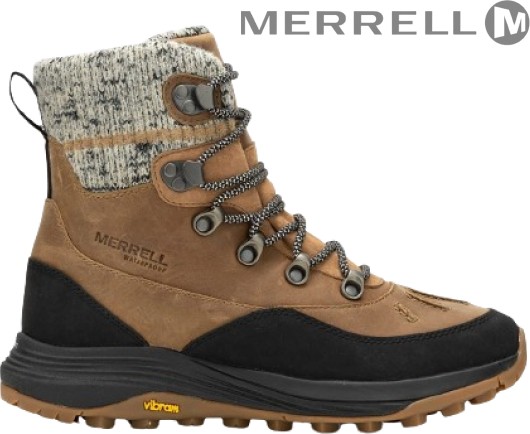
02 / The ProductWhat Sc_Foam actually is
Traditional insulation trades warmth for thickness - the warmer you want to be, the more loft you carry. Aerogel breaks that trade. Because it conducts heat so poorly, a thin layer does the work of a much fatter one. Solarcore® now ships this in a small family of foams: the flagship Sc_Foam for apparel and footwear; Sc_Foam_FR, a fire-retardant version aimed at EV battery packs and HVAC; and Sc_Foam_US, an ultra-thin variant built for military and defense programs. Same core material, three very different buyers.
The fire-retardant line is the most telling of the three. An electric vehicle battery pack is a thermal management problem wearing a metal case: cells need to stay in a tight temperature band, and if one cell overheats, you want a barrier that will not feed the fire. Sc_Foam_FR is Solarcore®'s answer - thin enough to fit the tight geometry of a pack, insulating enough to buy time, and engineered not to burn. It is also a quiet bet on the electric transition, a market with a very different sales cycle than a winter coat but a far larger appetite for material.
Warmth per millimeter - relative bulk to hit the same thermal target
Illustrative. Bars show relative loft needed for comparable warmth, not lab-certified clo values.
03 / The CustomersBoots, batteries, and the Department of Defense
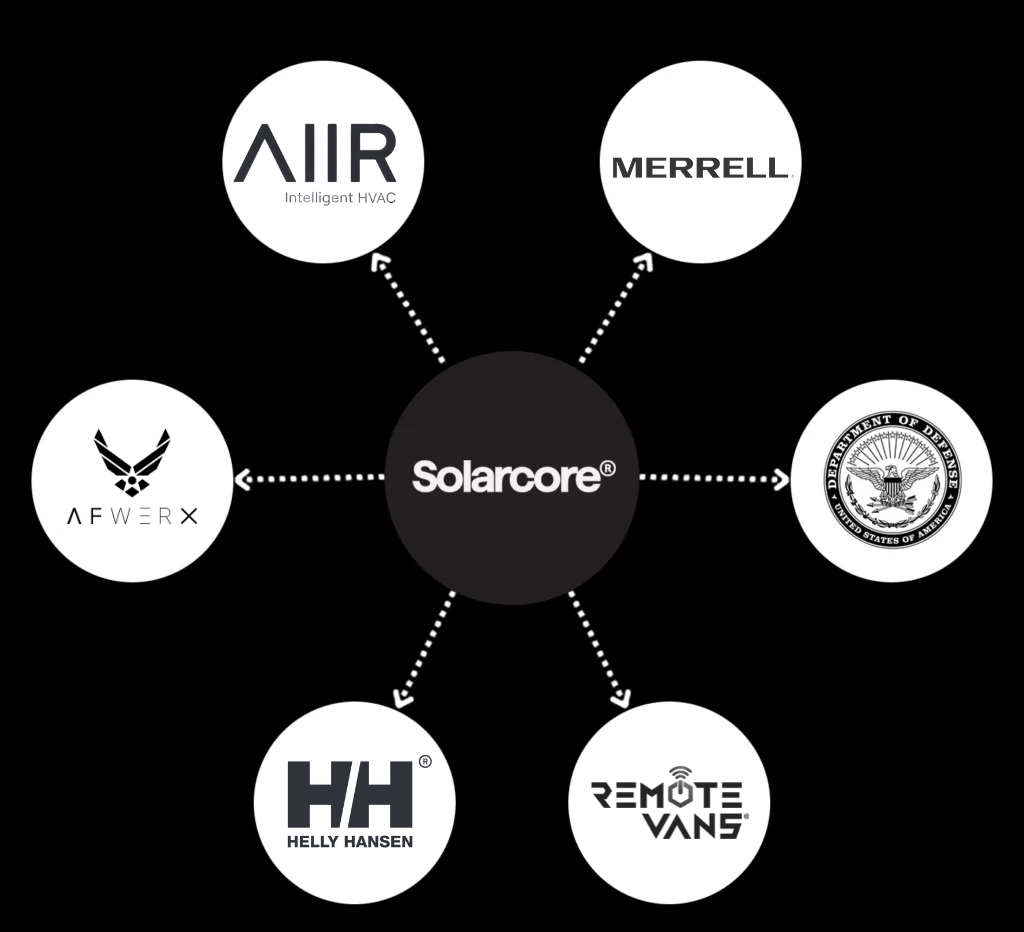
Because Solarcore® sells an ingredient, its customers are other companies. On the consumer side, that means footwear and apparel names like Merrell and Helly Hansen. On the commercial side, HVAC company AIIR and adventure-vehicle builder Remote Vans. And on the government side, the U.S. Air Force (through AFWERX) and the Department of Defense, including work on an Arctic Shelter program and cold-storage for medical supplies. It is a rare startup whose material lands in a hiking boot and a defense shelter in the same fiscal year.
Total opportunity, per company estimates
The market Oros/Solarcore® has publicly sized for insulating technology beyond apparel and footwear - reaching into batteries, buildings, HVAC and logistics.
For the person at the end of the chain, the benefit is refreshingly concrete. A winter boot that keeps your feet warm without feeling like a cinder block. A jacket that packs down small but holds its heat on a chairlift. A camper van insulated enough to sleep in below freezing without doubling its wall thickness. You are not buying "NASA technology" in any meaningful sense - you are buying the thing you actually wanted, which was to be warm and still able to move. The aerogel is invisible, which is exactly the point.
04 / The MoatWhy "it doesn't work yet" became the business
Most founders would treat a material that crumbles as a dead end. Solarcore® treated it as a wall competitors could not climb in a weekend. Aerogel has been public knowledge for decades; the value was never the raw material, it was the years of process engineering to make it behave. That is the difference between the company and a rival who buys the same aerogel and discovers, three months in, that it sheds in a wash cycle.
The strategy is visible in the cap table. After the early crowdfunding, OROS Labs raised a $22 million Series B in April 2024, led by Airbus Ventures, with REI Co-op Path Ahead Ventures, Platinum Mile Ventures, Enlightenment Capital and the Goldwin Play Earth Fund joining. An aerospace investor backing a warmth company is not an accident - it is a signal about where thin, high-performance insulation is headed.
05 / PortlandThey moved for the talent, on purpose
The company is headquartered in Portland, Oregon - and that was a deliberate bet, not a lifestyle choice. Portland is a dense hub of apparel and footwear expertise, and Solarcore® has recruited product and materials people out of Nike, Adidas, Columbia and The North Face. If your business is convincing footwear giants to redesign a boot around your foam, it helps to hire the people who used to design those boots. The team has grown from roughly 15 to the high 20s as it pushes deeper into HVAC, batteries and government work.
06 / What You Can TakeThe lesson worth stealing
Solarcore® is a clean case study in three ideas. First, the pivot from product to ingredient: sometimes you are not a coat company, you are a materials company, and the bigger market is the one hiding inside your supply chain. Second, distribution beats novelty - the breakthrough was not the aerogel, it was making the aerogel fit the machines factories already own. Third, a sleepy category is an opportunity, not a warning. Insulation had barely changed in decades. That is exactly why a scholarship, a stubborn material, and a decade of patience could turn into a business.
It would not work for everyone. Ingredient brands are slow - you are at the mercy of a partner's product calendar, and one boot launch can take years. The moat that keeps competitors out also kept Solarcore® itself grinding for the better part of a decade before the money arrived. But for a founder willing to treat "it doesn't work yet" as the whole job, that is the point. The hard part is the product.