Breaking Arm acquires DreamBig Semiconductor for $265M - October 2025 DreamBig raises $75M Series B co-led by Samsung Catalyst Fund - July 2024 MARS Open Chiplet Platform unveiled at CES 2024 Mercury AI-SuperNIC delivers 12.8 Tbps - January 2025 Sohail Syed: three startups, three exits DreamBig establishes chip design center in Pakistan with NUST Arm acquires DreamBig Semiconductor for $265M - October 2025 DreamBig raises $75M Series B co-led by Samsung Catalyst Fund - July 2024

Chiplet Pioneer • Serial Founder • ARM Acquisition Exit

Sohail
Syed

"The man who built a chiplet empire - then sold it to Arm for a quarter-billion dollars."

CEO & Founder DreamBig Semiconductor
$265M
Arm Acquisition
3x
Startup Exits
200+
Engineers Built
$92.5M
Total Funding Raised
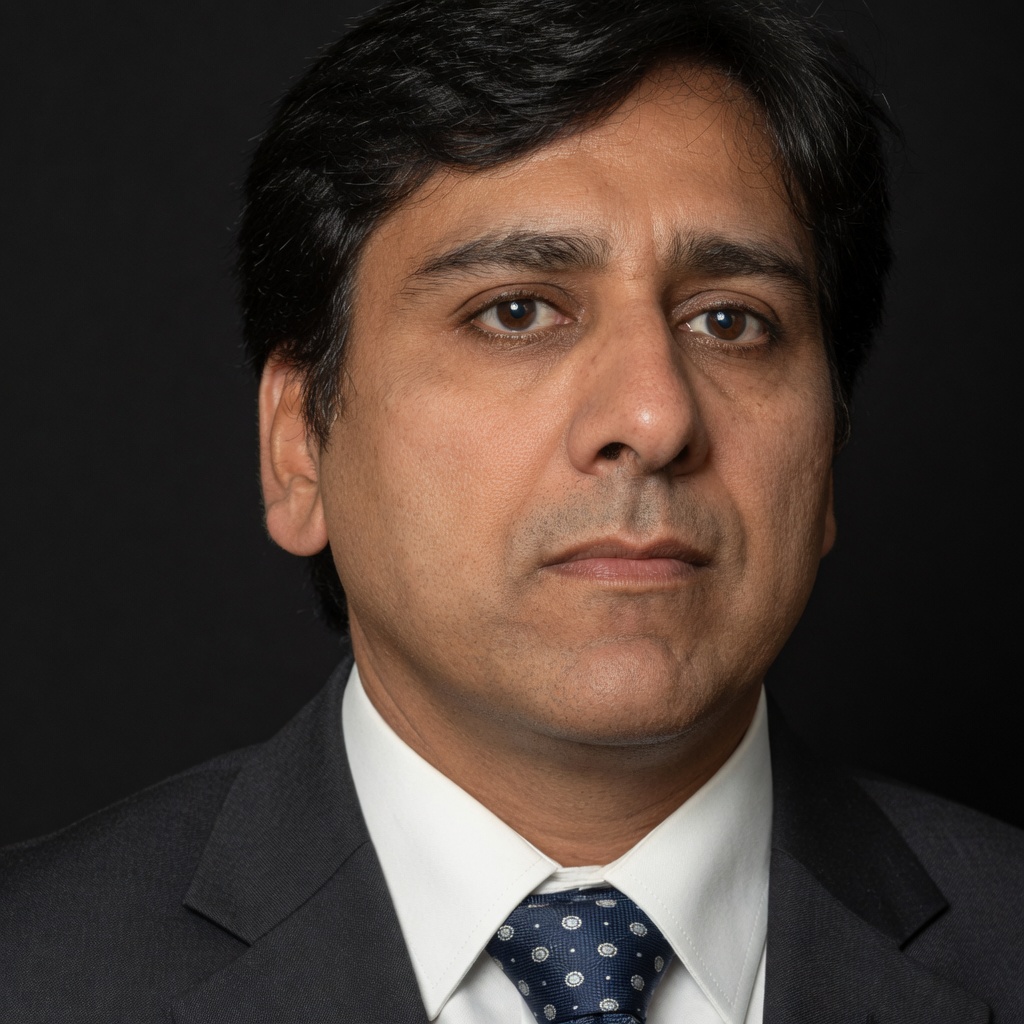
Sohail Syed, CEO and Founder of DreamBig Semiconductor
CEO & President
DreamBig Semi

The Engineer Who Wouldn't Stop Founding Companies

Sohail Syed didn't set out to sell his company to Arm. He set out to solve a problem nobody else was willing to touch - making high-performance chips affordable for the companies that couldn't afford NVIDIA's bill.

In October 2025, Arm Holdings announced it was acquiring DreamBig Semiconductor - a chiplet startup Syed had launched out of San Jose in 2019 with a team he built from scratch - for $265 million. The price reflected something Arm had figured out: Ethernet-based RDMA and chiplet-native networking are the next chokepoint in AI infrastructure, and Syed's team had solved it first.

That deal capped a career built entirely on a single instinct: identify the next networking bottleneck before it becomes everyone's emergency. Syed spotted it at Mentor Graphics in the mid-1990s, again at Virage Logic, again at Marvell where he helped engineer a network switch division that grew to $4 billion in revenue across 10 successful chip tapeouts. Each stop was less a job than a data point.

When he left Marvell, he didn't retire. He founded Questarium - which Marvell then turned around and acquired. He founded FIRQuest - which Corigine acquired. Then he spent three years inside Corigine as VP Engineering, learning the machinery of integration from the inside, before walking out and founding DreamBig.

The pattern isn't coincidence. It's method.

"DreamBig is disrupting the industry by providing the most advanced open chiplet platform for customers to innovate solutions that were never before possible - combining specialized hardware chiplets with infrastructure that scales up and out."

- Sohail Syed, CEO & Founder, DreamBig Semiconductor

$265M
Arm Acquisition
Oct 2025
$75M
Series B
Samsung-led, 2024
12.8T
Tbps Bandwidth
Mercury AI-SuperNIC
200+
Engineers Across
4 Cities

Career Timeline

30 Years of
Engineering the Future

1995 - 2002
Mentor Graphics
Started as Sr. ASIC Verification Engineer, advanced to Sr. Application Engineer. Built the foundations of a career in chip design tooling and EDA - the unglamorous infrastructure that every semiconductor company runs on.
2002 - 2010
Virage Logic
Technical Account Manager, then managed worldwide teams and customers. Eight years learning to sell complex silicon IP globally - the commercial instinct that later made DreamBig fundable.
2010 - 2011
eSilicon
Managed worldwide field applications. Brief, but positioned him between chip designers and the customers who need them - exactly the gap he'd spend the next decade closing.
2011 - 2012
Questarium - Exit #1
Founded and ran Questarium as CEO. Acquired by Marvell Semiconductor. First proof that Syed could build something worth buying - and that Marvell was paying attention.
2012 - 2015
Marvell Semiconductor
Senior Director of Engineering. Helped grow the network switches division to $4 billion in annual revenue. Delivered 10 successful chip tapeouts - a track record that remains the benchmark for execution in networking silicon.
2015 - 2019
FIRQuest + Cornell MBA + Corigine - Exit #2
Founded FIRQuest as CEO while pursuing an MBA at Cornell University (2015-2016). FIRQuest was acquired by Corigine in 2019. Served as VP Engineering at Corigine through the integration, then walked out and started again.
2019 - Present
DreamBig Semiconductor - Building
Founded DreamBig Semiconductor in San Jose. Brought in Marvell co-founders Sehat Sutardja and Weili Dai as Executive Chairman and Chairwoman. Built a team of 200+ engineers across the US and Pakistan. Launched the MARS Open Chiplet Platform at CES 2024. Raised $75M Series B from Samsung.
October 2025
Arm Acquisition - Exit #3
Arm Holdings agreed to acquire DreamBig for $265 million. The deal reflected Arm's recognition that Ethernet RDMA controllers and chiplet-native AI networking - DreamBig's core IP - are essential for the next generation of data center infrastructure. Expected to close Q4 FY2026.

MARS: The Bet That Paid Off

DreamBig's core thesis was counterintuitive: instead of building a monolithic AI chip and competing with Broadcom, NVIDIA, and Intel on their own terms, Syed built a chiplet platform that let anyone plug into the AI infrastructure stack. Call it modular ambition.

The MARS Open Chiplet Platform - unveiled at CES 2024 - solved two problems simultaneously. Scale-up: getting more compute and memory inside a single AI accelerator system. Scale-out: connecting those systems to each other across a data center fabric. Most companies tackle one. DreamBig tackled both with a single chiplet architecture built around UCIe open standards, 3D HBM stacking, and RDMA Ethernet networking.

MARS stands for Modular Architecture for Rapid Scaling. The platform allows startups or any size company to build AI, data center, edge, and automotive solutions that were previously only accessible to trillion-dollar cloud providers.

In January 2025, DreamBig unveiled the Mercury AI-SuperNIC - a monolithic chip delivering up to 12.8 Tbps of bandwidth, designed to connect AI chips like GPUs and TPUs via a chiplet-compatible component. It was DreamBig's product moment: the thing that demonstrated the MARS platform wasn't just architecture slides. It shipped silicon.

Why Arm Wrote the Check

Arm's spokesperson explained the rationale bluntly: "DreamBig has deep expertise and intellectual property in the Ethernet area and RDMA controllers, which are key technologies for scale-up and scale-out networking. As demand grows inside the data center, particularly in high-speed communications, this technology will play an important role in broadening Arm's offerings to end customers."

That's the acquisition thesis in one paragraph. Arm has the CPU architecture that runs most of the world's devices. What it lacked was the networking intelligence layer that connects AI accelerators inside a data center. DreamBig had built exactly that - and had the patents, the silicon, and the team to prove it.

At $265 million - against $92.5 million in total funding raised - the deal represents a 2.9x multiple on invested capital. Not a moonshot return by venture standards, but the kind of disciplined outcome that comes from building something with genuine infrastructure value rather than narrative.

The transaction is expected to close by the end of Q4 FY2026 - March 2026 - subject to regulatory approval.

"This investment underscores the market's recognition of DreamBig as a transformative force in AI and data center infrastructure. Our open MARS Chiplet Platform enables unparalleled scale-up and scale-out solutions so customers can achieve the highest levels of performance and energy efficiency at lowest cost and fastest time-to-market."

- Sohail Syed on closing the $75M Series B, July 2024

What He Actually Built

01
Three exits in three decades. Questarium to Marvell. FIRQuest to Corigine. DreamBig to Arm for $265M. Not a hot streak - a pattern.
02
Marvell's $4B network switches business. Syed was in the room - and running chips - when it grew. Ten successful tapeouts without a miss.
03
$75M Series B from Samsung. Co-led by Samsung Catalyst Fund and the Sutardja Family. Samsung doesn't write that check unless the chiplet roadmap is real.
04
MARS Open Chiplet Platform at CES 2024. The first open chiplet hub for AI, data center, edge, and automotive - at a price point that didn't require a hyperscaler budget.
05
Mercury AI-SuperNIC - 12.8 Tbps. Shipped silicon that connects GPUs and TPUs via chiplet-compatible interfaces. Infrastructure-grade bandwidth in a single chip.
06
Pakistan semiconductor ecosystem. Built design centers in Karachi, Lahore, and Islamabad. Partnered with NUST. Sponsored workshops at his own alma mater, NED University.

NED University to Silicon Valley

Sohail Syed graduated from NED University of Engineering and Technology in Karachi - Pakistan's oldest engineering university, and the institution that has quietly trained a significant portion of Silicon Valley's Pakistani-origin engineering workforce.

He didn't forget where he came from. DreamBig established a design center in Pakistan in partnership with NUST (National University of Sciences and Technology), complete with chip design facilities, training labs, and testing equipment. The company sponsored engineering workshops at NED University - his alma mater - and at UET Lahore.

The Arm acquisition of DreamBig was celebrated publicly in Pakistan as one of the largest semiconductor exits by a Pakistani founder in Silicon Valley history. Paklaunch - tracking Pakistani tech founders globally - called it "a beacon of inspiration showing what Pakistani founders can achieve on the global stage."

Syed got his MBA at Cornell University in 2015-2016 - the same window during which he was running FIRQuest as CEO. The overlap wasn't incidental. It was the kind of parallel execution that his chip architectures are literally designed to enable.

Standing on Giants' Shoulders

Syed didn't build DreamBig alone. He brought in two of the most consequential figures in semiconductor history as co-founders: Sehat Sutardja as Executive Chairman and Weili Dai as Executive Vice Chairwoman.

Sutardja and Dai co-founded Marvell Technology Group in 1995 and built it into one of the world's top networking semiconductor companies before stepping down in 2016. Sutardja holds over 440 patents and is an IEEE Fellow. Dai was named one of Forbes' "World's 100 Most Powerful Women" in 2012.

The connection is direct: Syed built his networking silicon expertise inside Marvell. When it was time to build something new, he went back to the people who built Marvell in the first place. That's not a coincidence. That's a founding team assembled from trust earned over decades.

The Sutardja Family was also a co-lead investor in DreamBig's $75M Series B - doubling down on the same bet they helped Syed make from day one.

The Details

Things Worth Knowing

🎓
Syed attended NED University in Karachi - the alma mater of semiconductor engineers across four continents. He later went back to sponsor workshops there as a DreamBig CEO.
📐
He earned his Cornell MBA in 2015-2016 while simultaneously founding and running FIRQuest. Running a startup during business school is uncommon. Running one while taking the classes is something else.
🔄
Syed has been acquired by the same company twice: Marvell acquired Questarium, then Marvell hired him. He learned the acquirer's playbook from the inside, then applied it to build DreamBig.
🌍
DreamBig's engineering team spans San Jose, Karachi, Lahore, and Islamabad - a distributed semiconductor org built before "distributed work" became a Silicon Valley talking point.
🏗️
MARS stands for Modular Architecture for Rapid Scaling. The chiplet platform was built to solve what NVIDIA and Broadcom were solving only for hyperscalers - and do it for everyone else.
📡
The Mercury AI-SuperNIC delivers 12.8 Tbps of bandwidth - that's roughly equivalent to transferring the entire Library of Congress every 2 seconds across a data center fabric.

Topics

Chiplet AI Hardware Semiconductor MARS Platform UCIe RDMA Data Center Serial Founder Arm Acquisition Pakistan San Jose Fabless Networking Silicon 3D HBM SmartNIC DPU CES 2024 Series B Samsung Marvell