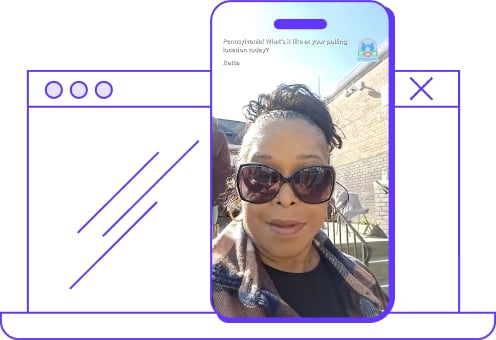
The revealing thing about Soapboxx is not the video. It is the absence of a small indignity. There is no app to install, no account to invent a password for, no producer waiting on a call while you search for the right sentence. A supporter opens a link in a browser, considers a prompt, records, retakes if necessary, and sends. This sounds almost aggressively ordinary. Then 5,698 voter stories arrive in less than two weeks.
That happened during an Empower Project campaign. Two waves of prompts asked people in battleground states why they were voting and, later, what happened at their polling place. Soapboxx gave the organizers somewhere to collect and sort the flood. The stories were placed on an interactive map. The interesting achievement was not merely getting people to speak. Social networks have spent years doing that. It was making thousands of separate acts of speaking manageable for the organization that had asked.
A film crew is a poor invitation
Before Soapboxx, Color Of Change hired professional contractors to make campaign videos. The footage existed, but the process was costly and it did not naturally include people on the ground. Production became another job for staff already trying to run campaigns. At a 2018 event for Stacey Abrams, the organization tried something smaller: one question, offered to field organizers - why do you support her? By the general election it had collected more than 200 videos without arranging 200 shoots.
Then the outside world supplied the harshest possible test. Travel stopped in 2020. E Pluribus Unum had previously sent a production team through 13 Southern states and planned to return. The pandemic made that plan impossible. Soapboxx began as a substitute for the trip: ask people to document their own lives, in their own place, on their own schedule. The organization sought 50 videos and received almost 200 in a month. The workaround stayed after the immediate crisis because it reached people physical production could not.
“Soapboxx makes it easier for our storytellers to share their experiences on their own time and in a lower pressure environment.”MomsRising case study
That lower pressure matters. A live interview creates a tiny stage. Someone is watching, the meter is running, and a first attempt feels final. Soapboxx lets a contributor record again until the story sounds like their own. Busy parents can wait until the house is quiet. Caregivers can participate without traveling. A campaign gets testimony from someone who might never volunteer for a scheduled shoot.
Collection is only the first quarter of the job
A normal social post is easy to publish and hard to govern. A useful campaign asset needs permission, organization, captions, brand treatment, approval, and often a call to action. Soapboxx sits between the private camera roll and the public feed. It collects five formats - video, photo, ad-video, reaction video, and video postcard - and gives staff a private dashboard. Administrators choose what goes live and can download the raw material for another edit.
Automation handles the unglamorous middle: custom overlays, captions, thumbnails, end cards, b-roll, suggested sharing copy, and analytics. The public site says prompts and pages are supported in English, Spanish, and French, with transcription across more than 50 languages. The service around the software is equally telling. Customers get strategists, designers, setup help, and a direct human contact. This is software sold to teams that may have a communications director but rarely have spare production capacity.
The latest expansion is away from the camera. Written Stories lets a supporter type instead of record. Staff can turn the result into a branded card, a text-to-video piece, or a website embed. Soapboxx’s explanation is sober: visibility can feel unsafe, and not everyone is comfortable on camera. A company built around video changed its mind about requiring video. The mission - getting a story into circulation - proved more important than the original medium.
Money and marketPriced like a service, built like software
Soapboxx does not post a universal rate. It quotes according to an organization’s size and storytelling needs. One unusually transparent partner listing from the Montana Nonprofit Association put a standard monthly subscription at $2,500 and offered members one dashboard for $500 a month on a one-year contract. That discount came with unlimited administrators and submissions, custom graphics, automatic captions, and a dedicated strategist. It is a specific association deal, not a current price card for everyone, but it shows the intended buyer: an organization comparing the platform with staff hours, freelance editing, or a production crew - not a consumer comparing $12 apps.
The nearby alternatives include Gather Voices, MemoryFox, VideoAsk, Vocal Video, StoryPrompt, and AnswerStage, along with the homemade stack: a form, a cloud folder, an editor, a captioning tool, and several spreadsheets. Soapboxx’s edge is its campaign grammar. It combines supporter acquisition, moderation, branding, distribution, calls to action, and human strategy. It is particularly legible to nonprofits, unions, civic groups, and political teams.
Founder Daniel Beckmann describes an unusual financing choice. The broader project began around 2015, although the company lists 2018 as its founding year. Beckmann says the team took little investment, avoided investor meetings, and built with paying customers. In 2024, Megan Castle became chief executive and Beckmann moved to executive chairman. The company lists 14 employees on LinkedIn. Smallness is visible in the offer: product and service have not been separated into distant departments.
“We built this company with our customers. We didn’t really have any investment.”Daniel Beckmann, marking ten years of the wider Soapboxx journeyWhat travels
The copyable part is the choreography
Stand.earth used supporter footage in a compilation aimed at an insurer of the Trans Mountain pipeline. The video drew 80,000 views across LinkedIn and Facebook and 129 petition signatures. Caring Across Generations placed QR-linked calls to action on stories about Medicaid cuts, then displayed them during a 60-hour vigil. The campaign recorded 2,515 scans and 1,370 accountability-form submissions during the reported week. In both cases, the story was not treated as the end product. It was the first step in a designed action.
The Biden campaign offers the large-system version. National, relational, and 17 state digital teams used 19 dashboards. Supporters recorded local appeals; teams downloaded raw footage for ads and press; ten compilation videos were assembled without conventional production crews. Nearly 50,000 minutes of supporter-made Soapboxx videos were watched on Facebook during the final three months of the 2020 campaign. Social media remained essential. Soapboxx did not replace it. The platform gave the campaign somewhere to gather and prepare the material before sending it into the feed.
What another team can copy
- Ask one concrete question, not “tell us your story.”
- Remove registration and let people retake before submitting.
- Decide approval, consent, branding, and file ownership before launch.
- Pair every story with one next action: share, sign, donate, attend, or reply.
- Build for the flood. A successful prompt creates an operations problem.
The conditions matter. This approach works when a group already has a community, a reason for that community to speak, staff willing to review submissions, and a distribution plan. It is weaker when the subject requires a controlled interview, evidentiary verification, cinematic craft, or when contributors face risks that consent forms and moderation cannot solve. Authenticity is not produced by lowering image quality, and participation is not guaranteed by removing an app. Trust still arrives from the organization that sends the link.
That is Soapboxx’s useful modesty. It cannot supply the relationship, the question, or the courage to answer. It can make sure those things do not die in an email thread, an editor’s queue, or a stranger’s camera setup. The supporter was always carrying a camera. Soapboxx built the rest of the room around it.