The most revealing thing about a SmartWings shade is not that it moves when someone says, “Alexa, close the bedroom.” It is everything that happened before the sentence: a customer measured the window, chose an inside or outside mount, picked a fabric and opacity, selected a motor protocol, decided between battery, solar or wire, and trusted a factory to cut the result. Only then does the curtain perform its little magic trick.
SmartWings Home is a Rancho Cucamonga, California, company selling made-to-order motorized window coverings directly online. Its catalog stretches from ordinary roller and cellular shades to zebra, woven wood, Roman, dual, outdoor, skylight, trapezoid and arched models, plus drapery and pergola products. Customers are homeowners, home-automation enthusiasts, designers and integrators, along with people for whom reaching a cord is difficult or impossible.
The problems are homely but persistent: afternoon glare on a television, a hot room, a tall window, privacy at night, a nursery that should stay dark, or ten separate shades that must be pulled every morning. The company turns each into a repeatable instruction. Open at sunrise. Close when the room gets hot. Drop to 40 percent for a video call. Run a “movie night” scene and let the house dim itself.
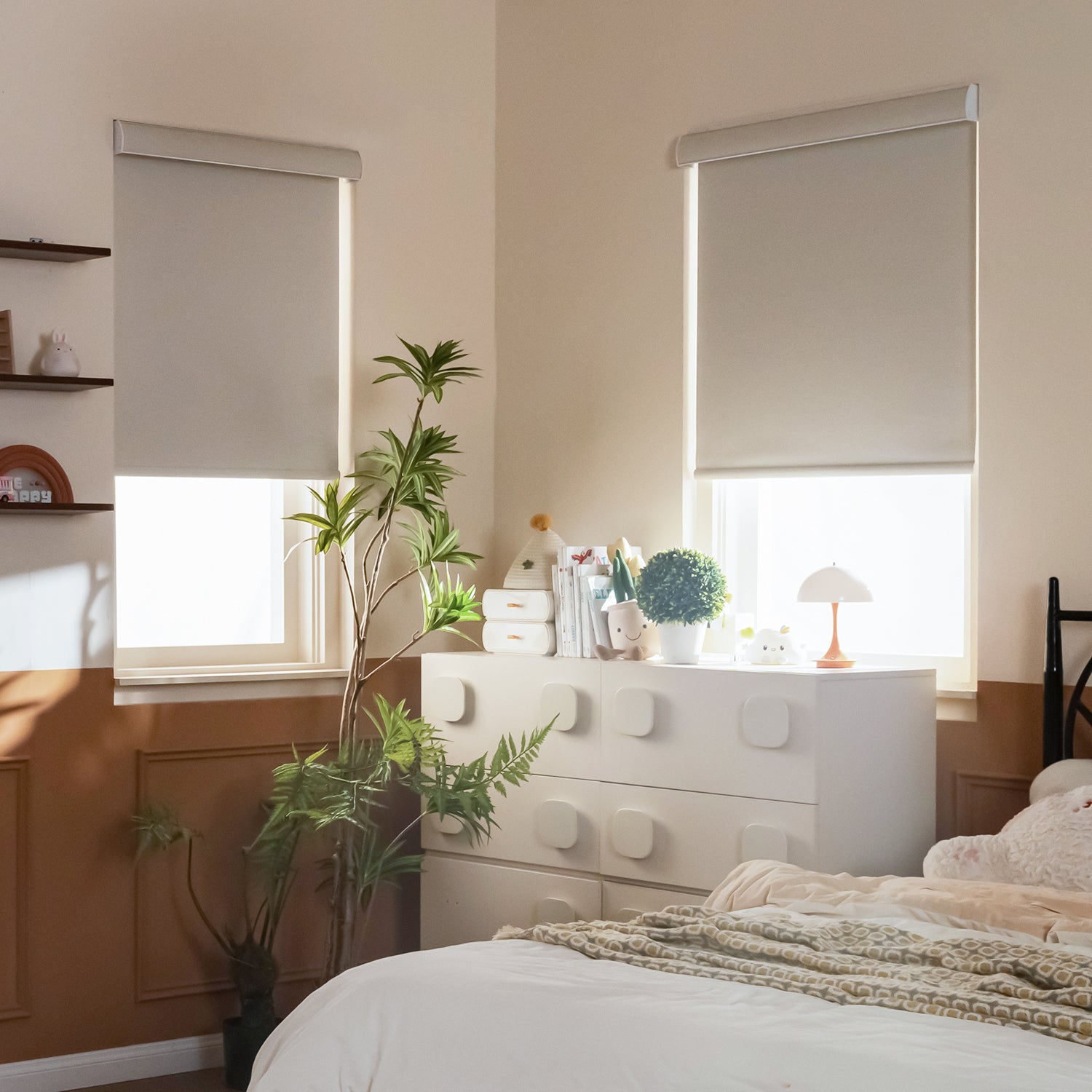
A custom blind, sold like a laptop
The differentiator is not one magical motor. It is the menu. SmartWings offers basic radio-remote control, Zigbee, Z-Wave, HomeKit over Thread, Matter over Thread and Matter over Ethernet with Power over Ethernet. Depending on the choice, a shade can join Apple Home, Amazon Alexa, Google Home, Samsung SmartThings, Home Assistant, Homey or Hubitat. The Matter version can work through the customer’s existing home app, with no dedicated SmartWings app required for everyday open, close and percentage control.
The business model is straightforward ecommerce with a combinatorial tail. Price rises with width, height, fabric, motor, power source, valance and accessories. A basic blackout roller configuration on the company’s store starts around $179.99. In a detailed comparison, smart-home writer Derek Seaman priced a 36-by-72-inch SmartWings zebra shade with solar charging and Matter over Thread at roughly $462 plus tax. His comparable Eve MotionBlinds quote was $784 before a temporary discount, or $510 on sale without solar.
SmartWings moved the showroom, tape measure and installer into a Shopify checkout.The whole business model, in one sentence
That price gap explains the trade. Traditional custom window coverings often wrap a consultation, measurement and installation into the bill. SmartWings ships fabric samples and instructions, pre-assembles the shade, sets its travel limits at the factory and leaves the final brackets to the buyer. It is custom manufacturing with customer-supplied geometry.
The machineryChoose your protocol, then choose your pain
Four ways to make the window move
Bars rank ease for a typical existing home, not technical quality. The right answer changes with wiring, hubs and radio coverage.
The wireless Matter pitch is clean: scan a QR code, add the shade to a compatible home, and avoid committing to one giant’s ecosystem. In practice, Thread still depends on a healthy mesh and a nearby border router. Early products exposed the familiar distance between “certified” and “boring enough to forget.” Seaman’s six shades suffered firmware stability and connectivity problems. Some motors carried third-party “HooRii” firmware that he found could not be updated through the expected route.
What failed first, in other words, was the invisible part. Not the fabric. Not the aluminum tube. The radio and firmware made a physical object feel unreliable. His verdict later changed after SmartWings supplied replacement motors running version 1.3. In a November 2025 update, he reported no issues with the new motors and firmware. The episode is useful because it is mundane. Interoperability logos do not finish the product. Update paths, support knowledge and network conditions do.
SmartWings’ more eccentric answer is a roller motor that takes Ethernet. One cable carries Matter data and Power over Ethernet; a built-in battery offers backup. Independent testing found immediate Home Assistant response and stable connectivity. It also found the obvious catch: very few finished homes have Ethernet waiting above the window. Pulling cable through a wall can consume every convenience the product later creates.
PoE works in new construction, a serious renovation, a showroom, or a hard-to-reach opening where charging a battery is genuinely annoying. It is a poor weekend upgrade when the drywall is finished and the router lives three rooms away. Wireless Matter is usually the saner retrofit. A plain remote is saner still when the buyer does not want a smart-home hobby.
The failure modesThe tape measure has no undo button
Technology gets the attention, but measurement carries the irreversible risk. TechRadar’s reviewer measured for an inside mount, then discovered her frame would not accommodate one. She installed outside the frame instead, leaving the shades visually narrow. She also found the included screws soft enough to strip and described installation as less than easy. The shade worked smoothly afterward, but “afterward” required a drill, patience and improvisation.
This is where SmartWings does not work. Renters may be unable to drill. Impatient buyers should not guess. Weak Thread or Zigbee coverage can make a good motor look broken. A bespoke shade is not easily repurposed if the dimensions are wrong, and it is expensive compared with a manual blind. Solar charging wants useful light. PoE wants cable. Blackout roller shades can still leak light at the sides unless channels or blockers are added.
Good fit
- Homeowner with accurate dimensions
- Several repetitive daily shade routines
- Existing compatible hub or border router
- Hard-to-reach or unusual windows
- New build with planned wiring
Walk away
- Lease forbids drilling
- Budget favors manual blinds
- Uncertain mount or measurements
- Patchy wireless mesh
- Expecting perfect blackout without side control
Competitors divide into three groups. Lutron Serena and Somfy-powered dealer systems lean toward established integration and professional channels. Eve MotionBlinds, Graywind and WEFFORT sell complete smart coverings with varying combinations of fabric and protocols. SwitchBot and Aqara retrofit existing blinds at lower cost, sacrificing the unified custom result. And manual shades remain brutally competitive: cheap, understandable and immune to firmware.
There is another customer hiding in the catalog: the person with a window that normal retail has decided not to understand. Skylights, arches and trapezoids make mass-market sizing useless. Outdoor openings bring wind, ultraviolet exposure and weather into the specification. For these buyers, automation is not the only value. A company willing to manufacture the odd shape already has their attention. Adding remote control solves the second problem - the awkward window is often awkward to reach. That combination makes the specialty range more defensible than another app-controlled rectangle.
The stealWhat another company can copy
Five pieces worth borrowing
- Turn complexity into a guided sequence of visible decisions.
- Mail samples before asking for an irreversible custom order.
- Pre-calibrate the product so installation is mostly mechanical.
- Support old and new standards instead of forcing one ecosystem.
- Keep a physical remote and button when the network has a bad day.
The copyable lesson is not “add Wi-Fi to furniture.” SmartWings gives a complicated physical product an online configuration system, education before checkout and calibration before shipment. It also preserves graceful fallbacks. A handheld remote remains useful even in a Matter home; the button on the shade still exists. Automation is better when failure does not turn a window into a support ticket.
The company says its fabrics follow standards and certifications including OEKO-TEX, UL, RoHS and GreenGuard, and it frames energy conservation, accessibility and child safety as part of the mission. Those are sensible directions, but buyers should resist magical energy claims. A shade can reduce solar gain, glare and heat transfer; actual savings depend on climate, glass, fabric, fit, schedule and HVAC behavior. “Close the west windows before the room cooks” is a useful automation. “This pays for itself” needs a spreadsheet SmartWings cannot fill in for every house.
Where does the company fit? Between the retrofit gadget and the showroom appointment. It offers more design choice than a bolt-on motor, more protocol choice than many premium shade brands, and more buyer responsibility than a dealer-installed system. That middle is attractive precisely because it is imperfect. The customer pays less money and contributes more competence.
Once installed, the best SmartWings experience is almost comically uneventful. Morning light appears. Afternoon heat gets blocked. The room closes itself at dusk. Nobody admires the protocol. Nobody opens an app. A motor turns for a few seconds, and a small household chore disappears. The cleverness is not that the blinds can listen. It is that, after all those choices, they finally know when to be quiet.