Oakley Transport had video. What it needed was a way to decide which video mattered. In SmartDrive’s account of the fleet’s experience, chief executive Thomas Oakley described earlier systems as delivering clips without context or priority. There is a small management disaster hiding in that complaint: you can collect evidence faster than anyone can make sense of it.
THE STORY IN THREE TURNS
- The job: turn driving events into evidence and coaching priorities.
- The customer: commercial fleets with people, vehicles and claims to protect.
- The catch: somebody still has to coach the driver.
The missing piece was the sorting
Oakley’s case study reports a 62% reduction in accidents after deploying SmartDrive, alongside a 2.1% improvement in fuel efficiency. It describes 500 equipped vehicles. Those are historical customer results, rather than a controlled experiment. But the purchasing logic is instructive: the fleet valued a service that prioritized the footage and helped managers direct their attention.
That is the useful way into SmartDrive. The company supplies cameras, but its work extends into the busy space between a recording and a decision. Its managed program combines video, vehicle data, expert review and coaching tools. The promise to a fleet manager is practical: a shorter queue of moments worth discussing.
A hard brake needs a backstory
A truck brakes hard. Has the driver followed too closely, or just avoided someone else’s mistake? The sensor registers deceleration in either case. SmartDrive executive Aidan Rowsome made precisely this distinction in a 2018 explanation of the service: a trigger alone cannot tell you whether the driver deserves criticism or credit. The surrounding video changes the interpretation.
In the managed workflow, an event triggers the capture and upload of footage. Analysts review and score what happened against the customer’s criteria. Managers use the resulting priorities for coaching. The Response Center brings video and vehicle information together. Its audience is broader than long-haul trucking: distribution businesses, construction operators and passenger transport providers also have driving behavior to understand.
FROM THE ROAD TO THE NEXT DRIVE
- 01CaptureAn event and its context
- 02ReviewExpert scoring and priority
- 03CoachA specific conversation
- 04RepeatWatch the pattern change
Customization matters here. A scoring feature announced in 2014 let fleets weight particular risks according to their policies. A bus operator and a freight carrier need not put every event in the same order. This is transportation expertise expressed as a work queue: the system must understand the operation well enough to direct a human’s limited time.
A Davis Transfer pilot across 20 trucks exposed another blind spot: even drivers with clean records had developed bad habits. Waiting for a crash to identify a coaching need means waiting for the costly signal. Reviewing ordinary risky moments gives managers an earlier opportunity to intervene, provided they follow through with training.
The driver needs a reason to believe
A safety camera also changes a relationship. Management gains visibility; drivers gain another reason to wonder who is watching. SmartDrive’s customer stories suggest that exoneration can help make the technology intelligible to the person behind the wheel. A recording can preserve evidence that the driver acted properly when an accusation says otherwise.
Averitt Express tested three competing systems before choosing SmartDrive. It selected road-facing Shield cameras for a rollout across its then 4,800-truck fleet. The case study says drivers embraced the system once they understood its ability to protect their records and livelihoods. It also reports several million dollars in liability savings. That is a different sales conversation from simply telling drivers that monitoring will improve them.
“Our core responsibility is to reduce collisions and the damage they cause to people and businesses.”
SmartDrive’s stated responsibility, Solera Fleet Solutions
At UK food distributor Reynolds, the program was embedded in driver orientation. Its published account links acceptance to that introduction and reports a 30% year-on-year collision reduction. The lesson is available to any operator: explain how footage will be used before the first uncomfortable coaching session. Trust is part of implementation.
A price tag with an asterisk
The business combines installed hardware with software and ongoing services. One unusually concrete example appears in Dallas Area Rapid Transit’s April 2026 board packet: a proposed five-year SmartDrive operator safety subscription renewal, capped at $1,650,800. The document describes behavior analysis and targeted coaching. It is a procurement recommendation, not evidence of payment or a universal per-vehicle rate.
For a buyer, the sensible comparison includes installation, subscription scope and the staff time needed to act. A system with nobody assigned to coaching can leave the original problem intact: plenty of footage, too little attention. Treat customer savings as a reason to design a pilot with measurable goals, rather than a number to paste into next year’s budget.
From one box to the bigger platform
SmartDrive’s investors backed that combination of equipment and recurring services. It announced $50 million in financing in 2015, followed by $90 million in 2019, led by TPG Sixth Street Partners. WABCO’s participation also joined vehicle safety technology to the video business.
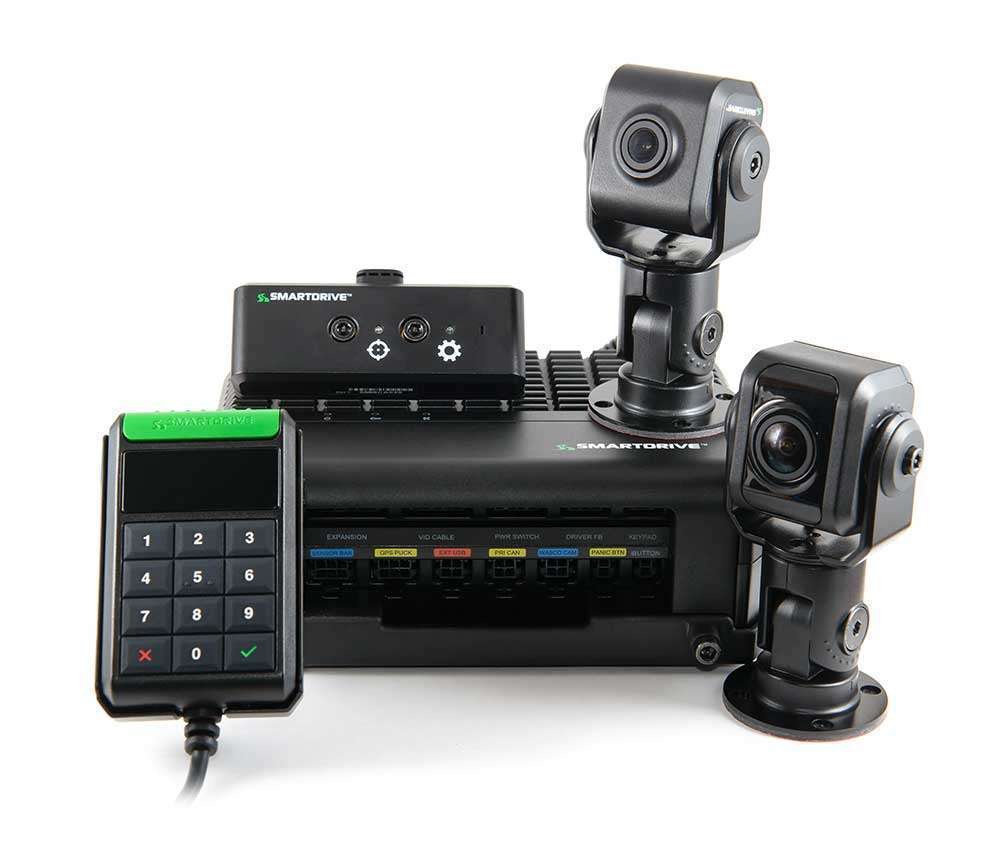
Omnitracs announced its acquisition agreement in 2020; Solera acquired Omnitracs in 2021. The direction was consolidation: safety information beside other fleet work. In October 2025, Solera announced the SR5 AI camera and Fleet Platform integration, pairing automated detection and driver voice alerts with human-informed context.
SmartDrive occupies a competitive category. Lytx, Samsara and Motive also offer video safety and alerts or coaching. Human involvement is not exclusive. SmartDrive’s proposition rests on how its review service, configurable workflows and Solera connections fit a particular fleet.
The product range reflects those different needs. SmartIQ turns fleet data into performance insights; Protect targets smaller fleets with video safety and driver feedback. That breadth makes the buying decision more specific: choose the configuration and service level that match the work your team can actually perform.
The next thing in the road
In May 2026, Solera introduced SmartDrive Pedestrian Collision Warning. It uses computer vision and vehicle data to assess people ahead of the vehicle, with audible warnings in the cab. Solera says it extends SR5 without additional hardware, targeting places such as urban delivery routes and yards.
The warning brings the story back to attention. An alert can point out a pedestrian; a reviewed clip can reveal a habit. Neither completes the driver’s job. For the fleet choosing the system, the question is wonderfully concrete: after the camera sees something, who does what next?