A pizza shop is an unusual place to begin a story about insurance software. But when Skye Theodorou was asked what gave her the idea for upcover, her answer was two words: “My dad.” His businesses included pizza shops, market stalls, homewares and discount variety stores. The business owner she wanted to help already had a face. He had been there all her life.
That family history gives her work a particular scale. Commercial insurance can be discussed in billions of dollars, distribution channels and underwriting capacity. A shopkeeper encounters it as another decision that must be made while running the shop. Theodorou has spent much of her career moving between those two views: the institution that supplies protection and the person trying to understand what to buy.
Today she is co-founder and CEO of upcover, the Australian digital insurance business she started with Anish Sinha in 2019. The company won InsurTech Company of the Year at the 2026 Finnies. Its beginnings were smaller and rather less tidy. There was a swiping prototype, an experiment with delivery workers and, eventually, a decision to turn off a product the team had worked hard to build.
The customer she already knew
Theodorou grew up in Sydney. As a child, her possible futures included singing and, more quietly, becoming a lawyer. She did pursue law, studying business and law at the University of Technology Sydney. Her LinkedIn profile records her solicitor qualification in January 2014, followed by further study in 2015 and 2016. Her dissertation examined small and medium-sized enterprises and emerging cybersecurity risk in Australia.
There is a useful continuity here. Long before upcover offered business insurance online, she was studying how small companies encounter new risks. A business need can change faster than its owner's vocabulary for describing it. Cybersecurity is a good example: an unfamiliar exposure still has to be understood, discussed and accounted for.
Her working life took her through Zurich and the New South Wales government. In a 2022 professional biography, she described six years across insurance functions including legal work, compliance, claims and underwriting, alongside three years in government working on innovation and regulatory reform for startups and small businesses. She had seen the machinery from several rooms.
That experience matters to the kind of company she chose to build. An insurance interface sits on top of decisions about risk, wording and who will accept the exposure. Changing the screen alone leaves much of that work untouched. Her background gave her a way into the less photogenic parts of the problem. There are no glamorous photographs of a satisfactory compliance process. Its absence, however, can become extremely memorable.
“I apply the 5 whys to everything I do.”Skye Theodorou, on asking better questions
A co-founder, a swipe, a different question
In 2019, Theodorou joined Antler's first Sydney cohort and met Sinha. She brought insurance knowledge; he brought experience in finance, technology and building businesses. Before the pairing, she had already worked on a prototype herself. Joining the program supplied something she wanted: a co-founder with whom to take the next step.
The early joint idea was a Tinder-style contents-insurance platform. People could swipe through things they might want to protect. It was an attempt to make an insurance decision feel familiar, borrowing an interaction that needed little explanation. Customer research then took the founders toward another audience: gig-economy workers, whose working arrangements did not fit comfortably into established insurance categories.
Theodorou pitched at Antler's inaugural Sydney Demo Day in front of more than 1,000 people. The public performance is the visible part of that episode. The more consequential part was the willingness to let research change the product. A prototype had helped them ask a question; it did not oblige them to keep the first answer.
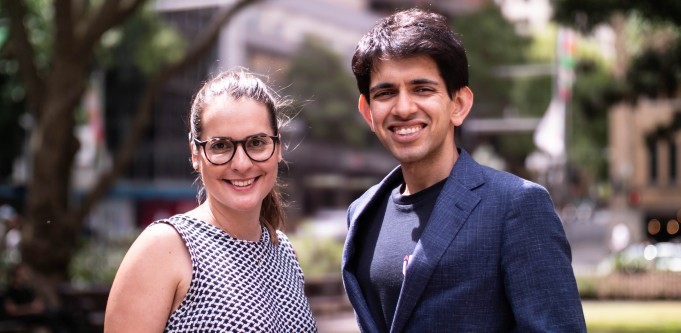
The pair later described their temperaments with a pleasing lack of founder mythology. Theodorou called herself “a bit of a cynical realist”; Sinha, in her telling, was the optimist. She also valued his approach to processes and systems. The partnership had room for different instincts about the same obstacle.
The product she chose to switch off
upcover's first delivery-insurance product launched in November 2020 with food-delivery platform EASI and Agile Underwriting Services. The founders had spent time talking with delivery workers, including conversations on the street and in workers' WhatsApp groups. They were trying to place the product close to the moment it would be used.
The experiment produced roughly 350 transactions and around 100 customers in 60 days, according to Theodorou's account. Those were signs of interest, but interest did not settle the economics. She identified volatility in the delivery-rider market and the administrative burden of a product priced at 70 cents a day as reasons for discontinuing it.
The team wanted to expand to small businesses and had to decide whether it could maintain both efforts. It chose to stop the delivery platform and rebuild. In 2021, upcover relaunched with an SME proposition backed by Professional Risk Underwriting. The change involved giving up something real, including the ability to keep supporting EASI through the original product.
and a partnership
launch
Rebuild for SMEs.
A pivot sounds neat when printed on a timeline. Living through it means deciding what to stop, which commitments can continue and what the previous work has taught you. Theodorou's explanation was practical: a small team needed focus. The broader aim survived; the first vehicle for getting there did not.
That is an instructive moment in her story because it complicates the usual account of persistence. Sometimes persistence means keeping a product alive. Here it meant accepting that the product should close so the business could keep working on the problem. The earlier customers and transactions became evidence for the next version.
Realism meets the fundraising market
By February 2023, Theodorou was speaking bluntly about the investment climate: “Insurtech is a totally dirty word now.” She was discussing a sector confronting compressed valuations and a harder search for capital. Her response included an unfashionable point for a founder seeking money: a greater insistence on viable economics made sense to her.
She questioned the logic of acquiring customers regardless of cost and argued for businesses with a path to profitability. The observation fits her own product history. Demand matters, but so does the work required to serve it. An inexpensive policy can still be expensive to administer. A growing customer count cannot answer every operational question.
In February 2025, upcover announced A$19 million in financing. That total comprised an A$11 million equity round led by RealVC and an A$8 million debt facility from Marshall Investments. Other equity backers included Antler Elevate, Betterlabs and Gandel Invest. The debt supported the company's payments-financing business.
Announced financing, with two distinct parts
The company also reported that it doubled revenue and halved costs during 2024. Those are relative changes, rather than published revenue totals, but they describe the operational direction behind the fundraising announcement. The money arrived alongside an account of making the business less costly to run.
Who gets to share in the result?
Theodorou's interest in financing extends beyond the headline amount. In a public post about a 2025 webinar on startup secondaries, she singled out the chance for early investors and team members to participate. She wanted share ownership and opportunities for returns to become more normal at different stages of fundraising, rather than waiting for an eventual exit.
A secondary transaction lets an existing holder sell shares. It therefore raises a different question from new funding for a company: when can the people who helped build it receive something tangible? For a founder managing a long journey, that question connects ownership with the everyday work of retaining a team.
Her account of the 2021 relaunch had already named designers and engineers alongside her fellow founders. She thanked people for specific contributions to the platform, frontend, backend and open API. It was a public inventory of work. Software described as instant for the customer had required long days from the people making it.
By December 2025, the founders were discussing a team spanning ten countries and relationships with 40 insurers. Geography and product complexity had both widened. Theodorou spoke about managers taking ownership of their work and the satisfaction of seeing the team develop. The early partnership had become an organisation that needed other people to make decisions well.
Seven years in, the question gets larger
The 2026 Finnies brought upcover a company award and Theodorou a finalist place for Female Fintech Leader of the Year. The distinction is worth keeping precise. The business won its category; her individual recognition was a nomination among the finalists.
By June 2026, upcover reported approximately 70,000 businesses assisted, around 7,000 active customers and more than 10,000 policies across the platform. These measures describe different things. A business that has received help is not automatically a current policyholder. Keeping them separate gives a clearer picture of the distance between reach and an ongoing customer relationship.
The company was also expanding into more complex commercial placements, bringing together broking, risk placement and premium funding. Its use of AI aimed at work such as structuring risk information and preparing insurance submissions. That direction takes Theodorou back to the machinery she knew before becoming a founder: the work behind the purchase, where information has to travel between businesses and insurers.
The aim has grown since the delivery experiment, but the original customer remains recognisable. Someone is running a business and needs an insurance process they can understand. Theodorou's father supplied the first reference point. Seven years of building upcover have supplied rather more paperwork, partners and decisions. The question underneath them is still a human-sized one: how much of the owner's day should buying protection consume?