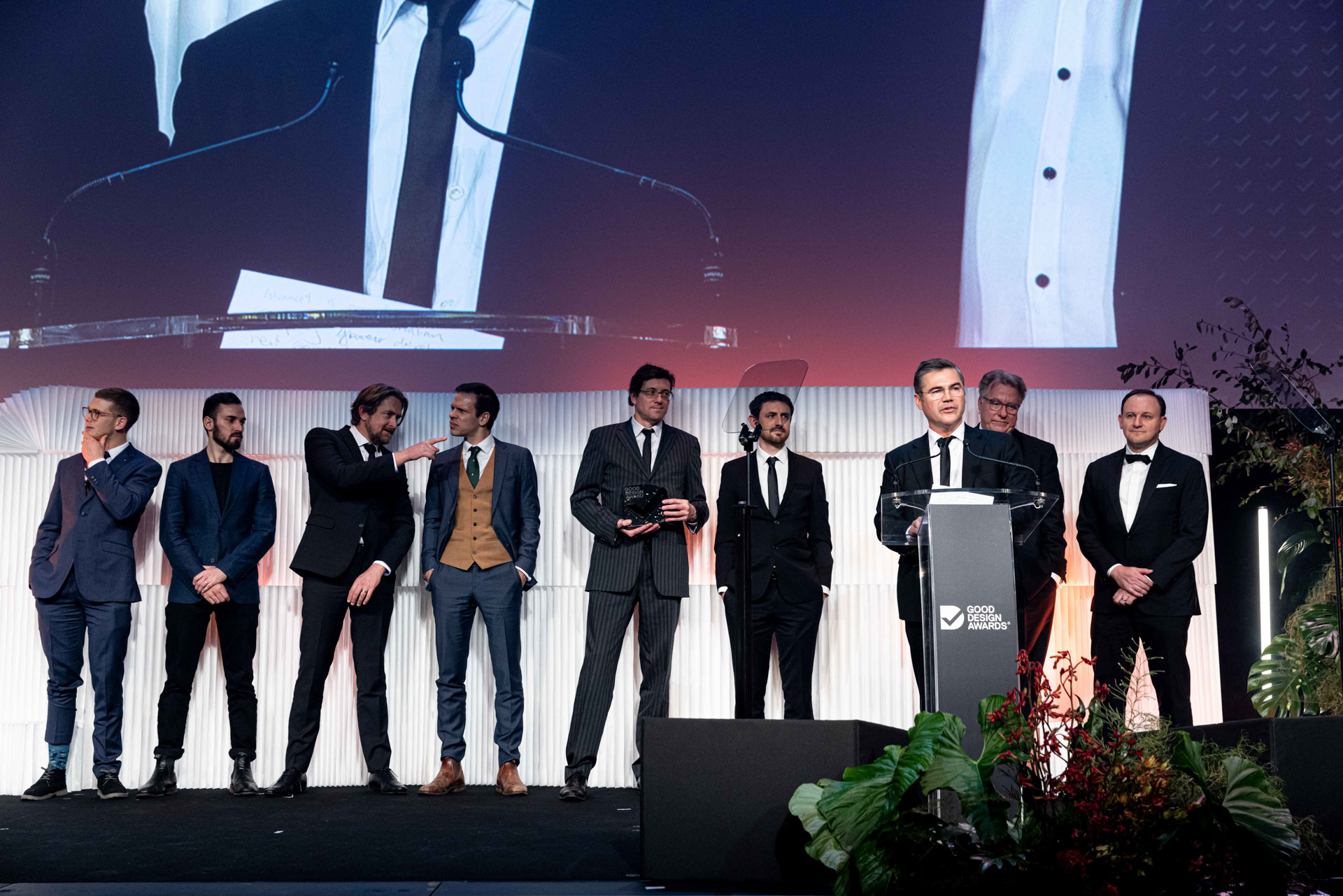
On a stage in Sydney in September 2022, Andrew Adamovich stood at a lectern while a collection of designers and colleagues gathered around an award. The object that had brought them there was an isotope generator. It had won the Australian Good Design Award of the Year. For a founder whose first professional address had been in Hong Kong finance, this was a rather different sort of closing ceremony.
The photograph makes a useful introduction. Adamovich has the microphone, but he shares the stage. AdvanCell, the company he founded in 2019, had worked with Design + Industry to turn a scientific idea into a physical product. The result had components, controls and a manufacturing problem to solve. A presentation could describe it. Someone still had to build it.
That distance between an idea and an object runs through his career. He has been an investor, a shareholder, a director and a chief executive. His work has crossed Hong Kong, Shanghai and Australia, with businesses ranging from radio advertising to managed technology services. By the beginning of 2026, he had added another entry: founder who hands over the chief executive's job and stays to work on the next chapter.
A Berkeley degree, then Hong Kong
Adamovich studied at the University of California, Berkeley, earning a Bachelor of Arts. His education also includes Phillips Academy in Andover, Massachusetts. The Berkeley years, listed as 1992 to 1997, contain a small detail that is more enjoyable than the usual executive biography: UC Jazz appears among his activities. It is a welcome bit of music in a document otherwise full of companies.
His professional career began at Peregrine Investments in Hong Kong in 1997. Roles at Zurich Centre Group and Equity Partners Asia followed. These were the early entries in a career that would involve evaluating companies and taking places on their boards. Long before AdvanCell, his working life already connected several markets.
Riverland Capital gave that career a vehicle of his own. A founder and director of the private investment firm, he led investment activity focused on China. The practical vocabulary was investment, expansion and ownership. The firm worked across Hong Kong and China, looking at businesses with operations to grow rather than simply ideas to admire.
A 2009 introduction to Riverland described a team involved in originating, executing and managing growth investments in China. Adamovich and Alan Ng were its named representatives. The firm handled Asian direct investment for the Italian group CIR as well as Hong Kong and US groups. Even at this stage, his business map stretched well beyond a single national market.
A sequence of documented connections, not a complete residential history.
The boardroom years count
Some careers become easier to understand when the less glamorous jobs are left in. Adamovich's includes recruitment company Ambition Group, where he served as a non-executive director. In 2011 he was a member of both the audit and remuneration committees. It is the sort of detail that rarely makes a founder's opening slide, although companies have a habit of needing both.
His directorships also included Hostworks Group and Yuan Chuan Radio. Hostworks, an Australian listed business, was sold to Broadcast Australia. Yuan Chuan Radio was sold to Shanghai-listed Orient Securities. He was a director and shareholder in each. These are distinct businesses, joined in his biography by the work of ownership and corporate transactions.
G2 Therapies and CGI Glass Lewis add further dimensions to the record. The latter is the Australian affiliate of the corporate governance advisory firm Glass Lewis. Across these appointments, Adamovich's career sits close to the machinery by which organisations are financed, supervised and sold. There is plenty of machinery before the actual machine arrives.
Read this way, his move into founding AdvanCell has a recognisable commercial background. He had spent years around companies and their investors. What changed in 2019 was the enterprise at the centre of his working life. AdvanCell made him responsible for building a company around a technology, with all the cooperation that such an undertaking requires.
The founder, the scientist and the designers
Adamovich has credited chief nuclear scientist Julian Kelly with the insight from which AdvanCell arose: a new method of producing an isotope. That allocation of credit matters. The scientific idea belonged to a named scientist; bringing a generator into existence involved a company, shareholders, public support and a specialist design team. The story has several working parts, much like the product.
Design + Industry worked with AdvanCell on the generator's development in New South Wales. In his account of the project, Adamovich described a period of less than twelve months to design and build the generator and produce its first isotope. The timetable gives the award photograph some context. The people on stage had a piece of completed work behind them.
His thanks were specific. He credited the design team's hard work and ingenuity. On the engineering side, the project included custom circuit boards, microprocessor firmware and the integration of several subassemblies. These are useful antidotes to the vague verb “innovate”. A circuit board has the considerable advantage of requiring an actual circuit.
“I would like to thank the entire Design and Industry team”
Andrew Adamovich · September 2022
The recognition continued. The generator received a Red Dot Design Award in 2023. Its design brought complex technology into a transportable device, with intuitive controls and a restrained appearance. A white finish and stainless steel gave it a composed exterior. Behind that exterior lay the decidedly less photogenic work of making the parts function together.
After the trophy, make it smaller
An award is an agreeable place to pause a story. Product development has other ideas. In 2024, the next generation of the generator received a Good Design Gold Award in Product Design and an award in Engineering Design. The company was designing and assembling generators at its 40,000-square-foot Brisbane facility. The work had acquired a larger address.
The next design brief concerned space. More units needed to fit into a defined manufacturing environment. That meant reducing the footprint, rearranging internal components and developing a modular, stackable configuration. Access for servicing mattered too. The device needed to fit the workplace around it, an unromantic requirement with a considerable influence on whether a product can be used efficiently.
Front and side panels allowed maintenance access. Modules could be maintained or replaced independently. These details make the collaboration between an investor-founder and industrial designers more concrete. The ambition had to pass through the dimensions of a cabinet and the hands of the people servicing it. Even an impressive company vision must eventually agree with a tape measure.
Award of the Year
Design Award
and Engineering recognition
A new name on the CEO's door
In February 2025, AdvanCell announced a US$112 million Series C financing. SV Health Investors, Sanofi Ventures, Abingworth and SymBiosis co-led the round. Existing backer Morningside participated alongside other investors. For Adamovich, who had spent an earlier part of his career investing in businesses, the company was now the organisation asking others to back its plans.
The next consequential change concerned leadership. In November 2025, AdvanCell announced that Philina Lee would become chief executive on January 1, 2026, based near Boston and Cambridge, Massachusetts. Adamovich would continue as Managing Director, Australia, and remain a board member. The founder's responsibilities were changing as the company expanded its American presence.
Lee arrived from Blueprint Medicines, where she had been chief commercial officer. Her appointment put a different executive background at the head of AdvanCell. Adamovich publicly welcomed the move and linked it to an American hub alongside continuing innovation in Australia. The arrangement gave the company's next phase two clear geographic points of reference.
There is a temptation to treat the CEO title as the entire plot of a founder's life. This transition offers a more interesting ending to that particular chapter. Adamovich stayed in management and on the board. His new title identifies a place as well as a responsibility. Australia remains an explicit part of the organisational structure he helped establish.
More room for the next chapter
By June 2026, the American expansion had an address and a floor area. AdvanCell announced a lease for a 128,000-square-foot facility in Andover, Greater Boston, intended to house its US global headquarters and future manufacturing centre. The plan complemented its established Australian operations. For someone educated at Phillips Academy in Andover, the town's appearance in the company story is a pleasing geographic rhyme.
In July, AdvanCell closed a US$315 million Series D financing led by Ally Bridge Group and co-led by Alpha Wave. New and existing investors took part. This was the company continuing to grow after its founder's change of role. The round funded its next stage, including expansion of manufacturing infrastructure.
Adamovich's story now contains both the act of starting and the act of continuing under a different title. The years in investment, the shared awards stage and the Australian managing directorship belong to the same career. At the lectern in 2022, the founder stood beside the people who had helped turn an idea into something tangible. Four years later, there are more people, more places and more company to build.