The first clue was the missed visit. At CWPS, a Washington-area IT services business, engineers were being scheduled with spreadsheets and email. Customers complained. One week’s spreadsheet did not reliably agree with the next. The company had people capable of doing the work, yet the machinery for getting them to it was letting everybody down.
George Estrada, its chief technology officer, wanted visits connected to the customer record in Salesforce. CWPS adopted Skedulo, and the company’s published case study reports a rollout in roughly three weeks and annual savings of $170,000. Recovered engineering hours were part of the explanation. A schedule had been quietly consuming resources; making it usable gave some of them back.
- The job: match people to work, then get the instructions onto their phones.
- The buyers: organizations juggling skills, locations, appointments and changing availability.
- The distinction: configurable workforce operations that connect to existing business systems.
- The lesson: investigate lost capacity before assuming every shortage needs another hire.
That is an unexpectedly interesting proposition for a scheduling company. The calendar, usually treated as the least glamorous object in the office, becomes a way to inspect the business. Skedulo sells software for the people who arrange work and the people who perform it away from a desk. Its subject is the distance between an appointment being booked and a promise being kept.

The earlier idea that led to a better question
Skedulo was founded in Australia in 2013 by Matt Fairhurst and James Davies. In a 2019 interview, Fairhurst described an earlier technology product that had been poorly received. It nevertheless gave the pair access to conversations with hundreds of companies across Australia and the United States. Again and again, employers were organizing mobile work with spreadsheets, whiteboards and aging internal tools.
The useful discovery was a recurring inconvenience with a buyer attached. Workers increasingly carried smartphones, while the office was still trying to coordinate them through systems that did not travel particularly well. Fairhurst was selling to American customers from Brisbane, working through the night. Eventually that arrangement became unsustainable, and he moved to the United States.
There is a founder lesson here, although it comes without the customary trumpet solo. A disappointing product can still buy an education. The valuable residue is the account of a customer’s working day: where information disappears, who has to wait, and what happens when the person with the spreadsheet takes a holiday.

An empty square is not enough
Consider a home-health appointment. An available clinician may live too far away, lack the necessary specialty or be unable to sustain the relationship over the coming months. Availability is merely the first question. Qualifications, travel, preferences and business rules follow it into the room.
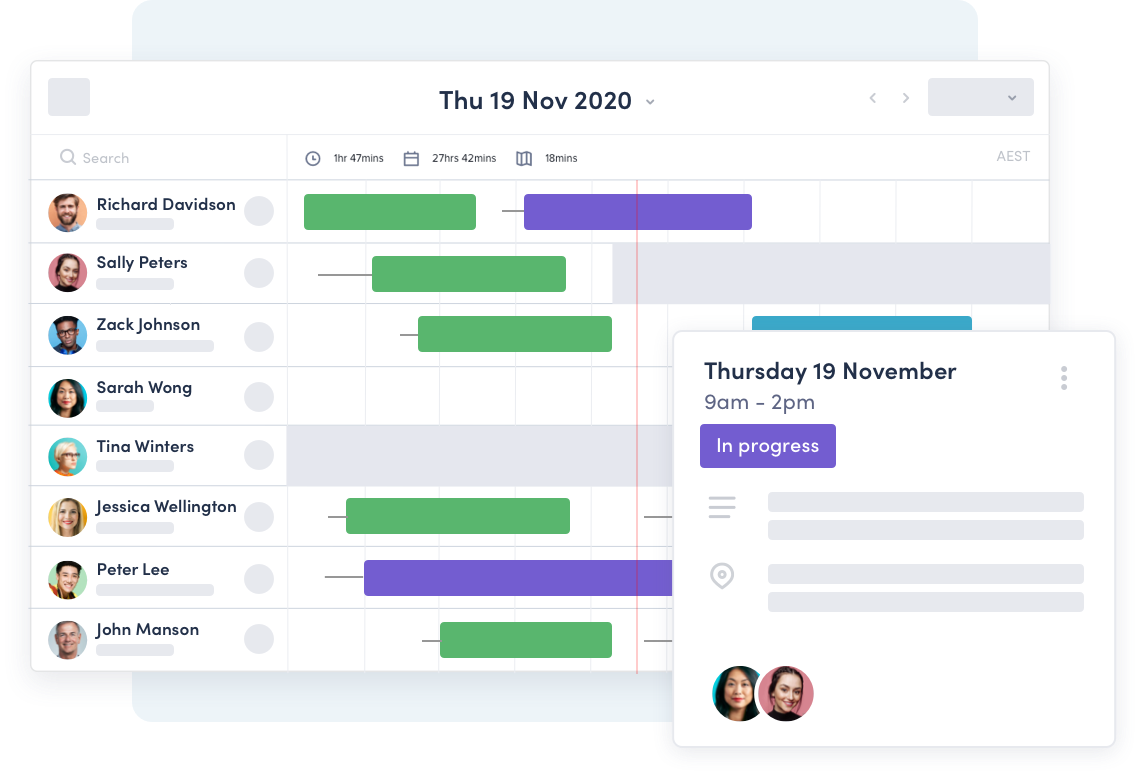
Skedulo’s scheduling tools match available, qualified workers to job requirements. Dispatch connects that plan to the field. The accompanying mobile experience carries job information and lets workers record what happened. The company also offers shifts and rostering for fixed locations, messaging, virtual meetings and analytics. The common thread is coordination across a working day, including work that does not involve repairing equipment.
The Pulse platform, introduced in 2022, gives this work a configurable foundation. It supports business rules, integrations and developer tools. The strategic question is how much recurring complexity can be handled as standard software, leaving customers to customize what truly differs. A platform earns its keep when an unusual workflow can be accommodated without making every upgrade an archaeological expedition.
When scheduling becomes a care decision
Solace Pediatric Home Healthcare supplies a particularly human example. Its previous scheduling product left important matching decisions dependent on email and individual workarounds. It needed to bring clinicians’ skills, geography and availability together, while preserving continuity for families. A poor initial match could mean a long journey and, eventually, a change of therapist.
The published case study describes weekly schedules and appointment reminders reaching families, alongside better communication with clinicians. It reports an 84% reduction in patient no-shows within one quarter of using Skedulo. That result belongs to this implementation; it is not a promise to every buyer.
“The EHR tells us what we did. Skedulo tells us what our potential is”
Darcie Peacock, Solace CEO
Peacock’s distinction is useful. A record of completed work answers one question. A view of workable capacity answers another. For an organization deciding where to recruit, the pattern of openings can be more informative than an undifferentiated complaint that everyone is busy.
The trainers and the solar advisors
The American Red Cross Training Services case describes instructor information scattered across spreadsheets, email and calendars, with course requirements held in a learning system and customer information split elsewhere. Regional scheduling existed; a national view did not. Bringing those pieces together through Skedulo and Salesforce addressed the coordination problem. The case reports a 30% reduction in scheduling cost and 31% less resource underutilization.
Sunrun offers a less obvious version of deskless work. Its story concerns solar advisors staffing retail locations. Managers needed to know who was scheduled and whether they had checked in. Attendance mattered to retail relationships; visibility also helped the business examine staffing and performance by location. The important unit was a person at a store, rather than a technician traveling to a repair.
These examples explain Skedulo’s position more clearly than a category label does. It works across healthcare, nonprofit operations and commercial field work because the same scheduling questions recur in different uniforms. The difficult part is retaining each organization’s rules while keeping the underlying process intelligible.
The phone has to finish the job
Skedulo Plus launched in October 2023. The mobile app lets workers access job details, accept or decline offers according to their organization’s process, add notes and collect signatures. Current documentation identifies Plus as the supported mobile app and lists the earlier versions as deprecated.
That matters because the dispatcher’s beautiful plan is only half the product. A worker needs useful instructions in the moment and a manageable way to return information. Otherwise the office’s new system can become the field team’s extra chore.
In November 2024, Skedulo introduced a command-line interface and bulk scheduling actions. September 2025 Salesforce package notes describe quieter improvements, including date validation and resource-tag fields. By 2026, its website markets four AI agents covering dispatch, configuration, mobile workflow building and development. Those are vendor claims about capabilities, and buyers should test them against their own rules and exceptions.
What the recovered hour costs
Skedulo’s pricing page describes per-user rates, minimum licenses and volume pricing, with quotes supplied by sales. It offers consulting and implementation services, and its FAQ says it does not accept monthly billing. A purchase therefore needs a view of the software commitment and the work of fitting it into existing operations.
The company financed its expansion with a $9.2 million Series A in 2016, a $28 million Series B led by Microsoft’s M12 in 2019, and a $75 million Series C led by SoftBank Vision Fund 2 in 2021. In 2021 it also placed at No. 1,350 on the Inc. 5000. Those milestones establish backing and growth history; a buyer still has to establish suitability.
Salesforce Field Service is an overlapping alternative, offering scheduling, routing and mobile tools. Skedulo’s proposition includes a Salesforce-native offering and an independent platform, with configurable workflows for varied deskless operations. Its case rests on that combination. Scheduling intelligence alone does not settle the comparison.
The copyable practice is straightforward: map the constraints, connect the records, and count what changes. Track missed visits, scheduling effort, travel and usable capacity. Start with a workflow whose pain is visible. As an operational inference, the case becomes weaker when schedules are simple, input data is unreliable or workers cannot adopt the new process. An algorithm cannot make an outdated qualification current.
At its most persuasive, Skedulo gives an organization a more exact account of its day. The supposedly empty spaces become visible: a journey, a delay, an unfilled slot, an unanswered message. Once they can be examined together, the next conversation about growth becomes a little less guesswork.
See the work for yourself
Explore the product, follow the company, or watch its tools in use.