Sirbuland Atlas has a question for the impressive demonstration: what happens next? When a discussion turned to an AI agent that could carry out tasks on websites, he wanted to know how it would handle unexpected user inputs and different site structures. The applause could wait. Somewhere beyond the demonstration was an awkwardly arranged web page, and somebody would eventually have to make the software work on it.
It is a revealing place to begin with the co-founder and CEO of Visnext Software Solutions. Atlas works in a business where technological possibility must survive the less theatrical business of implementation. A feature can look elegant on a slide. Putting it into somebody else's working day introduces dependencies, exceptions and people who have quite reasonably forgotten their passwords.
His public conversations about AI return to that distance between promise and use. He asks where ordinary code should remain in charge, what people are learning, and whether a team has changed the way it delivers. Taken together, those questions offer a portrait of a software founder interested in the machinery behind the performance.
The engineer behind the questions
Atlas studied at the University of the Punjab in Lahore between 2011 and 2015, graduating with honors in computer science. His listed coursework includes algorithms and artificial intelligence. Those subjects offer an early point on a career that now encompasses running a software company and a technology leadership role at NV Global.
His professional history also includes founding ViSales BPO and working as a full stack engineer at myHouseby Innovations before his recorded start as Visnext's co-founder and CEO in July 2020. These roles put business ownership and software development alongside each other. There is a useful difference between understanding what a program does and understanding why someone will pay for it.
Today, his LinkedIn profile places him in Prince Frederick, Maryland. The University of the Punjab remains part of his professional identity, while Visnext connects his work to a software business with an international client base. His career sits across those settings without requiring a tidy story about leaving one world behind.
University of the Punjab
Visnext co-founder & CEO
CXO mentor lineup
The spreadsheet arrives at the meeting
In a discussion about the practical difficulties of adopting AI, Atlas described a familiar collision: enthusiasm arriving before the supporting infrastructure. He recalled companies discovering that they needed structured data. The excitement was already in the room; the information needed to support it had yet to be put in order.
This is a particularly useful detail because it gives the implementation problem a shape. A company can buy access to a tool quickly. Preparing the material that makes it useful asks different things of the organization. Someone must understand the information, organize it and decide whether it is suitable for the job.
Atlas's observation makes an otherwise abstract technology conversation rather domestic. Before the clever system can perform its clever task, somebody has to tidy up. The office spreadsheet, after years of being treated as furniture, suddenly has a speaking part.
His point also changes the meaning of readiness. An enthusiastic buyer and a capable model are only two participants in the process. The surrounding systems matter. In his account, the obstacle appears precisely when the sales conversation gives way to the work of putting the system into operation.
Where ordinary code keeps its job
Responding to a discussion of combining deterministic code with AI, Atlas asked how the author decided which parts of a workflow should stay deterministic and which should become AI driven. It was a question about allocation: where should each kind of software do the work?
The distinction matters to the portrait. Atlas was engaging with a hybrid approach rather than treating every existing interaction as a candidate for replacement. He wanted to understand the decision behind the architecture. Asking where to draw that boundary leaves room for both conventional software and the newer capabilities.
There is also something pleasingly unglamorous about the question. The public debate can get occupied with the fate of entire industries. His response goes down a level, toward the workflow, where an engineer has to assign responsibilities and live with the consequences. Even a large technological change arrives at a desk as a series of smaller choices.
“I use it, but I don’t rely on it blindly.”
Sirbuland Atlas, discussing AI
In another exchange, about explaining AI to people unfamiliar with it, he used predictive text as an analogy. He emphasized the system's pattern based guesses and the possibility of mistakes. The sentence above captures the stance neatly: active use accompanied by judgment.
That is an accessible way to enter a complicated subject. It gives a listener permission to use the tool while continuing to question its output. The explanation makes room for curiosity without asking the audience to suspend its common sense at the door.
The question changes with the customer
Atlas's interests also reach into specific businesses. When Kevin Walker described an event for law firm associates about AI, Atlas asked which application had been most exciting for the associates. The question sought an example of use. A gathering about transformation became an opportunity to ask what people actually found helpful.
In a separate conversation about financing racquet sport infrastructure, he raised the possibility of using AI agents more deeply in underwriting. He suggested examining ongoing signals such as court utilization, revenue consistency and local demand. His comment explored an application of the technology; it was a proposal in a public discussion, rather than a claim to have built that system.
These are different commercial settings, with different decisions to make. The recurring interest is in the work itself: what information could be useful, where it would enter a process, and how a person might act on it. Atlas's questions become more specific as the business context becomes clearer.
Is the data
ready?
Where does AI
belong?
Can the team
deliver?
Learning has to leave the classroom
When a post discussed free AI training, Atlas argued that access was giving way to capability as the important distinction. He put the emphasis on learning through building. That choice of emphasis moves the conversation from getting a tool to developing the ability to do something useful with it.
Access is easy to display. A finished piece of work asks more demanding questions. Does it function? Does the builder understand what happened? Can the result be adapted? His comment points toward experience gained by making things, including the inconvenient parts that do not fit into a short demonstration.
In a discussion of AI coding fluency, he made a related argument about teams. The meaningful test of an AI first approach, he suggested, was whether it changed building, decision making and the delivery of value. Counting uses of a tool would tell only part of that story.
Read alongside the training comment, this presents learning as something that should become visible in practice. A team can adopt the vocabulary immediately. Changing the way it works is a more substantial undertaking, and the results have to travel beyond the person who first tried the software.
A room full of other people's businesses
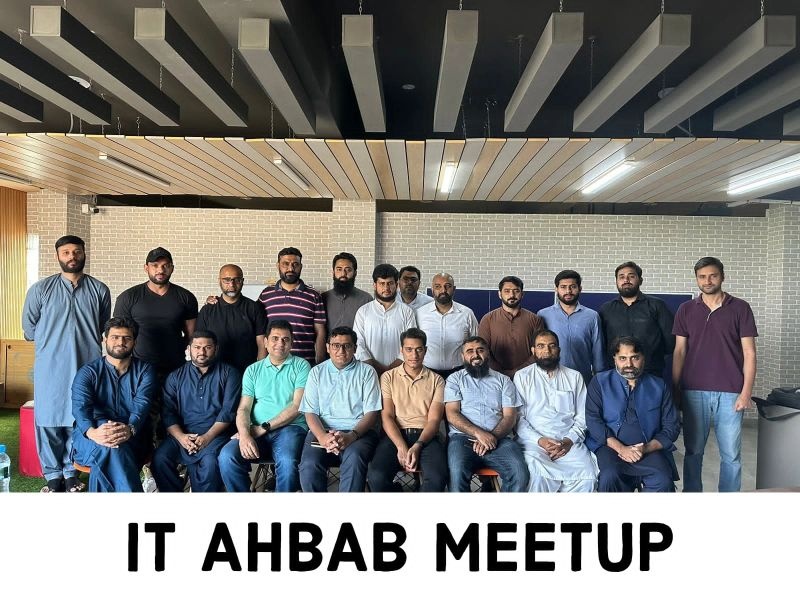
There is an in person counterpart to these online exchanges. In May 2024, Umaid Ashraf thanked Visnext and Atlas for hosting the second IT Ahbab meetup. Its agenda was business development. The group photograph offers a different setting for the same broad professional concern: people in technology getting together to discuss how business gets done.
In 2026, P@SHA named Atlas among the mentors for its CXO Mentorship Program. Other names in the lineup included leaders associated with iSkills, TEO International, InfoTech Group and DPL. The announcement places him in a peer network concerned with leadership and professional development in Pakistan's technology industry.
NV Global also lists him as CTO in Residence. Its description of his work includes technology strategy and engineering leadership, with an emphasis on scalable systems and collaboration. Alongside his Visnext responsibilities, this adds another setting in which technical choices meet the needs of a business.
At Visnext, his CEO message emphasizes developing the workforce and keeping technical skills current. Set beside the meetup, mentoring appointment and public interest in learning, the message supplies a consistent professional concern: the people doing the work need opportunities to become better at it.
These are responsibilities that sit naturally together in a software business. Developing a system requires decisions about architecture. Developing the team requires decisions about how people learn, collaborate and take responsibility for the result. Atlas’s public activity gives both subjects space. A meetup about business development and a conversation about engineering capability belong in the same professional picture.
The question after the demonstration is therefore larger than whether the software runs. It includes the information behind it, the decisions around it and the people expected to use it. Atlas keeps returning to those practical details. They may be less photogenic than a launch. They are also where a promising idea begins to acquire a working life.