Consider the engineer trying to improve a power transistor. Change a trench. Adjust the dose of an implanted material. Alter the heat treatment. Each choice may improve one characteristic and spoil another. The troublesome question is which experiment deserves a trip through the factory. Silvaco has built a business around giving that question a cheaper first hearing.
- Victory TCAD simulates how semiconductor structures are made and how they behave.
- Its circuit tools and licensed chip designs carry the work further toward a finished product.
- Micron helped develop FTCO, which trains digital twins using physics and manufacturing data.
- A 2025 loss and a 2026 recovery make financial discipline part of the story, too.
The company occupies a peculiar corner of technology. Consumers will almost never encounter its name on a box. Engineers may encounter it before there is anything to put in a box. Its customers work on memory, power electronics, displays, image sensors and photonics, where the difference between a useful device and an expensive disappointment can hide inside a structure too small to inspect casually.
01 Give the mistake somewhere cheaper to happen
Silvaco’s starting point is technology computer-aided design, or TCAD. Victory Process rehearses fabrication: etching, deposition, implantation, diffusion and oxidation. It produces a virtual semiconductor structure. Victory Device then asks how that structure behaves electrically, with additional capabilities for heat, light and radiation. One tool examines the recipe; the other examines the consequences.
This distinction matters. A measured current-voltage curve can reveal that a device breaks down. A physics simulation can help locate the region where breakdown starts and explain the mechanism. Engineers can vary geometry, materials and operating conditions, then compare the results. The screen becomes a place to test an explanation before asking the fabrication line to test it.
The promise has practical witnesses. In Silvaco’s customer accounts, Teledyne e2v describes comparing image-sensor pixel structures before production. SemiQ says oxidation simulation and support tailored to power devices helped it adopt new capabilities and replace its existing tools. These are particular engineering decisions, which makes them more useful than a sweeping claim that software will save everyone money.
“we were able to convert a theoretical idea into actual working material”
David Jauregui, CTO and co-founder, iDEAL Semiconductor
Jauregui’s description of work with Victory TCAD supplies the small drama at the heart of this business: an idea becomes something manufacturable. Silvaco sells part of the machinery for getting between the two.
02 Micron gives the virtual wafer an education
The next question is speed. A detailed physics simulation is useful, but engineers also want to explore many possible changes. Silvaco’s answer is Fab Technology Co-Optimization, or FTCO. A TCAD engineer combines simulation and experimental data to train a nonlinear model. The resulting digital twin can expose relationships between process settings and device or circuit outcomes.
Think of the training as an education in a particular manufacturing process. Once trained, the model offers a faster way to examine choices. Silvaco’s published examples include exploring how implantation doses influence a transistor’s threshold voltage, finding settings for a target characteristic, and estimating how variation in oxide thickness affects distributions of device measurements.
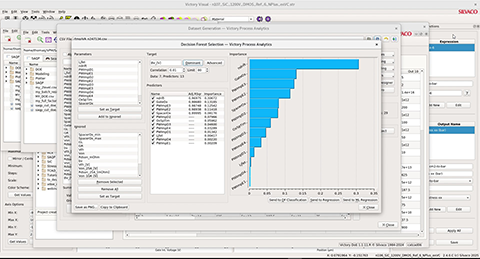
Micron provides the concrete case. The collaboration uses production data and physics simulation, including etching, deposition and mechanical stress, to develop models for memory technology. The intended audience extends beyond specialist TCAD engineers: a trained model can make an established body of simulation work easier for other process and design engineers to interrogate.
In April 2024, Micron invested $5 million through a convertible note and expanded its license and support relationship with Silvaco. By August 2026, Silvaco reported closing another $10 million Micron investment through a convertible note. Investment is no substitute for a controlled performance study, but it is a meaningful commitment from the customer helping develop the product.
There is a lesson worth borrowing here. First build the reference work. Then build the shortcut. An engineer evaluating this approach should check the underlying physics against measurements and keep new queries within a defensible training range. Those are engineering inferences from how the model is built. Sparse data, an unfamiliar material or a process change outside that range can make a confident-looking answer a poor guide to a real wafer.
03 The transistor still needs a circuit
Silvaco’s portfolio continues beyond device physics. SmartSpice simulates circuits. Gateway captures schematics, and SmartView helps inspect waveforms. Other tools cover layout, verification, parasitic extraction and library work. Parasitics are the electrical effects of the physical connections themselves, the little resistances and capacitances that can turn a tidy schematic into a less tidy result.
The company also licenses semiconductor intellectual property: reusable designs such as standard cells, memory compilers and interfaces. Customers can incorporate those blocks into a larger chip rather than design every component afresh. Modeling and library services supply additional engineering help. Software licenses, IP royalties, maintenance and services all contribute to the business.
That breadth gives Silvaco several doors into a customer’s workflow. A foundry may care about process development; a fabless designer about a circuit or an interface block; a university about device research. It also creates a demanding sales job. The product has to suit the customer’s material, design flow and existing tools. A convincing demonstration is the beginning of qualification, not the end.
04 A specialist among very large neighbours
Silvaco was founded in 1984 by Ivan Pesic and Katherine Ngai-Pesic. Four decades later it completed an IPO of six million shares at $19 each, raising $114 million in gross proceeds. Katherine Ngai-Pesic remains chair of the board. The long history helps explain the accumulated expertise in materials, numerical solvers, device models and engineering support.
Its annual filing names Synopsys, Siemens EDA and Cadence as frequent competitors. Silvaco’s positioning rests on specialist capabilities and customer-specific engineering rather than sheer portfolio size. The published customer accounts illustrate the distinction: an oxidation model, a reliable extraction flow, or scripting that helps port a design can be the reason a buyer changes tools.
It would be a mistake to treat the company as one universal alternative to every EDA product. Competition depends on the job. A tool for simulating a silicon-carbide power device answers a different question from a tool for laying out a digital chip. Silvaco’s appeal is strongest when its physics, circuit capabilities or IP match the problem on the engineer’s desk.
05 Buying breadth, then paying attention to the bill
In 2025, Silvaco added Tech-X’s multiphysics simulation software and bought Cadence’s Process Proximity Compensation product line. It also acquired Mixel, a connectivity-IP business, for $22.5 million in cash and shares. The additions widened the company’s reach into plasma and photonics simulation, manufacturing correction and mixed-signal connectivity.
The financial results were less comfortable. In 2025, revenue reached $63.1 million, up 6%, while the GAAP net loss widened to $41.2 million. TCAD revenue fell 25%; EDA and semiconductor IP grew. Those numbers describe a mixed year, and the acquisitions make it particularly unwise to read the total revenue increase as a clean measure of organic momentum.
Revenue rose 6%. TCAD revenue fell 25%. A broader portfolio came with a difficult year.

Rhines, formerly CEO of Mentor Graphics, arrived in August 2025. Silvaco subsequently introduced voluntary departure programs, an involuntary workforce reduction and planned site closures. This is the documented change in direction. The record supports a shift toward cost control; it does not require an invented boardroom epiphany.
By Q2 2026, revenue was $17.8 million, up 48% year over year. Non-GAAP operating income was $0.6 million. The GAAP operating loss was still $4 million. Improvement deserves its proper name, and so does the remaining loss. The two measures answer different accounting questions.
06 More computing, more connected physics
The newer partnerships address two limits on virtual experimentation. Computing can be slow, and useful information can be stranded between models. In July 2026, Silvaco announced a collaboration with NVIDIA covering accelerated simulation, AI surrogate models and digital-twin workflows.
One reported proof point was specific enough to examine: a three-dimensional photonic edge-coupler simulation with 3.2 billion mesh nodes, run on 32 NVIDIA GPUs in under four hours. Silvaco said that workload did not converge on CPUs and that the simulation differed from measurement by less than 0.15 dB. It is a company-reported result for one workload, with a disclosed hardware commitment, not a speed guarantee for every customer.
In August, a Dassault Systèmes partnership proposed connecting equipment-scale plasma simulation, Silvaco’s feature-scale process modeling and structural analysis. That would let engineers study how chamber conditions affect wafer features and how resulting structures behave mechanically. The interfaces and workflows are announced development plans; their ambition should not be mistaken for a finished installation.
For a buyer, the useful starting point remains modest: choose a device and a fabrication question, compare the model with measured behavior, and ask which physical experiments it can credibly replace or narrow. Silvaco’s attraction lies in the ability to make that loop repeatable. In semiconductor development, a well-rehearsed mistake can be a surprisingly valuable product.
Take the experiment further
Silvaco website · Company news · Victory TCAD Lab · 2025 TCAD release
Watch / learn