The tidy version of a corporate rebrand arrives in a launch video. The new name glides onto the screen. A logo resolves. Someone has chosen a hopeful verb. Everybody applauds, then wanders back to a desk where the old company name still lives in a dozen browser tabs, three contracts and the muscle memory of every customer call. Shoma Sarkar Thomas knows the untidy version. In 2018, after Kinnser Software had been acquired by Mediware, she helped gather more than 30 healthcare and community-care brands beneath a single new identity: WellSky. The public reveal came less than 11 months after she joined the combined organization. The calendar was brisk. The human problem was not.
Thirty brands mean thirty sets of loyal customers, familiar phrases, product histories and office allegiances. A name may be retired by executive decision; affection is less obedient. Thomas's assignment was to make one company visible without pretending its many parts had never existed. The work joined marketing to management. It asked the same question at several scales: What can everyone here honestly say together?
That question became the hinge of her career. Thomas had led marketing and strategic growth at Austin-based Kinnser, a software company serving home-based care providers. After the 2017 acquisition, she moved into the larger enterprise and became chief marketing officer. Her remit now spans marketing strategy across WellSky's products, plus the brand, public relations, communications and strategic marketing. In other words, she is responsible for both the promise and the many places where the promise can wobble.
A corporate name with a job to do
WellSky had to be broad enough for businesses that served different corners of care and specific enough to mean something. The name also needed to travel internally. Ragan's account of the work credits Thomas with helping rally more than 1,500 employees around a shared mission and vision. That figure makes the launch sound like a communications triumph, which it was. It also reveals the deeper task: people had to recognize themselves in a company that did not exist, by that name, a few months earlier.
Marketing language likes transformation because the word photographs well. Actual transformation is full of spreadsheets. There are websites to redirect, presentations to rewrite, signs to replace, sales teams to prepare and customers to reassure. Every acquired business brings its own vocabulary, and vocabulary is where corporate archaeology hides. One group says client, another says provider. One sells a platform, another a solution. The new brand needs room for all of them without becoming beige.
Thomas's academic background provides an intriguing prelude. At the University of Virginia, she studied economics and international relations, graduating in 2004. Economics asks how value moves through systems. International relations asks how parties with different histories and interests can coexist. Neither degree is a literal manual for consolidating software brands, but together they form a remarkably useful pair of lenses for the work she eventually took on.
“If you don't love what you're doing AND who you're doing it with, you're doing it wrong.”Shoma Sarkar Thomas
Her public comments repeatedly return to the second half of that sentence. After WellSky's seventh CareForum, held in Denver, Thomas wrote about an event that had welcomed more than 1,000 clients, prospects, partners and employees. She praised the set design, the speakers and the people who built the gathering. Then she named members of her marketing leadership team, one after another, and said she learned from them every day. Corporate social media usually squeezes a crowd into the word “team.” Thomas made room for the names.
The launch was the prologue
A lesser profile might end with the new logo. Thomas stayed for the longer and less cinematic part: making the identity durable. WellSky expanded, its annual customer gathering continued and the company kept asking a single brand to carry a broad catalog of software and services. Her role placed her near the seam between product complexity and public comprehension. Every product team wants precision. Every company story needs shape. The CMO must honor the first without losing the second.
The work earned notice. Becker's Hospital Review placed Thomas among its 2019 list of 66 healthcare leaders under 40, pointing to the speed and scale of the WellSky rebrand. PRNEWS recognized her in its 2019 Top Women in Healthcare program. Ragan named her a Trailblazer honoree in 2020, highlighting the brand consolidation, employee alignment and educational resources created for professionals. Women We Admire included her among its Top 50 Women Leaders in Technology in both 2023 and 2024. Her LinkedIn profile also lists a 2023 finalist recognition in the leader category of Ragan's Top Women in Marketing.
One career, widening circles
The public milestones move from company integration toward industry recognition and community leadership.
Awards are useful punctuation, though they can flatten a career into a row of plaques. The more revealing continuity is Thomas's presence. She was there when the acquired company needed a common name. She was there when that name needed annual rituals and public proof. She was there when CareForum moved online in 2020, speaking about transformation during a period when every event producer was learning to build a stage out of browser windows. She joined a panel about care-transition technology that year, extending the marketing role into industry conversation.
A portfolio of rooms
Thomas's work outside the marketing department has a similar connective shape. As a board member of the WellSky Foundation, she helps guide a philanthropic mission centered on communities and the conditions that shape people's lives. The role turns corporate proximity into civic responsibility, especially in Austin, where she lives and where the foundation has partnered with local organizations.
She has also served as an advisor to the Miracle Foundation, an Austin-based international nonprofit supporting children and families. From 2019 through 2023, she mentored through Ceresa, a program created to address the women’s leadership gap. And as a member of TPG Capital's CMO council, she has shared marketing and communications experience with peers across industries. Boardroom, nonprofit, mentoring conversation, peer council: four different rooms, each asking a leader to listen before offering a point of view.
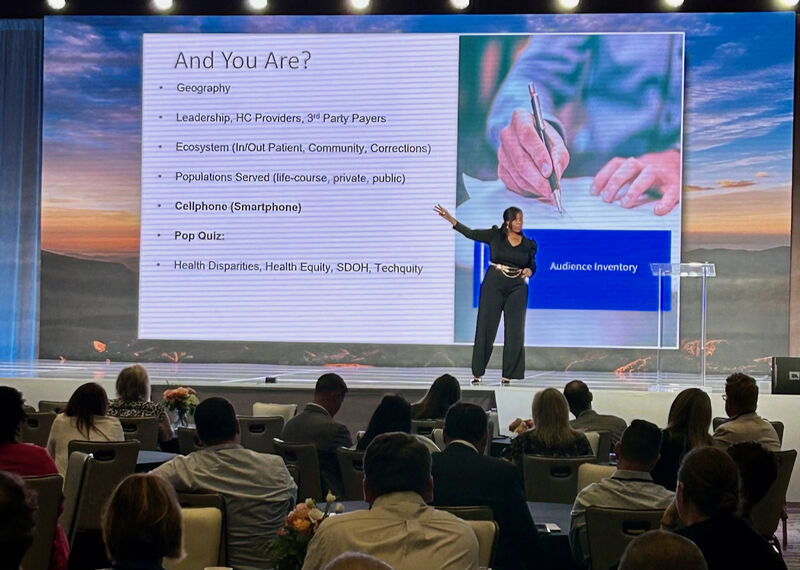
In March 2024, Thomas took another room: the keynote stage at the Greater Austin Association of Asian Engineers Women's Conference. She later described the Saturday as energizing, enlightening and inspiring. The organizers thanked her for helping make the conference a success. The appearance fitted the career she had built - technology, leadership, Austin and the advancement of women gathered under one roof.
Her online biography is compact. It does not supply an origin myth, a catalogue of childhood ambitions or a dramatic conversion to marketing. The public record begins where the work becomes visible. That sparseness is appropriate for an operator whose signature achievement involved subtraction. More than 30 names went in; one coherent identity came out.
The discipline of coherence
There is a temptation to describe marketing leaders as storytellers, a word so agreeable that it can mean almost anything. Thomas's record suggests a sterner craft. She is an editor of organizational reality. The raw material arrives from acquired companies, product road maps, executives, customers, employees and communities. Some pieces contradict each other. Some refuse to fit. The job is to find a form that remains truthful after the launch applause ends.
That is why the WellSky consolidation remains more interesting than its speed. Less than 11 months is a fine case-study statistic. The years after it are the proof. The name persisted. Thomas remained responsible for it. The company grew while keeping a public identity expansive enough to hold its range. A brand can be unveiled quickly, but coherence has to be renewed every time the organization changes.
Coherence also requires restraint. A broad software business can describe itself with a blizzard of capabilities, each one accurate and each one competing for the front of the sentence. The marketer's discipline is to decide what the listener needs first. Thomas has spent years working at that intersection: the engineers and operators know why every distinction matters; the audience needs a path through them. The result is less like simplifying a machine than drawing its map. Leave out too much and the map misleads. Put everything on it and nobody can find the road. WellSky's continued use of a single identity suggests that the original map left room for new routes.
Her own stated aspiration is equally concise: she is “dedicated to realizing care's potential.” It is corporate language, certainly, but her surrounding choices give it dimension. She has carried that idea through a commercial role, a foundation board, nonprofit advising, mentorship and public speaking. The phrase keeps meeting different audiences.
Thomas's career offers a modest lesson for any company that has mistaken a collection for an identity. The important question is not how many brands can fit beneath one logo. It is whether the people inside those brands can see a future in common. A good name can help. A patient operator makes it believable.