Shep Murray quit a job that required a tie and started a business selling them. It is an unusually tidy act of revenge against a dress code. The customers would keep going to the office. He and his younger brother, Ian, would go to Martha’s Vineyard, carrying neckwear decorated with reminders of everything an office could keep you from.
There were fish. There were Jeeps. There were island street signs. A small patch of silk could accommodate quite a lot of elsewhere. The proposition was perfectly intelligible to anyone who had ever sat through a meeting while thinking about a boat: wear the required uniform, but take a little holiday inside it.
That was 1998. The company became vineyard vines, with a smiling pink whale for a logo and a vocabulary of summer that eventually extended to shirts, shorts, dresses and children’s clothes. Murray’s story has acquired the polish of a well-told family anecdote. Underneath it remains a rather personal question. What happens when the career you are supposed to want leads to a life you would rather avoid?
The promotion he didn’t want
Murray grew up in Greenwich, Connecticut, with summers on Martha’s Vineyard. His parents, Stanley and Nancy, were travel writers. Travel was part of family life, but the island became the place to return to. That distinction matters. A travel writer’s child might build a business around constant departure. Murray built one around a familiar destination.
At Skidmore College, his interests wandered before his career did. He arrived considering music, thought about English, and settled on management and business, graduating in 1993. The introductory business course asked students to work together on a problem for a real company. It gave him a practical reason to value the freedom to think.
Then came advertising in New York, including a job at Young & Rubicam. A later recollection of being told to think inside the box reads like a gift from a screenwriter. Murray had been educated in a place whose motto was “Creative Thought Matters.” He also looked ahead at his boss’s position and found little to covet. The ladder was there. Its destination was the problem.
“I didn’t want my boss’ job.” His explanation has the economy of someone who has already done the calculation. Moving upward would have meant getting more of the life he disliked. In 1998, he and Ian left their jobs on the same day. The brothers financed their early business with credit cards. Freedom arrived with a repayment obligation.
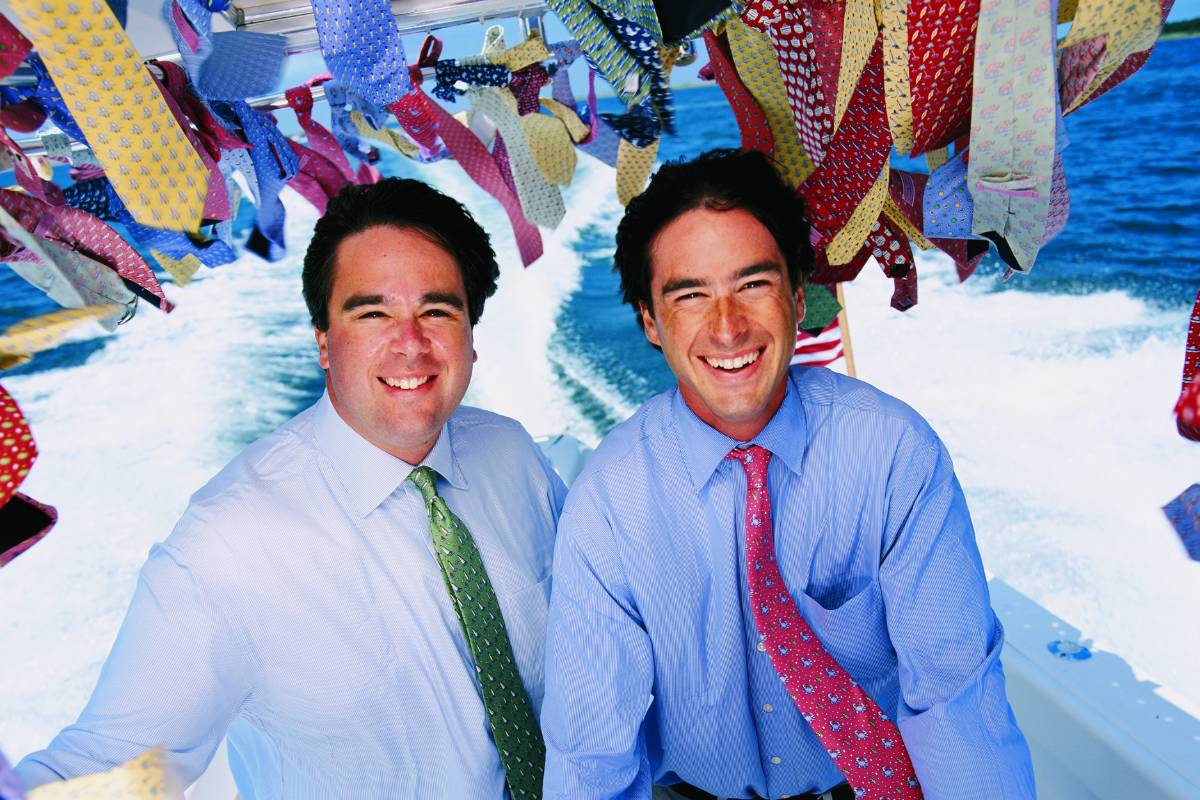
A holiday small enough to knot
The tie was an astute starting point for inexperienced apparel founders. It did not require a rack of trouser sizes. It could be bought repeatedly by the same customer. It was also an unusually visible piece of office clothing, sitting directly beneath the face. Put a private joke there and the wearer becomes its accomplice.
The early designs were scaled down so they could pass for conventional patterns from a distance. Up close, their loyalties were easier to read. The effect was more mischievous than a large declaration across a T-shirt. A tie could satisfy the occasion while registering a modest objection to spending the whole day indoors.
Murray and Ian sold from their Jeep and their boat, approaching shops and finding customers where they could. This was a small operation with a large amount of personal exposure. Every rejection reached the people who had designed the merchandise. Every sale could feel like a verdict on whether leaving their jobs had been sensible.
The first wholesale breakthrough came at The Fligors of Edgartown. Ian sold $1,800 worth of ties on consignment, then called Shep from a pay phone. A consignment order still needed to turn into purchases. Even so, for two new founders, somebody agreeing to give the ties shelf space was cause for celebration. An island shop had made their proposed future slightly less hypothetical.
The ties that needed an airplane
Before the business could become a souvenir of a lovely summer, it had to survive a distinctly unlovely delivery problem. On July 3, 1998, with launch orders being assembled, the brothers discovered that the red street-sign ties were missing. Shep had left them at the family home in Greenwich. An attractive design is of limited use to a shop when it is in another state.
Calls went out to people who might be able to help. A neighbor on the Vineyard, who was a pilot, offered to make the trip if Shep paid for fuel. The ties arrived at sunrise. The customer got the order. The founders got an early lesson in the distance between a brand promise and the work required to keep it.
The episode deserves its place in the company’s history because it interrupts the easy version of the tale. Leaving an office did not release Murray from responsibility. It moved responsibility closer. He could no longer hand a problem to another department. The department was his brother, waiting for the ties.
A whale from the family doorway
The pink whale has its own family connection. Stanley Murray carved wooden whales; one hung above the front door when the brothers were growing up. When they needed a logo, the animal linked something from home with the Vineyard’s whaling history. They gave it a smile.
The colors came from another familiar coastal pairing. Murray has connected the pink to the faded shade of Nantucket Reds sold by Murray’s Toggery Shop, and the navy to the polo shirt worn with them. A design that now travels on shopping bags and sweatshirts began with an accumulation of things the founders already knew.
That is part of the appeal of Murray as a business subject. He supplies objects, places and habits where a more abstract founder might supply terminology. A carved whale. A favorite island. Clothes seen on people nearby. The material has a past before it has a marketing budget. You can disagree with the aesthetic and still understand where it came from.
The pullover that refused to retire
Another object supplied another product. As a teenager skiing in the Alps in 1987, Murray bought a navy quarter-zip pullover. He kept wearing it as the elbows and seams wore out. By the time he had an apparel company of his own, he could do something about the impending loss of a favorite shirt.
In 2004, that attachment helped produce the Shep Shirt. The name is pleasingly literal. Instead of inventing a hypothetical customer and asking what that customer might need, Murray began with the item he had been reluctant to surrender. A wardrobe favorite became something other people could buy.
“I wanted something and I made it.” There is useful modesty in the description. It leaves room for the customer to decide whether the founder’s taste is worth sharing. It also explains why continuity matters to this business. A favorite garment earns affection through repeated wear. Replacing everything each season would make that relationship harder to sustain.
“I think places in life don’t go out of style.”
Shep Murray
The office catches up with the escape
The business grew through specialty retailers, a catalog and its website before the brothers opened their first store on Martha’s Vineyard in 2005. The charming idea acquired the ordinary complications of retail: staff, stores, inventory and customers who expected the right item to be there when they wanted it.
Murray’s definition of a good day nevertheless stayed personal. In 2010, he described being able to take his children to school before going to work on products people enjoyed. The story of quitting can obscure that detail. He wanted a working life that made room for other parts of life. The company gave him more say over how those parts fitted together.
His leisure interests are consistent with the goods he sells. Tennis, guitars, cameras, fishing and old four-wheel-drive vehicles recur in his interviews. In 2009, he described an uncomfortable encounter with a vacation destination where shorts were out of place. Some travelers object to the food. Murray objected to the trousers. His preferences make the brand’s relaxed wardrobe considerably easier to explain.
Returning to the room where decisions happen
Owning the business did not settle every question about running it. In October 2022, vineyard vines brought in retail executive John Mehas as CEO, after a recommendation from adviser Roger Farah. The brothers remained involved, but tried giving an outside leader more responsibility. By May 2025, they were back at the helm.
The return adds friction to an origin story often told as a clean break followed by continuous growth. A founder can build an organization large enough to need experienced executives and still find it difficult to hand over the interpretation of its character. Murray and Ian had to work out how much distance they actually wanted from decisions made in their names.
Their stated priorities put employees first, customers second and profitable sales growth third. That order asks a good deal of a business organized around feeling good. It turns a cheerful slogan into something that can be judged through everyday treatment. A pleasant photograph cannot substitute for a store employee who knows the product or a customer whose order arrives.
Twenty-eight summers later
Recent collaborations keep returning to the founders’ old enthusiasms. In June 2026, vineyard vines released its second Jeep collection, following the first in 2024. Shep said he and Ian had nearly twenty Jeep vehicles between them. The original delivery vehicle has become a collecting habit, and then a partner. One suspects parking requires rather more planning than it once did.
The same summer brought a women’s collection inspired by Nantucket, followed in August by merchandise with Nantucket Crisps. The ingredients remain recognizable: a place, something people enjoy there, and a way to carry the association home. Expansion has given the idea more surfaces to land on.
Murray’s ambition is still tied to making things he and the people around him want to use. That makes his story unusually concrete. Its objects can be touched, worn out, forgotten in Greenwich or loaded into a Jeep. The tie that helped him leave the office did not abolish work. It gave him a reason to choose the work, and a small, colorful reminder of what to do when the working day was over.
Keep the conversation going
- vineyard vines: the founders’ story
- Shep Murray on LinkedIn
- The brand on Instagram
- The brand on Facebook
- The brand on TikTok
- The brand on LinkedIn
- Shep on his Skidmore years
- The early Edgartown years
- The founders return to leadership
- Listen: How I Built This, April 2026
- Watch: Naples opening with the founders
- Watch: vineyard vines on YouTube
- The Jeep collection, June 2026
- Nantucket Crisps partnership, August 2026