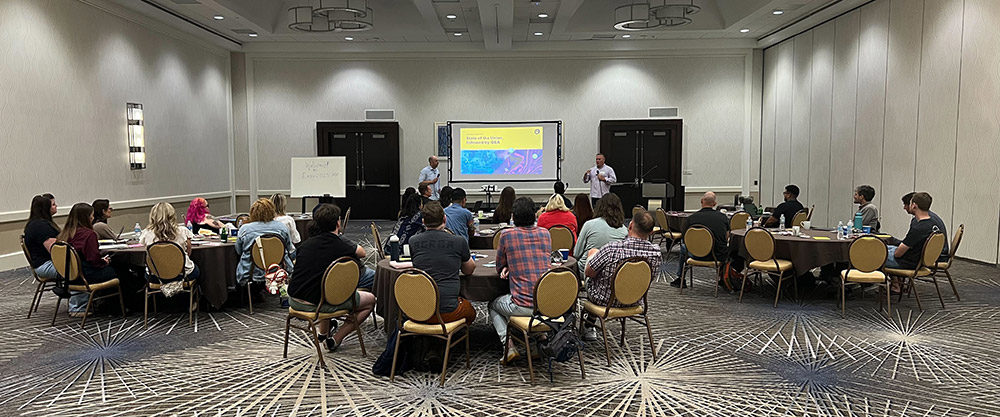
Shawn Rubel spent $125,293 getting people together in Orlando. For a founder whose company distributes digital files to people he will never meet, it was a substantial investment in being in the same room. Thirty-one colleagues attended the September 2025 gathering in person. There were presentations, meals and a day at Disney. The bill, which he published the following March, included the less magical necessities of travel, rooms and meeting equipment.
It makes a curious opening scene for someone who began with free Photoshop brushes. The early job was to gather useful things scattered across the internet. The later job involved gathering people scattered across a company. Both required Rubel to notice that something technically available could still be difficult to reach.
Getting from one problem to the other took years. Along the way, he mistook early success for a repeatable trick, built businesses that went nowhere, and discovered that a designer’s ability to make things could become a founder’s very expensive distraction.
The afternoon dropout
Rubel grew up in Jordan, in Ontario’s Niagara region. Art and design interested him; for a while, teaching seemed a possible destination. He studied at Niagara College, then went on to university. The subjects outside his interests made the exercise feel increasingly questionable. He decided he could begin a design career without finishing.
The decision survived part of a day. A friend working in California explained the degree requirement attached to the route he had used to work in the United States. Rubel returned to class that afternoon. He eventually graduated from Brock University with a BA in Visual Arts in 2004. The dropout story acquired a rather inconvenient ending: graduation.
His first Kentucky employer was Hitcents, which hired him as a graphic designer. Camping World followed, with a move into marketing. The change meant replacing much of his day looking at shape and color with spreadsheets. Away from work, design became something he wanted to get back to.
A useful little corner of the internet
The problem he chose was familiar to working designers. Good free resources existed, but finding them meant hunting through separate sites. Rubel contacted people who offered Photoshop brushes on their own pages and asked permission to share them through Brusheezy. Many welcomed the additional exposure. The useful act was bringing the material together.
He launched in 2007, then applied the approach to vector graphics with Vecteezy. Visitors shared the sites through Digg, Delicious and StumbleUpon. Bloggers linked to them. These were recommendations from people who had found something worth passing along, giving the sites traffic and a reason for other designers to visit.
There is something wonderfully modest about the original proposition. A designer could stop searching and get back to designing. Rubel did not need every visitor to care about his company. He needed the site to be useful enough for them to return. Ads and affiliate programs supplied a way to earn money around that usefulness.
Too many open tabs
One early measure of success arrived through someone else’s surprise. Rubel showed his Camping World boss, Neil Scott, the traffic to his brush website: roughly 8,000 visitors a day. The reaction helped him understand that his little project had become a business opportunity.
Unfortunately, he also drew a broader conclusion. If building one website worked, perhaps building more would work too. An RV marketplace called RV Zen produced an encouraging rush of paid listings. Then people began calling about charges they did not recognize. Fraudsters were using stolen cards to post fictitious vehicles. The orders had looked rather better before the telephone rang.
An outdoor publishing venture also failed to gain traction. He kept trying things while the creative-resource business offered an opportunity already in motion. That history gives his account of entrepreneurship a welcome lack of tidiness. He can explain the detours because he took them, and paid for them, before he learned to concentrate.
“It’s always been one grand experiment, right?”
Shawn Rubel
He left his full-time job in February 2009. Going independent did not immediately solve the problem of attention. Leaving an employer frees up hours; deciding where those hours belong is a separate piece of work.
The work he could not do alone
The growing company required expertise beyond its founder’s. Adam Gamble joined as chief technology officer in 2014. For Rubel, trained in design, technical leadership meant trusting someone else with the foundations. A marketplace needs engineering that can support the catalog and the people using it, even when that engineering produces little for a visitor to admire.
By January 2019, Eezy had 30 employees and occupied 3,000 square feet at Western Kentucky University’s Center for Research and Development. Cornhole boards and a colorful mural supplied the office with a less solemn atmosphere than its business responsibilities might suggest. A display of live website analytics provided its own kind of office entertainment.
About half the employees worked remotely, and Rubel put the share of website traffic coming from outside the United States at 80 percent. Bowling Green was a base for a business whose users were mostly elsewhere. That combination makes his career geographically interesting: an Ontario designer, Kentucky roots, and creative work moving across borders every day.
The choice of people became as consequential as the choice of product. A founder can draw an interface alone. Keeping a marketplace working, understandable and useful requires other people to make decisions while he is busy somewhere else.
The artist behind the download button
Vecteezy had two groups to satisfy. Designers wanted resources they could afford. The people making those resources wanted compensation. Rubel knew the first frustration personally and had heard the second from contributors. A free download could be useful to its recipient while still representing hours of someone else’s work.
His business developed a model that pays contributors for free downloads as well as premium content. Pro subscriptions added another source of revenue and another reason to broaden the collection. The word free describes what a user pays at a particular moment. Behind the button sit the arrangements that make producing and distributing the work worthwhile.
That perspective has stayed close to Rubel’s account of the company’s purpose. The aim is to make resources accessible while giving contributors a way to earn. Each side needs the other to keep participating. A collection with no audience does little for an artist; an audience with nothing useful to download will soon find another tab.
Rubel’s marketplace has to make the exchange work for both.
A photograph still has to have happened
Expansion brought the business beyond the material suggested by Vecteezy’s name. Stock photos and videos joined the platform in 2020. Editorial images followed in 2025. A name built around vectors now covered more kinds of creative work, an occupational hazard of naming something before knowing how far it might travel.
AI has added another set of decisions. Vecteezy offers filters for people who want AI-generated material, human-created material, or both. Rubel also points to tools such as background removal and reverse image search as useful applications. His approach asks where the technology improves the experience and where the user needs something else.
Editorial photography gives that distinction a concrete setting. Sports and cultural coverage depend on pictures of events that took place. A convincing image and a record of an actual moment serve different purposes. In that part of the market, Rubel sees continuing demand for authentic photographs.
He also argues that curation and understanding an audience become more valuable as production gets easier. More material leaves somebody with the job of deciding what belongs. The designer’s eye has work to do after the software has finished.
Room for the people
Outside work, Rubel’s interests include skiing, cycling and the Toronto Maple Leafs. His family settled in Kentucky, where he has coached youth sports and kept connections to the local creative and entrepreneurial community. A business conducted through screens has not made him indifferent to the place where he lives.
In September 2025, he became one of the inaugural inductees into the Regional Technology Council’s Technology Hall of Fame. His advice at the occasion was direct: “You can’t do it alone - you need help, you need resources.” Coming from someone who once kept opening new businesses, it sounds earned.
There is a practical consequence to accepting help: the helpers need to know one another. The Orlando meeting brought that obligation into view. A company can distribute work across locations with remarkable ease and still need to spend time building the relationships around it.
Rubel began by saving designers the trouble of searching in too many places. Running the company has asked him to solve a related problem for himself: where to put his attention. The answer has become less solitary with time. There are colleagues to trust, creators to pay, and a business that needs tending long after the pleasure of inventing its name.