Girish Navani was a boy crossing a railway bridge when his father gave him a rather demanding assignment. His father, a civil engineer for the Indian railways, had helped build bridges. This one would survive its builder, he told his son. Girish ought to make something that would survive him, too. Most children receive instructions about finishing their homework. Navani received a brief concerning posterity.
He has returned to that memory when explaining why he wanted to build an enduring company. There is an appealing inconvenience to the idea. It makes a sale price an incomplete answer to the question of success. A bridge has to keep carrying people after the opening ceremony. A business, by the same reasoning, needs a purpose beyond its founder’s departure.
Before the boardroom, the robot
Navani moved from India to the United States in 1988 for graduate study. He had studied mechanical engineering in India; at Boston University, he earned a master’s in manufacturing engineering, graduating in 1991. While studying, he wrote software to control robots making parts. The attraction was practical: instructions on a screen could change something happening elsewhere.
His working education continued at Teradyne, the semiconductor testing company, and then Fidelity Investments. He spent three years at each. Fidelity offered an absorbing technical environment, including work supporting institutional business and fund managers. Eventually, the scale became frustrating. He wanted his contribution to register more directly, and he wanted technology to be the business itself.
In 1997, he joined Aspen Technology. His work included helping establish PetroVantage, a venture concerned with the petroleum business. Manufacturing, finance, supply chains: these were different settings for a familiar engineering interest in getting information and work to move together.
The $10,000 lesson in ownership
Before eClinicalWorks, Navani wrote an application on the side and sold it to a small business for $10,000. By his account, the buyer used it to build a $5 million business. When he suggested that his contribution deserved another payment, the owner offered an education more economical than a business degree: he should have kept the software.
The lesson concerned ownership. The next time he wrote something with commercial possibilities, he intended to build a company around it. There is no need to pretend that every early transaction conceals a grand strategy. Sometimes a founder’s philosophy begins with the discovery that the other fellow made the better bargain.
A wireless technology conference in Geneva in 1999 supplied the next opening. A presentation about using wireless systems at work caught his attention. Two colleagues had travelled with him, and their conversations helped turn a technical possibility into a business idea. That year, eClinicalWorks began.
A startup with a salary attached
Navani did not immediately abandon his job. He supported the early operation with his salary and investments while colleagues worked from a small office. He also described making money trading options in a storage company, giving him additional room to finance the venture. The runway had a distinctly personal balance sheet.
Keeping his income mattered. It gave the group time to prepare its product without making an immediate launch the condition of survival. In his account, the arrangement supported both his household and the young business. The familiar leap into entrepreneurship came with a foothold left carefully in place.
By the end of 1999, the first users were trying the software. The early monthly price was $250, a figure Navani said in 2010 had remained unchanged. That is a historical price, attached to the early business, rather than a quotation for what the company sells today.
Salary and investments bought time. Monthly payments helped sustain the business.
One customer was a perfectly good start
The first sales effort was personal. Navani visited prospective customers at their offices and homes, fitting the conversation around their availability. He had to explain why the technology deserved consideration before he could persuade anyone to pay for it. An unfamiliar product does not arrive with its own demand conveniently attached.
He recalled being told that small customers would neither spend enough nor produce a worthwhile business. The response was to continue meeting them. His original ambition was modest in scale: a sustainable company that could last. He was comfortable working through the market one customer at a time.
That makes the beginning more interesting than a retrospective march toward a billion dollars. The founders did not need to foresee the eventual size to find the next sale worthwhile. A recurring payment could help finance the next piece of work. Ambition had somewhere concrete to stand.
Growth without a departure date
By 2010, Navani described a business sustained by recurring revenue and operating without debt. He wanted to preserve its private ownership and the freedom that came with it. His explanation was refreshingly personal: he enjoyed what he was doing. A founder can have quite a sophisticated financial position and still prefer to spend Monday building software.
In 2014, he was forecasting annual revenue above $320 million. The scale had changed; his interest in an exit had not. He spoke about reinvesting in research and development even when that reduced margins. Profit remained necessary, but ownership let him decide what else deserved time and money.
“I do it because I like to do it, not because I have to do it.”
Girish Navani, 2014
That statement offers a useful glimpse of temperament. He talked about staying private as an adventure, and about quickly becoming bored if he stopped working. The reward he described included continuing to do the work.
A company can have too many business cards
Navani’s resistance to corporate ceremony extended to management. In 2010, he described teams with very little distance between a new employee and himself. He contrasted that arrangement with a previous employer’s nine layers of hierarchy. For an engineer, an organisation could be another system with unnecessary steps to remove.
In 2014, he explained his dislike of escalating job titles. Advancement should come through larger projects and responsibilities, he said. Vice president, senior vice president, executive vice president: the progression could become an occupation in itself. The stationery would flourish. Whether the work improved was a separate question.
The preference was also informed by an early mistake. At Fidelity, aged 27, he managed five people who complained to his boss that he had restricted their ability to talk to others. He said the experience changed his approach quickly. Authority had given him an opportunity to obstruct people, and they had noticed.
His later account included an oval table outside his office, eight chairs, and a whiteboard where colleagues could join conversations. It is a pleasingly ordinary piece of management equipment. The table did not require an impressive title from anyone who sat down.
Eleven players, fewer titles
Cricket supplied another language for the same preference. Navani began playing at six and competed in high school. His father had played at national level in India; old photographs offered a family history of matches and formal white uniforms. There was teamwork to admire before there was a company to organise.
He remembered a school semifinal in which his bowling made a meaningful contribution. Years later, he used the sport to explain the value of people with a strong speciality who could also contribute beyond it. A company organised around teams needed colleagues capable of working across boundaries.
By 2015, eClinicalWorks had a team playing in the New England Cricket Association. The sporting connection therefore went beyond a borrowed metaphor. Navani could discuss collaboration with a match in mind. Corporate life has produced many elaborate diagrams of teamwork; a game at least has the courtesy to reveal the score.
- 1988Moves to the United States for further study.
- 1991Graduates from Boston University.
- 1999Cofounds eClinicalWorks.
- 2014Returns to BU as a doctoral convocation speaker.
- 2026Still leading the company’s conference keynote.
The obligations that come with staying
The company’s history also includes a substantial legal reckoning. In May 2017, eClinicalWorks and certain employees agreed to a $155 million settlement resolving federal False Claims Act allegations concerning software representations and promotional payments. Navani and two other founders shared liability with the company for $154.92 million of that amount.
The claims were allegations, with no determination of liability. The agreement did not constitute an admission by eClinicalWorks, which denied the allegations. It also brought a five-year corporate integrity agreement and independent oversight of software quality. Those conditions belong in any account of the company’s development alongside its growth.
Afterward, Navani spoke about strengthening compliance while continuing product development and customer service. Remaining at the company meant responsibility for its response as well as the opportunity to direct its next release. The freedom of private ownership does not remove that obligation.
The engineer still takes the stage
Navani’s public role has grown beyond the early customer visit. Boston University invited him back to speak at its doctoral engineering convocation in May 2014. Its engineering leadership advisory board also lists him among its members. The student who had come to Boston to study manufacturing had become someone the institution asked to address its graduates.
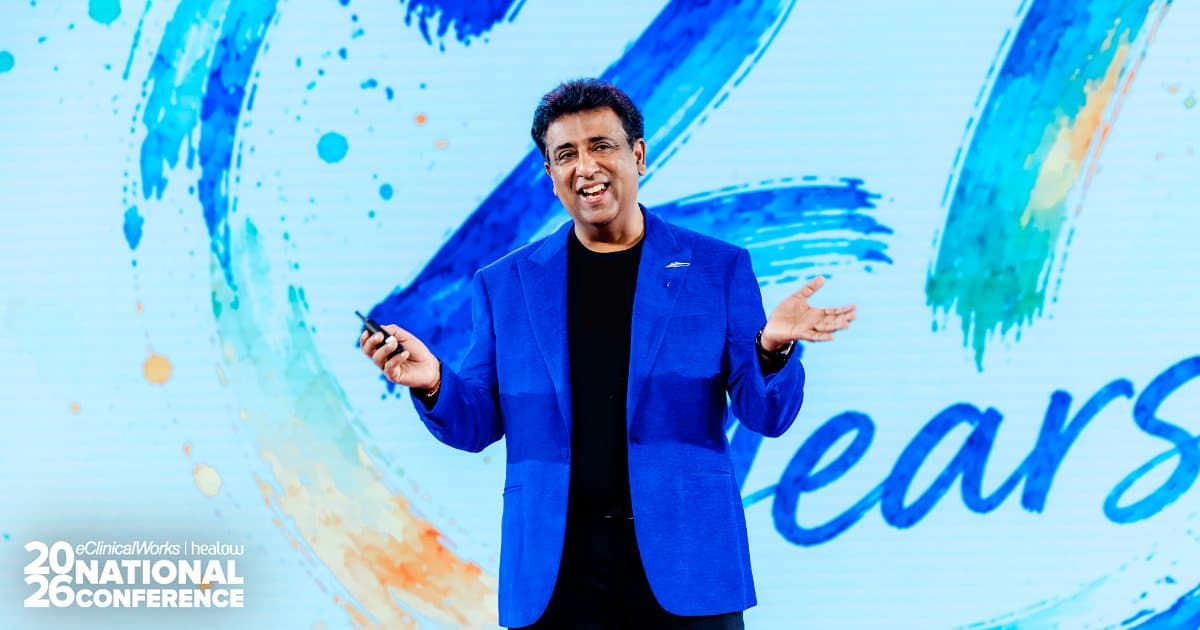
At the company’s 2025 conference, the opening included music, customers cheered by employees, and a colourful stage for product demonstrations. Navani occupied the centre of that presentation. The show had grown considerably from the small office. He was still explaining the product himself.
On October 23, 2026, he delivered the keynote in Nashville. The company announced a redesigned workspace and further work on AI and software agents. eClinicalWorks and healow projected combined 2026 revenue above $1.3 billion. The year was still in progress; the announcement was a forecast.
Through those changes, his stated aspiration has remained recognisable: build an organisation that can outlast its founders. As a child, he had seen what that could mean in steel and concrete. Software offers fewer scenic crossings, but it leaves him with much the same assignment: keep building something that other people have a reason to use.