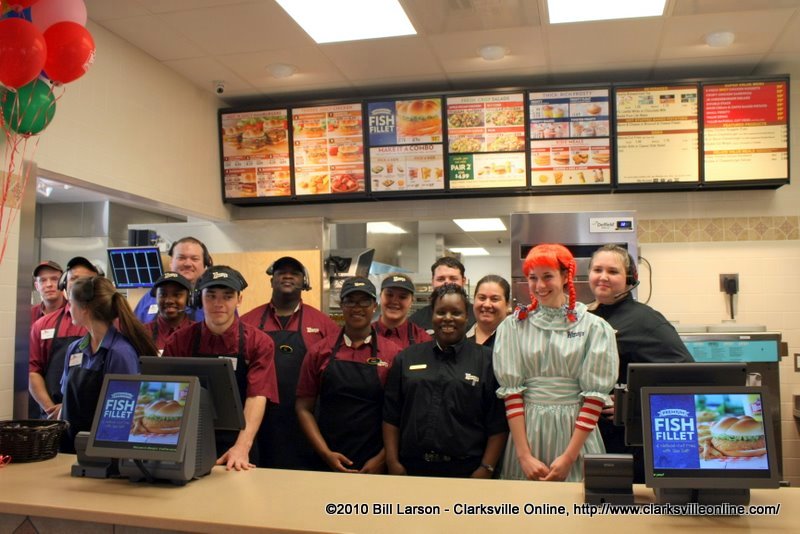
A fast-food restaurant can lose almost everything and still leave its owners with a difficult question. In May 2010, floodwater reached four feet inside a Wendy's on Riverside Drive in Clarksville, Tennessee. Wendy's of Bowling Green eventually chose to gut and renovate the building. The lot constrained its options. More than $1 million later, the restaurant reopened in March 2011.
There was an unusually honest detail in the new interior: river stone marked the high-water line. Customers could eat beneath a reminder of what had happened. A familiar restaurant had acquired a very particular memory.
- A regional operator turns Wendy's national menu into a local, daily business.
- Acquisitions drive expansion; restaurant teams make that expansion usable.
- The useful lessons live in ordinary places: a pickup counter, a roadside sign, a rebuilt dining room.
The name above the door, and the company behind it
Wendy's of Bowling Green, usually shortened to WBG, is an independent franchise operator. Customers buy hamburgers, chicken sandwiches, nuggets, chili and Frosty desserts. They also buy convenience: somewhere to stop with children, collect dinner on the way home, or get breakfast before work. WBG's expertise is making those transactions happen repeatedly across a restaurant network.
The distinction matters. The Wendy's brand supplies an identity and a recognizable menu. The franchisee runs the restaurants. Its business rests on food sales and the practical decisions behind them: hiring, training, maintaining buildings and keeping service moving. It competes for the same hungry customers as McDonald's, Burger King and other quick-service operators.
WBG dates to 1975. Mike O'Malley joined in 1988, when it operated 18 restaurants, became a partner in 1990 and became senior partner and CEO in 2012. That sequence describes a business built over decades. The square hamburger may be standardized; the organization serving it has its own history.
Forty-four restaurants, in one move
In June 2019, WBG acquired 44 Wendy's restaurants in the Nashville market. The deal brought its reported total to 101 and placed it among the country's 15 largest Wendy's franchise groups at the time. Buying an existing network can change a company's scale much faster than opening one restaurant after another.
June 2019 restaurant count. 57 is calculated as 101 minus the 44 acquired restaurants. These are historical figures.
By July 2024, reporting put the group at 136 locations across Kentucky, Tennessee, Indiana, West Virginia and Alabama. Auspex Capital subsequently announced an 18-restaurant acquisition for WBG in November 2025. These are dated snapshots of an expanding business, rather than a promise that a restaurant count stays still.
Development also means finding useful buildings. Wendy's highlighted WBG's conversion in Owens Cross Roads, Alabama: from scouting the market to serving the first Frosty took less than six months. Reusing a site offers a practical route to opening sooner. Its usefulness depends on the building, its location and the work required to make it function as a restaurant.
The hard part has a name tag
Ryan O'Malley became a franchisee in 2021 after working through restaurant management and operations roles. In a 2024 interview, he credited restaurant employees for the group's results and reported that WBG held Wendy's highest national average breakfast sales. That is an operator's reported achievement, with a date attached, rather than a permanent ranking.
“The largest contributor to our company's success is my team within the restaurants.”
Ryan O'Malley, 2024
Breakfast makes the staffing argument concrete. A restaurant can have a recognized name and still need a team ready when a customer wants an early meal. Adding a selling occasion creates another set of routines to teach and execute. Expansion gives the organization more opportunities to get those routines right, and more places where a weak handoff can disappoint someone.
A drink for the person carrying dinner
One revealing adjustment involved DoorDash. In a 2026 interview, Ryan described frustration over refunds and pickup behavior, then a change in perspective: delivery represented too much business to treat as an adversary. WBG moved pickups into the dining room and introduced free drinks and a loyalty card for drivers. He described the initiative as the group's own idea.
The lesson is available to other operators: examine the handoff that irritates everybody, then change its incentives and physical arrangement. A driver needs an efficient pickup. A crew needs an orderly queue. Hospitality can help align those interests. It still requires ready orders and a usable collection point; a complimentary drink cannot repair a kitchen that consistently keeps people waiting.
Even the sign has a shift to work
WBG also replaced some manual roadside reader boards with Watchfire digital displays. The old process required changing letters by hand. The new system allowed messages to vary by location and time of day, with remote updates through Ignite OPx software. The supplier's case study described nearly 15 displays operating when it was written.
A sign could advertise food, then recruit staff. That is a modest but useful kind of flexibility. Watchfire argues that digital boards reduce the recurring effort of manual changes. A buyer still has to weigh installation and running costs against the work saved. The sensible takeaway is to count the work a tool removes before assuming that a moving picture earns its keep.
A national menu needs local roots
WBG's local commitments extend beyond the dining room. Bowling Green's Community Education organization recognized its support for school programs, libraries and groups including HOTEL INC and the Family Enrichment Center. The Dave Thomas Foundation's 2022 annual report also recognized WBG for meeting its 2021 per-restaurant sales challenge for adoption-fundraising Boo! Books and Frosty Key Tags.
In 2011, Mike O'Malley and John Hughes received Wendy's Founder's Award, the brand's highest honor. The recognition belongs alongside the less ceremonial work: buying a restaurant, training a crew, changing a sign, choosing where a driver stands. For customers, all that effort resolves into a small test. Is this a place worth coming back to?
Follow the operation
Meet the company on LinkedIn ↗, explore the Wendy's menu ↗, or listen to Ryan O'Malley's extended interview ↗. WBG's historically listed domain is wenbg.com ↗.