An internet connection has an awkward habit of attracting attention precisely when it stops working. While it behaves, it disappears into the furniture. The call goes through. The match keeps playing. A document reaches the person waiting for it. Somewhere behind this domestic peace sits a company full of decisions. Sewa Pathak has spent much of her career on that side of the connection.
She is the CEO of Vianet Communication in Nepal, and a chartered accountant by profession. Her route into the job passed through finance and operations, two departments whose achievements seldom make exciting dinner conversation. Yet they help determine whether a business can keep its promises. A cable may carry the signal; an organisation has to support everything around it.
Pathak’s career invites a look at the less theatrical parts of leadership. There are awards, certainly. There is also the question of how responsibility moves through a company. Who gets to decide? Who understands the goal? Who receives credit when the ordinary work goes well? Those questions give her story its shape.
The finance office had a wider view
Before Vianet, Pathak worked at Shikhar Insurance Company Limited in finance and administration. She joined the internet provider in 2012 as Director of Finance and Operations. In 2018, she became its chief executive. Six years separate those two appointments, enough time for an operator to become acquainted with the distance between a plan and its execution.
An early professional biography describes a remit extending beyond financial operations and investment planning. She participated in technology selection, infrastructure layout and product design. She also oversaw an IT division handling accounting, human resources and financial modules for clients. The finance title sat over work that crossed several parts of the business.
That combination matters. Technology choices have financial consequences. Investment choices shape the service a customer can buy. Product design has to make sense to the people delivering it as well as to the people paying for it. Her documented responsibilities placed her at those intersections long before the chief executive title.
Accountancy is an interesting entrance to this world. The profession brings close attention to records, costs and explanations. Telecom operations add physical infrastructure and the unpredictable demands of everyday use. Pathak’s career brings the two together. The tidy columns of a financial statement eventually have to accommodate a rather untidy world.
& Operations, Vianet
chief executive
award
woman award
A service people expect to forget
Vianet was established in 1999, before Pathak joined it. The company’s history includes the introduction of fibre to the home in Nepal. That history belongs to the organisation and its teams. Pathak’s contribution is best understood within it: a finance and operations leader who later took responsibility for the whole business.
Broadband is an unusually intimate piece of infrastructure. It enters homes, interrupts conversations when it fails, and becomes the silent companion of work and entertainment when it succeeds. Customers experience a single service. Inside the provider, delivering that experience requires many kinds of work to agree with one another.
This makes the chief executive’s job difficult to compress into a portrait. A person can be photographed at a desk. A functioning organisation cannot. The achievement is spread across decisions, colleagues and repeated tasks. To describe Pathak only through her title would leave out much of the terrain her earlier role already covered.
There is a useful restraint in following the career rather than assigning every company milestone to its CEO. Infrastructure businesses accumulate work over years. Pathak entered an existing enterprise, took on a broad operational brief, and moved into its leadership. The sequence is substantial enough without borrowing someone else’s beginning.
When responsibility leaves the top floor
Pathak has spoken publicly about a change in how Vianet works. Earlier, decisions were more centralised. She describes a subsequent move toward defined performance indicators and results, accompanied by feedback and cooperation across functions. The intention is to help people understand their contribution and take responsibility for it.
“Over time, we realised this limited ownership and agility.”Sewa Pathak, on centralised decision-making
Her account makes room for an admission: an earlier way of running the company had limits. She says the newer approach helps teams address underlying problems and follow progress. These are her descriptions of the change, rather than a numerical verdict on its results.
A place in every department
In February 2023, Vianet became a signatory to the Women’s Empowerment Principles. Pathak’s accompanying statement put equal opportunity in practical terms. She described an initiative to include at least one woman in every department and reported women’s participation above 40 percent in the core administration and operations department.
The figure is dated. The departmental commitment gives a broad principle a specific place in the organisation.
Women’s participation in core administration and operations, as reported in the company’s statement.
40% reference point. This is a dated company statement.“Being a woman CEO, we have committed and practiced the equal opportunities concept,” Pathak said. The sentence links her own position to a workplace commitment. It gives the conversation a practical destination beyond celebrating the presence of a woman at the top.
The name on the trophy, the team in the thank-you
At the end of 2022, Pathak received the Leadership Female of the Year award at the HRM Awards for Corporate Excellence in Kathmandu. The following year brought another recognition: Professional Woman of the Year at the NewBiz Business Women Summit and Awards.
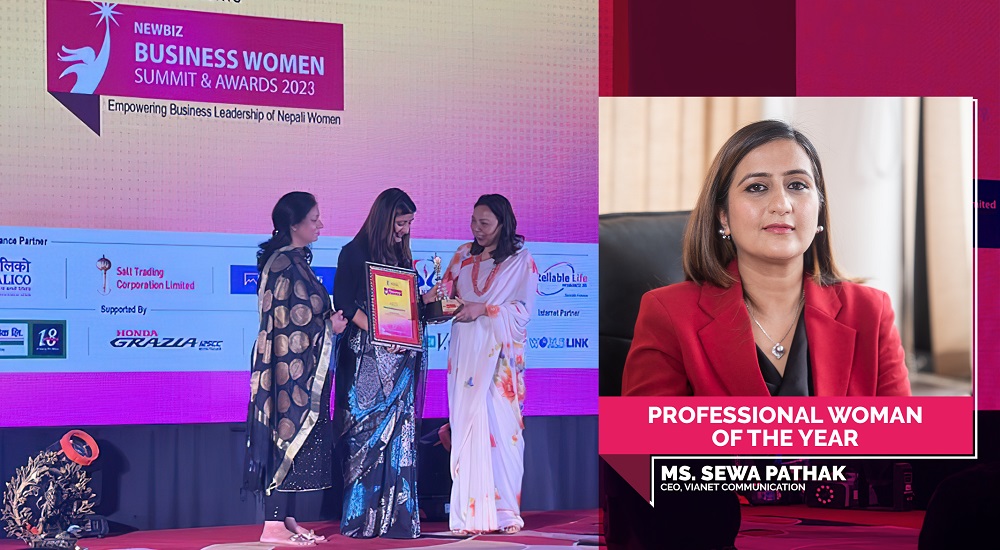
Her public response to the HRM award included thanks to the organisers and jury, followed by credit to her team for its support. The response fits the problem of writing about anyone who leads a service company. The recognition is personal. The work has many names attached to it.
An award gives a career a visible punctuation mark. It does not do the daily work of the business, nor explain every decision that preceded the ceremony. Here, the recognitions sit alongside a longer operational record. The finance role, the CEO appointment and the workplace commitments supply the substance around the applause.
The award photograph offers a brief change of scene. A service that generally hopes to remain unobtrusive has brought its executive onto a stage. The next part of the story still belongs to the people who return to their jobs after the presentation is over.
Beyond the broadband brief
Pathak’s public responsibilities extend to Alpha Capital, which lists her as a director and as chairperson of its Audit & Compliance Committee. Those roles connect her executive career with corporate governance. They also bring her professional background into another setting where decisions need scrutiny and responsibilities need to be clear.
She has taken part in public conversations about business, too. A 2022 appearance on Unheard with Saloni was titled “Sewa Pathak on scaling up the right way.” In March 2023, she appeared alongside Vianet’s Binay Bohra on episode 290 of On Air. A TechPana interview addressed tax policies and women’s empowerment in Nepal’s technology field.
These appearances put different aspects of her job before different audiences: business growth, the experience of leading an internet provider, and the conditions surrounding the industry. They offer ways to hear her beyond an award announcement. The person in the finance and operations role has become someone invited to discuss the wider business.
Coffee with Mr. Question Mark
In a public recollection of her friend Ujwal Thapa, Pathak describes meeting him in a tiny, one-room Vianet office in Kantipath after his return from the United States. He arrived with an Apple Mac desktop and a complaint about parts missing at the airport. Their conversations wandered from Kathmandu’s restaurants and clubs to ideas and the country.
Thapa introduced her to coffee, she recalls, and she jokingly called him “Mr. Question Mark” because he kept asking why. She also remembers his work on Vianet’s first logo and website. It is an affectionate account of a friendship that included both everyday pleasures and questions about the world around them.
The coffee is a pleasing detail. So is the nickname. They make room for a younger professional life with conversations that had no need to fit an agenda. A company’s history includes those exchanges as well as its formal appointments: people arrive, bring their curiosity, and leave something behind.
A book, and the next ordinary day
At the start of 2026, Pathak wrote about finishing Arundhati Roy’s memoir Mother Mary Comes to Me. She called it her first Roy book and admired the clarity and detail of the writing. It is a small personal detail, but a welcome one in a public record otherwise occupied by appointments and company responsibilities.
A reading reflection gives a different measure of attention. Here is an executive taking time to describe the language and effect of a book. It would be a mistake to turn that into a theory of her entire personality. It is enough to let the detail stand: she read it, responded to it and recommended it.
Her working story continues elsewhere, in the less literary business of helping an organisation deliver its service. The career has moved from financial administration to broad operations and then chief executive responsibility. Along the way, her public commitments have addressed participation, accountability and the contribution of colleagues.
The ordinary connection remains a useful way to understand the stakes. Someone makes a call, opens a file or watches a match. They may never think about the finance office, the departmental goal or the team behind the service. Pathak’s career brings that work into view. Then, ideally, the connection carries on and everyone gets back to what they were doing.