The name on your broadband bill does not tell you everyone getting paid. Buy internet from Origin Energy and Superloop can be working behind the scenes. Buy from Exetel and you are buying from a company Superloop owns. Pick Superloop itself and the relationship is more obvious. Three shopfronts, different arrangements, traffic moving through the same group’s infrastructure.
That is the useful way into this Sydney-based telco. Superloop sells the familiar things: home internet, mobile plans, business connections. It also supplies the machinery that lets other companies sell connectivity. The pitch reaches households hunting for a better plan, enterprises needing managed networks and brands that want broadband customers without assembling an entire telecommunications operation.
In the year to June 2026, Superloop reported A$664.3 million in revenue and A$17.5 million in net profit after tax. It finished with 935,000 customers across the group. Those figures describe a business much bigger than the name a householder might recognise. The less visible wholesale operation helps explain how it got there.
The network behind the name on the bill
Founded by infrastructure entrepreneur Bevan Slattery in 2014 and listed on the ASX the following year, Superloop began with fibre in its bones. Its assets and access arrangements span metropolitan networks, subsea connectivity and fixed wireless. Dark fibre, despite the faintly sinister name, means fibre supplied without the transmission equipment that lights it up. Customers bring the electronics.
Owning infrastructure gives a provider choices about capacity and how services travel. It does not mean owning every metre to every front door. Superloop uses nbn access for nbn customers, then combines it with its own network and operating systems. Its mobile service similarly uses wholesale carrier access, including Telstra’s wholesale network. The distinction matters when assessing coverage and control.
The commercial structure has three parts. Consumers pay for subscriptions. Businesses buy connectivity and services such as managed Wi-Fi, voice, security and SD-WAN, which helps manage connections between sites. Wholesale customers pay for network access and related capabilities. A rival at the retail counter can therefore be a customer elsewhere in the building.
Network + software + operations
The brand taking the order and the company carrying the traffic can be different.
A$110 million bought the missing traffic
The early constraint was commercial: expensive infrastructure needed enough paying demand. Superloop’s own description of its turnaround makes that plain. In 2021 it agreed to buy Exetel for A$110 million, bringing more than 110,000 consumer and business customers. Management explicitly tied the deal to putting its existing network to greater use.
The completed transaction comprised A$100 million in cash and A$10 million in shares. A placement and entitlement offers raised A$100 million. The acquisition announcement anticipated about A$5 million a year in network savings, largely by moving Exetel traffic onto Superloop infrastructure. That was an expectation at the time, not a standalone measure of savings subsequently achieved.
Then came a move in the other direction. Superloop agreed to sell its Hong Kong operation and selected Singapore assets to DigitalBridge and Columbia Capital for A$140 million. Completion in April 2022 produced roughly A$125 million in cash settlement proceeds after the associated access arrangement. Superloop retained regional connectivity through a 15-year right of use.
“simplifying the business to focus on core markets of scale”
Paul Tyler, CEO · April 2022
Those were Tyler’s words for the turnaround. The transactions reveal the change in priorities: release capital from some assets, preserve useful access and concentrate on customers who could make the remaining operation work harder. The sale price was above carrying value. Calling the entire Asian venture a failure would miss what the company actually did.
Origin brought its customers - and got equity
Buying a retailer is one route to traffic. Signing one is another. In March 2024, Superloop secured a six-year exclusive wholesale internet agreement with Origin. The energy company had about 130,000 broadband accounts to migrate. Superloop expected the existing base, once transferred, to contribute more than A$19 million in annualised EBITDA, with growth offering further upside.
The bargain included equity. Origin received roughly 9.85 million shares upfront, with another roughly 9.85 million tied to completing the migration, plus up to A$30 million in shares for further customer-growth milestones. There were also options to acquire additional shares. Distribution had a price, even when it did not arrive as a simple cash acquisition.
The migration finished in October 2024. Origin kept its retail relationship; Superloop gained traffic. Its separate AGL backhaul relationship showed another way to serve an energy retailer’s broadband business. These arrangements give Superloop a route to households beyond what its own advertising can recruit.
The operational ingredient is Superloop Connect, launched in 2021. Its public API documentation covers checking whether an address can receive a service, placing orders, arranging appointments, changing plans and receiving service notifications. This is work that can otherwise generate a procession of forms, calls and follow-ups. Automation makes wholesale distribution more practical as volumes rise.
For someone building a business, the transferable idea is to make an existing capability easy for a partner to sell. Superloop supplies infrastructure and operating systems; a partner supplies access to customers. The arrangement depends on reliable fulfilment and economics that leave both sides a reason to stay. Software cannot rescue a deal whose customer-acquisition incentives consume its returns.
The upgrade button has small print
At home, nobody buys an API. People want the movie to play, the download to finish and the connection to survive a busy evening. Superloop competes with Telstra, Optus, TPG’s brands, Aussie Broadband and smaller providers for that monthly decision. Its owned infrastructure and wholesale business distinguish its corporate model; customers still have to judge the actual offer.
One unusually concrete feature is My Speed Boost. On eligible plans and connection types, it temporarily upgrades the service for 24 hours. Selected plans include five upgrade days a month, with unused days rolling into a bank capped at 30. Additional days cost A$2. Think of a large download scheduled for the weekend, rather than a permanent commitment to a higher tier.
The eligibility table does real work. Some plans have no upgrade available; access technology constrains others. A household should check its exact plan and address, rather than assume the feature follows the logo. Superloop’s terms also specify that speed reverts when the upgrade ends. Temporary means temporary.
Nor does a higher service tier fix every problem inside a house. Superloop’s own troubleshooting guidance recommends an Ethernet speed test to separate wireless issues from the connection itself. Router placement, walls and device capability can affect the experience. A faster plan is a poor first purchase when the bottleneck is the Wi-Fi link to the bedroom.
Fibre before the front door
Another part of Superloop’s business starts before there is a household account to win. Smart Communities supplies fibre-to-the-premises and Wi-Fi solutions for developments and accommodation. Its markets include build-to-rent properties, student housing and new residential communities. Here the problem is coordinating connectivity with the building, instead of treating it as the occupant’s later headache.
Bradfield City Centre in Western Sydney makes that ambition tangible. Superloop was selected as its statutory telecommunications infrastructure provider, with plans for fibre serving up to 10,000 residential lots. The role also encompasses supporting infrastructure; its work with OneWiFi includes public Wi-Fi and multifunction poles. This is a different conversation from offering a discount to switch an existing nbn account.
By FY26, Superloop reported about 190,000 contracted Smart Communities lots, while neoloop brought its FTTP assets together under an open-access wholesale brand. Contracted lots represent a pipeline, not 190,000 occupied homes already paying monthly bills. Development schedules and residents moving in will determine when much of that opportunity becomes recurring revenue.
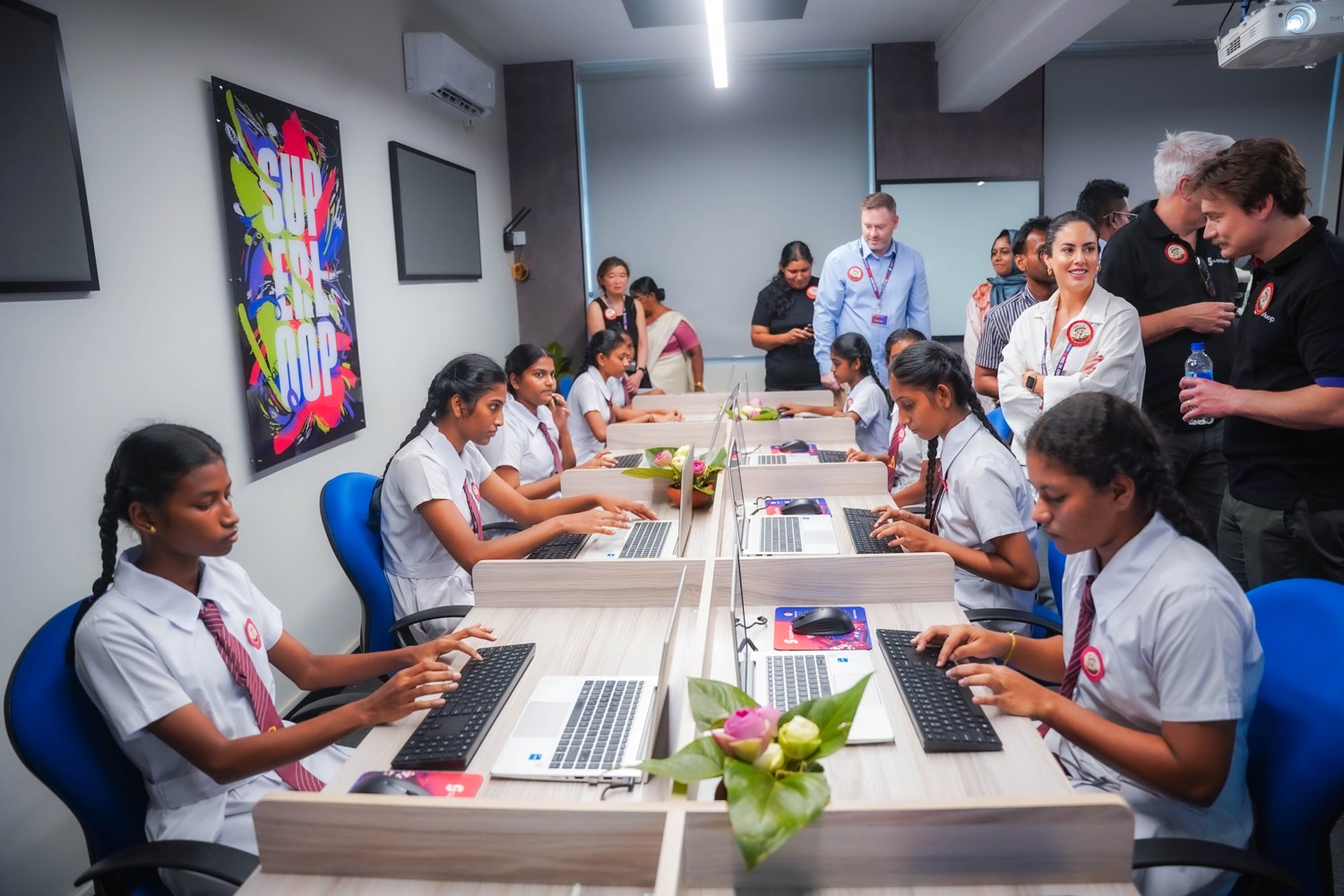
The company’s human footprint also reaches beyond Australia. Its Colombo TechHub supports technology and customer experience. In August 2026, Superloop opened a digital learning lab at Anuruddha Balika Vidyalaya, a girls’ school in Colombo, providing laptops and upgrading the room. Its stated values emphasise customers, shared work and speaking up; the lab is a specific example of community involvement alongside that language.
A billion-dollar ambition needs paying customers
The next strategy, SuperCharge29, targets more than A$1 billion in group revenue and A$200 million in underlying EBITDA by FY29. Those are management’s ambitions. FY26’s A$122.7 million underlying EBITDA and A$84.4 million of company-defined free cash flow provide a starting point, not a guarantee that the next three years will repeat the last three.
Acquisitions still cost money. The Uecomm purchase in February 2025, for example, was A$17.5 million before A$0.2 million of completion adjustments. More infrastructure means more capacity to sell, and more assets to operate. Wholesale customers can also leave: the FY25 presentation recorded about 17,000 Symbio subscribers migrating to their new parent’s network. Distribution works in both directions.
Superloop’s lesson is therefore quite practical. Match assets with demand. Make ordering easier. Let partners bring customers. Keep a distinction between a signed pipeline, cash generation and accounting profit. The appealing part of its model is that the customer does not have to choose Superloop’s name. The demanding part is that someone still has to choose the service, use it and keep paying.