01 / THE LONG WAY TO THE FIELD
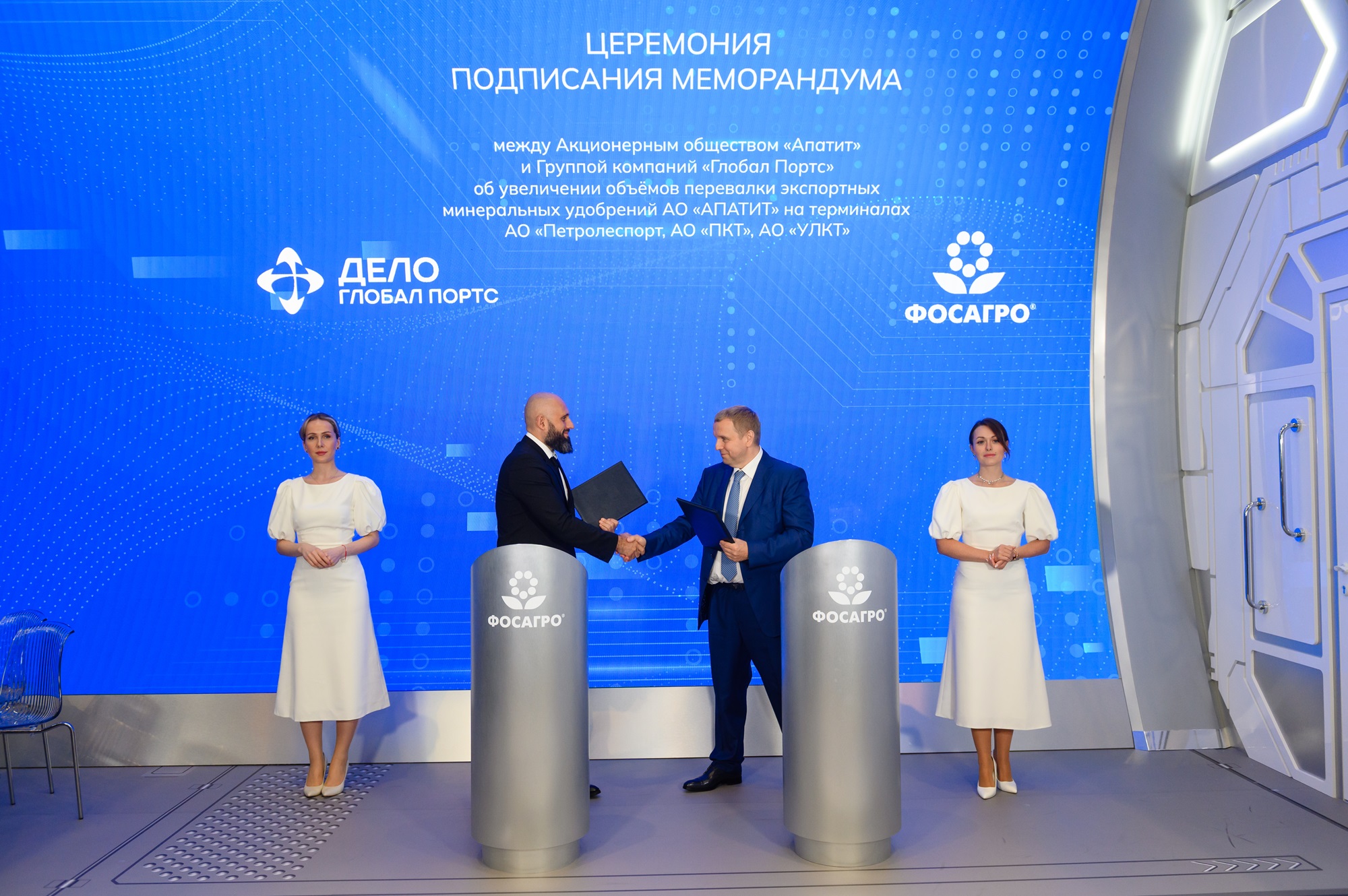
At the St. Petersburg International Economic Forum on 19 June 2025, Sergey Pronin signed a memorandum with Global Ports chief executive Albert Likholet. Behind the handshake was a rather substantial reservation: the agreement provided for PhosAgro’s minimum guaranteed fertilizer handling through the operator’s Baltic terminals to rise from three million to four million tonnes a year, with a further increase to five million envisaged. A table for two is easy. A berth for several million tonnes requires more planning.
Pronin singled out the value of booking port capacity for the long term. The partnership had begun in 2019; a five-year contract followed in December 2023. Its physical machinery included specialized containers and terminals in St. Petersburg and Ust-Luga. This is a useful place to enter his story. Much of his working life has concerned the distance between making fertilizer and getting it somewhere useful. The contract gives that distance a measurable shape.
The customer could choose
Nearly two decades earlier, Pronin was addressing a different audience. In July 2006, writing as PhosAgro AG’s director of fertilizer sales for Russia and the CIS, he described warehouses, delivery services and crop-specific nutrient mixtures. He also made a point that deserves to survive the sales brochure: the distribution bases carried products from other manufacturers. Customers, he argued, should be able to choose and compare.
The offer extended to storing purchases until sowing time and helping farms with delivery and application. Blending facilities could prepare mixtures for particular crops and fields using soil maps. These were concrete services attached to a chemical product. Read together, they describe a commercial proposition built around the customer’s working calendar: buy when it suits, store until needed, select a suitable mixture and arrange the journey. A warehouse was being asked to do quite a lot of conversational work.
“Consumers should have the opportunity to choose and compare.”Sergey Pronin, July 2006 · translated from Russian
An engineer enters the distribution business
Pronin was born in 1964 and graduated from the Moscow Kuybyshev Construction Engineering University in industrial and civil engineering. He also holds a Candidate of Economic Sciences degree. Between 1997 and 2002, he occupied senior managerial positions at Voskresensk Mineral Fertilizers and Ammophos. His continuing career at PhosAgro dates from 2002.
His responsibilities before 2010 included deputy chief executive duties at the management company, leadership of PhosAgro-Region, and domestic and CIS fertilizer sales. Senior posts in the management company followed in 2010–2012, before he returned to lead PhosAgro-Region from 2012 to 2017. The sequence matters because it places the distribution network near the centre of his career, well before the international sales brief. Construction engineering, economics and regional sales sit together in this biography. They are an unusual combination of subjects until one considers how much infrastructure selling a bulk product entails.
Twenty-two places to keep a promise
In August 2017, Andrey Vovk took over as general director of PhosAgro-Region. Pronin moved into a deputy CEO role encompassing domestic and export sales strategy, marketing and logistics. The export brief covered more than 100 countries. It was a widening of geography and responsibility after five years running the regional business.
The network he had led was an arrangement of real places. At the time of the handover, it had 22 distribution and logistics facilities, with packaging operations and simultaneous storage capacity exceeding 450,000 tonnes. It operated in 14 principal agricultural regions and delivered to more than 60 Russian administrative regions. Those figures put some weight beneath the word “distribution.” Every additional market requires arrangements beyond a sales conversation. Pronin’s promotion brought the selling and the moving into the same job description, a pairing that would remain visible in his later port negotiations.
Buenos Aires joins the address book
By November 2018, the international story had acquired an office in Buenos Aires. PhosAgro-Argentina became the group’s tenth foreign trading office and its second in Latin America, after São Paulo. Latin America then accounted for more than a quarter of PhosAgro’s fertilizer exports. The company was putting people closer to a market that already mattered.
Pronin pointed to 135,000 tonnes sold to Argentina during the first half of 2018, nearly three times the comparable earlier volume. He set out a plan for annual sales of 200,000 tonnes, linking it to better knowledge of demand and more direct sales. That was an ambition stated at the time, rather than a result to be quietly awarded in retrospect. Across the company, direct sales had passed 90%, against 53% five years earlier. The commercial direction was clear: more local knowledge and a more direct relationship with buyers.
The domestic map keeps expanding
The Russian business also kept moving outward. In 2018, PhosAgro-Region supplied 2.93 million tonnes to the domestic market, up 7%. Its distribution centres increased from 22 to 25, and simultaneous storage capacity passed 530,000 tonnes. Pronin highlighted the opening of a Siberian office in 2017 and a Far Eastern representative office in 2018. He spoke of encouraging grain and soybean production in the latter region.
By the first half of 2019, regional distribution sales reached 1.65 million tonnes, a rise of 14.3%. Pronin described interest from regional authorities in having PhosAgro nearby, working closely with farms. Agreements with two major Siberian regions were intended to extend that presence. Around RUB 250 million went into the network during those six months, while expanded storage and field-delivery capacity made liquid complex fertilizers available to smaller farms. The detail is revealing: proximity meant a service a farmer could actually use, including one whose order would never fill a ship.
A label in Berlin, a crop tour in Brazil
In January 2020, PhosAgro presented an eco-label at Green Week in Berlin. It was a Russian conformity mark tied to national standards for mineral fertilizers, part of a Green Standard brand introduced at the Golden Autumn exhibition the previous year. Pronin, then responsible for sales and marketing and serving on the Russian fertilizer producers’ association management board, presented the label as a way to distinguish Russian-origin products and their environmental characteristics.
The following January brought a more mobile form of marketing. PhosAgro sponsored and participated in Brazil’s Rally da Safra, a harvest survey involving 26 crews of agronomists, market specialists and fertilizer experts. The programme ran from January to June, visiting soybean and corn production areas, with company specialists scheduled to meet around 60 farmers.
Pronin described Brazil as a key market and said the São Paulo office had operated for more than five years. He outlined planned shipments of about 1.3 million tonnes of phosphate fertilizers to Brazil in 2021. His emphasis also included helping customers develop crop nutrition programmes. An exhibition label and a field visit operate at different distances from the crop. Both had a place in the sales effort he represented.
The conversation grows beyond the shipment
At a BRICS economic partnership discussion in June 2021, Pronin connected fertilizer trade to the management of agricultural land. He proposed that member countries consider a shared platform for exchanging soil-management experience and effective technologies, with participation from business and government. It was a proposal for cooperation alongside the movement of products.
He also discussed a possible digital ecosystem and online trading platform covering agricultural produce and the inputs used to grow it, including fertilizer, seeds and equipment. At the time, he said more than two million tonnes of the company’s seven million tonnes of exports went to BRICS countries, identifying India and Brazil as key partners and noting activity in South Africa. These remarks show the breadth of the agenda he was advocating publicly: distribution, practical knowledge and a digital means of connecting the participants. They describe aspirations expressed in 2021, rather than proof that a shared platform subsequently came into being.
The timetable catches up with the sales pitch
In January 2025, PhosAgro produced 1.06 million tonnes of agrochemical products and shipped 1.07 million tonnes, alongside 1.01 million tonnes of apatite concentrate. All were company records for the relevant monthly measures. Pronin, by then deputy CEO and commercial director, credited cooperation among the transportation team, Russian Railways, port administrations and logistics partners.
It was a very practical list of colleagues. The commercial executive was explaining performance through coordination across the route to the customer. More production creates more material to dispatch; keeping those movements aligned becomes part of fulfilling the original order. The port memorandum signed that June belongs in this same picture. A fertilizer factory can increase output on its own premises, but the journey beyond its gates involves several other organizations. Pronin’s public explanation gave those organizations their due.
From selling the output to securing the inputs
His responsibilities had already widened again. In 2023, Pronin took charge of procurement and supply, and in December that year became commercial director. In March 2026, he was appointed First Deputy CEO of PJSC PhosAgro. Buying and supplying now stood alongside a career long associated with selling and distributing.
The scale of the business around that role is visible in the 2025 operating results: agrochemical output reached 12.2 million tonnes, up 4%. The product mix comprised 58 grades spanning fertilizers, feeds and other products. In his commentary on those results, Pronin linked growth to investment projects, production capacity, the Russian distribution network and the group’s position abroad. Asia and Africa were the fastest-growing destinations for agrochemical sales.
The career has moved from regional bases to overseas offices, from marketing labels to reserved port capacity. Its recurring subject is the practical arrangement behind a sale. Back in 2006, Pronin offered customers storage until sowing time. By 2025, he was signing for more room at Baltic terminals. Different quantities, different paperwork, the same consequential question: where does the product need to be next?
Follow the route
Career details, interviews and the commercial milestones in this story.