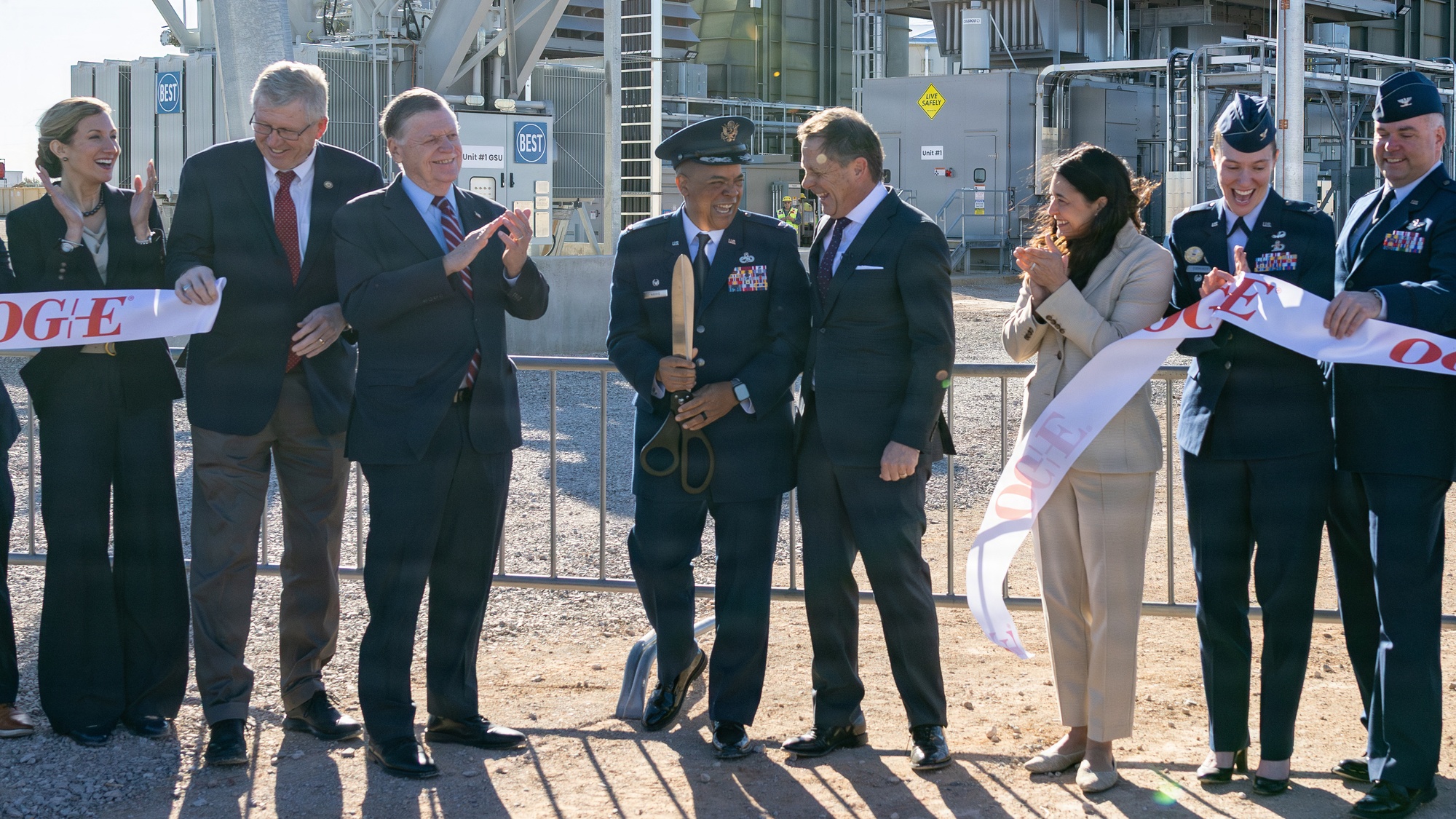
The scissors at a power-plant ribbon cutting are wonderfully disproportionate. Big enough to suggest that electricity might be a tailoring problem, they make a complicated piece of infrastructure briefly comprehensible. In February 2026, Sean Trauschke stood beside Col. Cisco Harris outside Tinker Air Force Base, smiling over a freshly cut ribbon. Behind them sat the equipment that would have to do the less photogenic work.
The new OG&E plant could generate up to 96 megawatts from two natural gas-fired turbines. It could also support the base independently when necessary. Trauschke, OGE Energy’s chairman, president and chief executive, had helped bring a utility project to the point where military officers, elected representatives and company leaders could stand together and applaud. The ribbon marked an opening. The obligation would last considerably longer.
That difference in timescale runs through his career. A utility executive has to talk about tomorrow’s opportunities while keeping today’s service dependable. Growth brings customers, investment and jobs. It also brings equipment to buy and costs to allocate. For Trauschke, who arrived in Oklahoma City as a finance chief in 2009, the difficult question has become increasingly public: who gets the benefit, and who gets the bill?
An engineer learns the language of money
His university education included mechanical engineering at the University of North Carolina at Charlotte, followed by an MBA at the University of South Carolina. He also completed Harvard Business School’s Advanced Management Program. The combination put physical systems and financial decisions on the same résumé. In electricity, those subjects have a habit of meeting whether their practitioners have been introduced or not.
At Duke Energy, Trauschke worked in purchasing and strategic sourcing before moving into finance. His assignments included treasury, business-unit finance, risk management and investor relations. By the time OGE recruited him, he was Duke’s senior vice president of investor relations and financial planning. He had worked on buying things, accounting for them, assessing their risks and explaining the results to investors.
OGE announced his appointment in April 2009, with an April 27 start date. Pete Delaney, then the company’s chairman and chief executive, pointed to that breadth of experience. Trauschke moved with his wife, Jill, and their three children. The job brought a new company; the move brought a city whose institutions would eventually occupy a substantial part of his working life.
Advancement came in measured stages. In July 2013, he became president of Oklahoma Gas and Electric while retaining his finance responsibilities. Delaney explicitly described the appointment as part of succession planning. The parent-company presidency followed in August 2014. By June 2015, Trauschke was chief executive; that December, he became chairman. There was a plan, and it had several steps.
The diploma he remembered
One of the more revealing details of his Oklahoma years concerns a school ceremony. Trauschke joined Heritage Hall’s board in 2011. When the school marked his departure from the board in 2017, it recorded his favorite highlight: handing his daughter Claire her diploma. Board initiatives and resolutions had their place. The moment he chose to remember involved a father, a daughter and a piece of paper.
It is a small anecdote with useful proportions. Executive biographies tend to give every committee equal billing, until the person disappears beneath the committees. Here, an institutional role made room for an ordinary family milestone. He also praised the school’s opportunities for students to participate and become engaged in their education. Participation would recur in his public arguments about the city.
A city is another kind of network
As Greater Oklahoma City Chamber chair in 2021, Trauschke described a city that had grown substantially since his arrival. But his attention quickly moved to who could participate in that growth. Skills training and certification mattered because rising opportunity needed people equipped to use it. A successful regional economy, in his telling, required a broader supply of talent and a broader distribution of chances.
He discussed cooperation among universities, technical education institutions and employers, including efforts to match training to demand for aerospace and digital skills. These were practical connections: employers needed workers; residents needed routes into better jobs. His argument for different perspectives was similarly direct. The answers a community needed might come from someone whose experience differed from the people already around the table.
That civic job eventually passed to Teresa Rose. In early 2024, she recalled that Trauschke and Chamber staff had brought her into conversations and briefings for months before she took over. Succession had appeared in his own promotion years earlier. Here it appeared again as the work of preparing someone else to lead, with the handover beginning well before the title changed.
“A thriving and growing arts community means a thriving city.”
Sean Trauschke, 2024 Allied Arts campaign kickoff
His current public biography places him on boards including Allied Arts, United Way of Central Oklahoma, the Oklahoma State Fair and Myriad Botanical Gardens. These organizations give his Oklahoma City involvement a particular shape: culture, public spaces, community support and gathering places. A utility serves a territory on a map. Those institutions help explain what people do inside it.
The engineer and the arts campaign
In 2024, Sean and Jill chaired the Allied Arts fundraising campaign. They were already longtime donors and members of its Circle Club patron group. Sean’s explanation for taking the role concerned curiosity and imagination: the arts helped people expand their thinking and believe in what they could create. For someone whose day job deals in generating capacity, it was another account of how capacity develops.
The campaign had a $3.73 million goal. At its June celebration, Allied Arts announced $3,778,403 raised. Funds supported more than 40 local nonprofit cultural organizations. The result belonged to donors, volunteers and participating institutions as well as the campaign chairs. The Trauschkes thanked the people who contributed, putting the emphasis on access to arts programming across the community.
His description of that commitment could be more lyrical than the language of utility operations. In an Allied Arts statement, he called the arts a revelation of a community’s soul. It is an unexpectedly expansive concern beside a financial résumé. Yet both parts of his public work involve the places where people choose to live, bring up children and invest their time.
A shareholder’s daughter writes back
Another family appeared in Trauschke’s April 2025 shareholder letter. A woman had written about her father, an electrician who learned his trade in the Navy in the 1950s. He had owned OGE shares for 40 years. The daughter explained that the dividends had contributed to retirement income and the family’s financial life. Trauschke used the account to describe the obligation attached to stewardship.
The anecdote gives the investor-relations portion of his career a human counterpart. A dividend is a line in a corporate announcement until somebody describes what it pays for. At the 2026 annual meeting, he again addressed the connection between individual shareholders and customers: some people both owned a piece of the company and depended on its electricity. Their interests could meet in the same household budget.
That makes the company’s promises unusually close to home. Customers experience service through ordinary routines; investors experience the business through results and distributions. The same executive must answer to both. Trauschke’s stories about employees, students and shareholders repeatedly bring large institutional responsibilities back to particular people, even when the decisions themselves remain technical.
Big Orange, one new engineer at a time
His public posts often turn toward the workforce OG&E calls Big Orange. In one, he welcomed Anne Shay as a full-time engineer after she had received a Positive Energy Scholarship and spent her college summers interning with the company. The sequence was concrete: support a student, give her experience, then welcome her as a colleague. He expressed anticipation about what she would do next.
Elsewhere, he praised crews returning from Georgia after Hurricane Helene while others headed toward Florida ahead of Hurricane Milton. Mutual assistance carried the company’s work beyond its Oklahoma and Arkansas service area. These posts offer a view of what he chooses to acknowledge publicly: preparation, practical service and the people who carry it out. The engineering degree has company on that side of his résumé.
The bill arrives in the present tense
By July 2026, his company was talking about new large electricity users while stressing protection for existing customers. OGE reported second-quarter earnings of $0.56 per diluted share, compared with $0.53 a year earlier. Trauschke framed the next phase around investment, reliable service and affordability. For a former CFO, growth still required an account of how its costs would be handled.
Then came a more immediate household calculation. On September 30, OG&E filed a rate-review request. The company said approval would mean an average residential monthly increase of $23.88. It identified generation replacements, grid work and completed technology changes among the costs involved. As of October 2026, this was a request awaiting review, rather than a change already imposed on customers.
Separately, OG&E said its proposed large-load tariff was intended to protect residential customers from data-center-related costs, with a public hearing scheduled for November. The distinction matters. A safeguard against one category of new expense does not settle the cost of the existing system. Trauschke’s affordability argument now sits beside a specific proposed increase that customers and regulators can examine.
The ribbon-cutting photograph captures the agreeable part of the job: construction finished, partners assembled, everybody briefly facing the same camera. His longer task sits outside the frame. He must explain why equipment is needed, how it will be paid for, and what service people should expect in return. The engineer can point to the machinery. The former finance chief has to make the arithmetic persuasive.