Sean Hogan’s name appears in the credits of a school sports program. It is a small detail, tucked into Pembroke Hill’s 2015-2016 publication, alongside the names of people who helped with its layout and design. Elsewhere, he is listed as Raider Club president. In the world of advertising, where considerable effort goes into getting a name noticed, this is an agreeable sort of evidence: a name attached to something other people needed.
A sports program is a modest object. It helps turn separate teams, families and fixtures into a shared occasion. Someone has to arrange the words and pictures. Someone has to get it printed. The crowd gets the pleasure of belonging; the credits offer a glimpse of the work that made the occasion possible.
That detail provides a useful entrance into Hogan’s story. He is a co-founder and partner at DMH, the Kansas City agency whose initials come from Diamond, Merckens and Hogan. His professional business is helping organizations communicate. Around that business is a record of participation in the institutions of his city. Read together, the two suggest an interesting question: what has to happen before an invitation means anything?
The H has company
DMH was founded in 2007. Paul Diamond, Brian Merckens and Hogan are identified as its founders in a 2012 business feature about the agency’s approach to growing relationships through smaller assignments. The headline itself offers a pleasantly unromantic starting point for an agency story. There is room in business history for the small job, completed well, that earns the next conversation.
A founding partnership also makes the initials more than a visual device. They put several people on the same letterhead. The name carries an expectation of joint responsibility: for the work, for the client relationship and for the business that continues after the presentation is over. Hogan’s place in that name is part of his story, but the company has always contained other people’s work too.
The current team includes creative directors, account managers, media specialists, public relations staff and social media leadership. Hogan sits among several partners. This is the practical machinery behind an agency’s output. A campaign may look effortless once it reaches the public. Inside the business, it passes through people with different specialties, different questions and, ideally, enough patience to hear the answers.
DMH’s range extends from brand development and messaging to creative services, research, media, public relations, social and search. Those capabilities place Hogan in a business where a client’s identity has to survive several changes of format. A useful idea must make sense in the sales conversation as well as on the screen. Consistency becomes a working problem, with real people responsible for the handoffs.
A bow tie, with a listening brief
There is a bow tie in Hogan’s professional biography. An occasional one, to be precise. DMH uses it to introduce his attachment to traditional client service: listening, choosing a strategy and carrying it through. The clothing gets a little character into the description. The sequence gives the character something to do.
Listening sounds inexpensive until you ask someone to do it while a deadline is approaching. It means leaving space for an inconvenient answer. It means allowing the person paying for the work to explain the business in terms that may differ from the agency’s preferred language. An elegant recommendation can still fail if it solves the wrong problem.
DMH describes Hogan as attentive to detail and focused on branding, with a strategic role in client relationships. Those are the agency’s descriptions of its partner. The more tangible evidence comes from a client acknowledgment: Swartz thanked Hogan and the DMH team for helping give Indurante an updated appearance, while connecting its visual identity with Swartz’s.
There is a recognizable business complication inside that thank-you. Two companies can share connections and still need distinct identities. Color and design must help explain the relationship without making the audience untangle it. The client singled out Hogan alongside the team. It is a small public acknowledgment of the relationship work that sits behind the finished mark.
The customer has somewhere to be
A later DMH project provides another view of the agency Hogan helped establish. Foley Equipment, a Caterpillar dealer, needed its online experience to explain the value of the dealer within a familiar equipment brand. DMH reorganized the site around equipment, parts and service, and clarified the role Foley played in keeping customers’ jobs moving.
The agency reports first-year increases of 420 percent in active users, 430 percent in page views, 381 percent in returning users and 40 percent in time on page. It also reports recognition as a 2025 Webby honoree for navigation and structure. These are team results reported by DMH. They illustrate the agency’s work without turning a collective project into an individual trophy for Hogan.
The human question underneath a website is often very plain. Can I find the part? Can I locate the service? Can I get back to the job? A brand enters somebody’s day at that level. Advertising makes a promise, then the everyday experience has to carry it. For an agency partner, keeping those two in conversation is a continuing responsibility.

A joke that remembers the name
Hogan has shown an appreciation for a lighter touch. On a DMH LinkedIn post about its Mazuma Credit Union campaign, he wrote: “Love this campaign, a little wordplay to build brand recognition!” The campaign made use of the credit union’s name. His comment is brief, and revealing in its choice of what to applaud.
Wordplay is easy to enjoy and surprisingly easy to waste. A reader can remember a joke while forgetting who paid for it. Hogan’s comment ties the pleasure to recognition. The amusement has a task. It should help the name remain in the audience’s mind, where a future decision might eventually take place.
“Love this campaign, a little wordplay to build brand recognition!”Sean Hogan, commenting on DMH’s Mazuma campaign
There is something companionable about that small observation. It leaves room for wit inside an otherwise serious commercial purpose. An agency can care about strategy and still make a person smile. The trick is to keep the smile attached to an idea that belongs to the client. A joke with its name tag on is more useful than one wandering unattended through the room.
The neighborhood is part of the job
DMH is based on Genessee Street in Kansas City’s West Bottoms. The Historic West Bottoms Association’s membership directory names Hogan as the representative for DMH Advertising. His connection to the area therefore has a public, organizational form as well as a business address.
A neighborhood association puts companies in the company of other companies. Architects, distributors, security businesses and civic organizations appear in the same directory. Their work differs, but they share a place. Membership creates occasions to think about the surroundings that make each individual business possible. The local map acquires people, obligations and conversations.
Hogan’s publicly listed commitments include leadership of DMH Community Day and service as a Christmas In October house captain. The agency’s own account of its culture includes an annual volunteer workday. The connection between the two is practical: an organization that names volunteering as part of its life needs people who will help organize it.
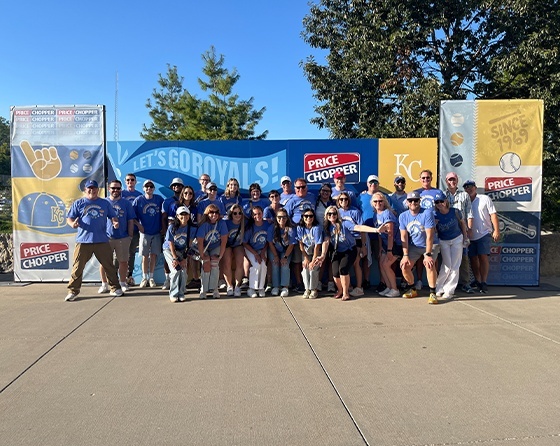
The company also describes an open working floor and a preference for collaboration. Its culture page makes room for birthdays, anniversaries and a summer social life. These are ordinary ways of giving colleagues repeated reasons to encounter one another. The group photograph from a Royals outing records one such occasion. Whatever an agency says about togetherness, it still has to arrange the day.
Before anybody calls it a community
In April 2026, Hogan published an essay examining the relationship between useful products and the communities that form around them. His central argument gives customers an active role: brands can provide reasons and opportunities for participation, while people decide what to make of them.
It is an argument with an interesting limit built into it. The marketer can work carefully and still cannot command belonging. A product can enter a person’s routine. An invitation can reach the right person. What happens between people afterward has its own life. Hogan’s essay asks the brand to leave room for that life, including room to listen.
- ListenUnderstand the person and the problem.
- Make usefulGive the invitation a practical foundation.
- Leave roomLet people choose how to participate.
Back in Kansas City, another invitation is on the calendar. DMH is scheduled to host KC Ad Club’s Ad Hops gathering on October 14, 2026. Advertisers, marketers and creative people are invited into the agency’s space. The event belongs to the company and the club; it also makes a fitting contemporary setting for the question running through Hogan’s professional and civic work.
Before the conversation starts, somebody needs to make the place ready. Before the school crowd arrives, somebody needs to finish the program. Before the customer returns, somebody needs to make the next visit worthwhile. The visible moment gets the photograph. The less visible work gives the photograph a reason to exist.
Hogan’s story is clearest in those particulars: the partner’s initial, the client’s thank-you, the campaign comment, the neighborhood listing, the credit at the back of the program. They are different kinds of participation. Together, they make a portrait of a working life spent around the question of how people connect. An invitation needs a sentence. A welcome takes a little more work.