In surgery, a narrow field of view is a feature. The world outside the incision disappears; what remains is anatomy, judgment, and the next exact move. Sanjiv Lakhanpal carried something of that discipline into business. After training as a cardiovascular and thoracic surgeon across India and the United States, he fixed his attention on a clinical category that rarely commanded the grand entrance of a hospital. Then he designed a smaller door for it.
Center for Vein Restoration began with one clinic in southern Maryland in 2007. The proposition was less theatrical than heart surgery and more operational: bring specialized, physician-led care into a local outpatient setting, make the experience coherent from diagnosis through follow-up, and repeat the model without turning the doctor into scenery. Nearly two decades later, CVR says it has grown beyond 130 locations and treats more than 200,000 patients each year.
The map is impressive. The more useful story sits beneath it. Lakhanpal did not merely open clinics. He chose a problem specific enough to standardize, important enough to sustain an institution, and common enough to support a national network. Focus was not a limitation. It was the engine.
The long route to a narrow specialty
Lakhanpal's path to Maryland began in India. His medical training included Amritsar Medical College and the Post Graduate Institute of Medical Education and Research in Chandigarh. In the United States, he continued through surgical residencies associated with Albert Einstein College of Medicine at Bronx-Lebanon Hospital and the University Medical Center of Southern Nevada, followed by cardiovascular and thoracic surgical training at the University of Minnesota.
Those institutions trace an unusually wide geographic arc for a career that would become known for depth. He went on to serve in cardiac-surgery leadership roles around greater Washington, DC, and earned board certifications in general surgery and cardiovascular and thoracic surgery. He is also a Fellow of the American College of Surgeons.
Then came the observation that changed the shape of his work. In his account, patients with overlooked or untreated vein conditions often moved through a system poorly suited to consistent specialty care. The response was a one-stop outpatient organization built around the category itself. Large hospitals organize care by departments. Lakhanpal organized an institution around the journey of one kind of patient.
As long as we take amazing care of our patients, all else will fall in place.Sanjiv Lakhanpal
That sentence is polished enough for a culture book, and indeed it appears in CVR's public materials. But it also contains the founder's essential management claim: the patient is the core stakeholder, and other decisions should line up behind that fact. The philosophy turns a sprawling organization into a test with a human answer. Does this choice improve the experience and outcome of the person who walked through the door?
A clinic that learned to copy itself
Replicating a medical practice is not the same as franchising a sandwich. Judgment cannot be laminated. Trust does not arrive in a shipment. Every new market introduces doctors with their own habits, patients with local expectations, and rules with little interest in the founder's preferred tempo.
CVR's expansion suggests a four-part answer. Keep the clinical category clear. Place care in accessible outpatient settings. Build education into the network. Let physician leadership travel with the brand. By 2020, the organization reported 84 locations, 64 physicians, more than 500 full-time employees, and more than 200,000 annual patient interactions. By 2026, it described more than 120 centers and 90 physicians; its current founder profile puts the footprint above 130.
The repeatable-care loop
Growth also came through partnership. In July 2025, Lakhanpal announced new Texas clinics in Fort Worth, Grapevine, and Houston, adding to two Austin locations. His language emphasized the people joining the network: veteran surgeons, established practices, and a recent graduate of CVR's fellowship. It is a telling detail. Geography appeared on the map, but talent supplied the story.
Lakhanpal's institutional design extends beyond CVR. He founded Center for Vascular Medicine, a related outpatient practice for more complex vascular work, and the Lakhanpal Vein Foundation, which supports research, education, and philanthropy. Together they form a small ecosystem: routine specialty care at scale, deeper clinical practice, and a nonprofit vehicle for knowledge and access.
From operating room to operating system
- CVR begins with a single southern Maryland clinic.
- Lakhanpal ranks ninth on Glassdoor's U.S. small and medium business CEO list.
- His foundation backs a dollar-for-dollar global-care matching campaign.
- VISION moves to Washington, DC, with AI and patient-centered care on the agenda.
Leadership without the throne
Lakhanpal's writing on leadership is unusually suspicious of the pedestal. A leader, he argues, is an equal part of the enterprise, responsible for articulating a large vision and creating the conditions in which other people can solve problems. The aim is not personal recognition. It is capability distributed across the organization.
That belief is convenient for a chief executive, of course. It is also a mathematical requirement. A surgeon can be present for one operation. A founder cannot be present for every decision made across 130 clinics. Scale demands that the original judgment become culture, training, and trust. The founder must gradually trade control for coherence.
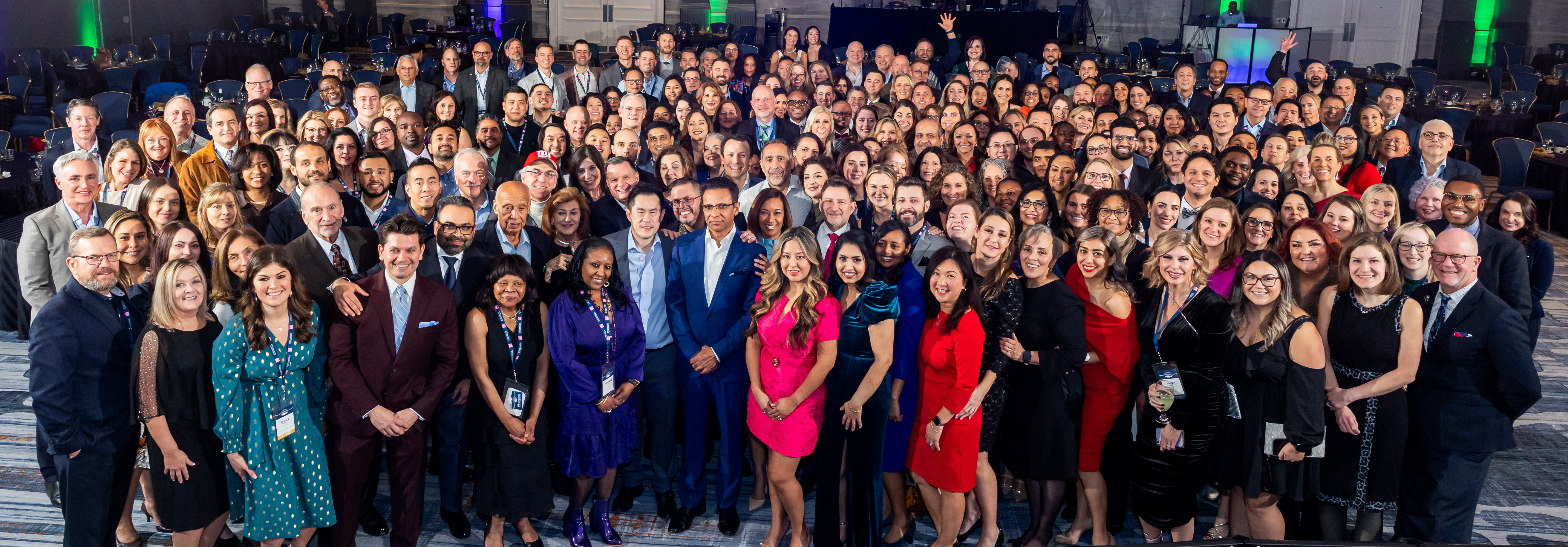
The annual VISION gathering is one mechanism for that trade. It creates a shared room for clinical cases, operating questions, recognition, and professional debate. A network can distribute instructions by email; it develops a common vocabulary by letting people teach one another. The conference makes culture visible, including the disagreements and new ideas that a large practice needs if repetition is to become learning rather than mere routine.
Employees offered one public measure of how that approach landed. In 2019, Glassdoor placed Lakhanpal ninth among 50 chief executives in its U.S. small and medium company category. The award announcement reported a 98 percent approval rating based on 133 anonymous employee reviews. Awards age quickly; the more durable signal is that staff associated his leadership with their experience of the company.
Away from work, his foundation biography supplies two compact details: he likes riding his bicycle and traveling overseas. They fit a leader who repeatedly writes about humility and continuous learning. A bicycle offers no corner office. Travel makes expertise feel provincial. Both activities reward forward motion and punish the belief that one has already arrived.
A great leader problem-solves by selflessly enabling and empowering the capabilities of others over seeking personal recognition for oneself.Sanjiv Lakhanpal, writing on leadership
The weight that arrives with scale
A balanced account of growth must include the obligations growth creates. In March 2026, Lakhanpal, CVR Management, Center for Vein Restoration, and Center for Vascular Medicine agreed to pay $4 million to resolve federal False Claims Act allegations involving billing to Medicare, Medicaid, and TRICARE from 2010 through 2016.
The precise legal distinction
The Justice Department described the resolved claims as allegations only and stated that there was no determination of liability. A civil settlement closes a dispute; it does not, by itself, establish the allegations as proven facts.
That distinction matters, and so does the event. Healthcare founders operate where trust, public money, clinical judgment, and business incentives meet. The larger the network, the less room there is for fuzzy systems. Scale magnifies access and educational reach. It also magnifies the need for controls, documentation, and accountability. An organization built around the patient as core stakeholder has set itself a demanding standard against which every operational choice can be examined.
The next operating room
In January 2026, VISION, CVR's clinical gathering, moved from Baltimore to Washington, DC. Attendance rose 20 percent from the prior year, and the program ran in person and online. Lakhanpal used his keynote to make a bet on artificial intelligence: it should expand a clinician's capabilities, not replace the clinician.
The phrasing is consistent with his older operating philosophy. Technology is another way to distribute capability. Used well, it may support education, diagnostics, and patient engagement while preserving professional judgment. Used lazily, it becomes merely a shinier waiting room. Lakhanpal's stated aspiration is the former: better tools in the hands of physicians, closer to the communities they serve.
His career has been an argument for noticing what large systems neglect. First came a specialty that seemed peripheral. Then came a clinic designed around it. The clinic became a network; the network grew a conference and a foundation; the founder returned to the same central question at a larger scale. How can expertise become more available without becoming less human?
There is no final answer, only an operating discipline. Focus narrowly enough to understand the problem. Build carefully enough that another person can deliver the solution. Learn publicly. Keep the people inside the system visible. And remember that every elegant map of 130 locations is, in practice, 130 front doors opened one patient at a time.