Forty years after leaving Nalanda College in Colombo, Sanji Gunawardena returned with a warning about the future and some advice that could have belonged to the past. Artificial intelligence would change the jobs awaiting the students in front of him, he said. They would enter a different working world. His recommendation was to pursue the things they cared about and believed they could do well.
There is something appealing about a finance executive going back to school without bringing a forecast. Gunawardena recalled entering Nalanda in 1981 and leaving in 1986. The return meant enough to him that he shared the speech publicly. For a few minutes, the President and CEO of Philadelphia-based Fidem Financial was an old pupil talking to new ones.
His working life has been spent examining how value moves between institutions. Banks sell portfolios. Investors supply capital. Brands want credit cards that customers will use. Someone has to decide whether the arrangements make sense, then help them function after the congratulations have subsided. Gunawardena founded Fidem in 2018 to work in that space. The school visit offers a useful place to begin understanding the person behind it.
“pursue your passion, and success will follow.”Sanji Gunawardena, reflecting on his return to Nalanda College
The card in your wallet has colleagues
A credit card looks reassuringly self-contained. It has a name, a number, and perhaps a reward worth remembering. Behind it sits a division of labor: someone issues the card, someone maintains the technology, someone funds the borrowing, and someone designs the loyalty program. The customer sees one object. The businesses involved see a collection of obligations.
Gunawardena’s company works on those relationships. Fidem buys credit card portfolios from banks looking to adjust their balance sheets or reposition their business. It also helps fund and grow co-brand programs, where a consumer brand and a financial partner come together around a card. Its operating approach includes underwriting, pricing, portfolio management, servicing oversight, and analytics.
These are dry terms for consequential decisions. An acquisition establishes who owns an asset. Servicing determines how an account is handled. Underwriting shapes which borrowers qualify and on what terms. A loyalty offer may persuade someone to apply, but it cannot do the work of all three. The machinery has to keep running after the advertisement has done its job.
This is the professional setting in which Gunawardena has chosen to build. His company’s emphasis on managing what it acquires puts ongoing responsibility alongside the transaction. A deal has a closing date. A portfolio has tomorrow morning, next month, and the next set of payments to consider.
One card, several jobs. The announced Bilt Card 2.0 partnership makes the division of work visible.
Learning to see the whole transaction
Before Fidem, Gunawardena held positions across analysis, banking, advisory work, and acquisitions. His education includes a finance degree from the University of Georgia and an MBA in finance from the University of Toronto’s Rotman School of Management. His LinkedIn profile dates the Rotman studies to 1997 through 1999.
The career includes business analysis at DuPont and responsibility for global card-services mergers and acquisitions at Bank of America. He also worked as a principal advising consumer-finance businesses on realignment, acquisitions, and divestitures, and served as Senior Executive Vice President of Mergers and Acquisitions at Kessler Group. These roles put different parts of a financial transaction within his professional field of view.
A former collaborator recalled working with him on international expansion in Asia, including financial forecasts and investment valuations for joint ventures. The colleague remembers a responsive, hands-on partner willing to work long hours when required. It is one person’s recollection, but it gives texture to a résumé made mostly of institutional names.
The useful detail is the joint venture. Partners can agree that they want to grow while disagreeing about what the growth is worth, what it requires, and who should carry the risk. Forecasting and valuation give those disagreements a language. They are tools for making a proposal sufficiently concrete that other people can commit to it.
By founding Fidem, Gunawardena moved into building a business around consumer-credit assets. The experience preceding it helps explain the fit: he had worked on both the structure of financial arrangements and the numbers used to evaluate them. At Fidem, those tasks sit beside the continuing work of managing portfolios.
A big number, with a careful label
In a public milestone message, Gunawardena described the belief that had prompted Fidem’s founding: consumer-credit portfolios could be built, acquired, and grown in a better way. He credited the company’s bank, brand, and investor partners, along with its team, as he marked $20 billion in total receivables acquired. His attention then turned to further growth.
Credit card and other unsecured consumer loan assets acquired under Fidem’s leadership.
Fidem puts its acquired-asset figure above $23 billion, covering credit cards and other unsecured consumer loans. That is a measure of acquisitions. It should be read with its label attached. Cumulative purchases do not, by themselves, tell a reader the value of assets held today, the return earned on them, or the founder’s personal wealth.
The distinction matters because finance can make a large number sound like several different achievements at once. Here, its clearest use is to describe the scale of transaction activity associated with the business Gunawardena founded. Understanding how those assets are funded, managed, and serviced requires looking beyond the milestone.
Three partnerships make the idea tangible
In November 2025, Fidem and Transformco announced the Shop Your Way 5321 Visa credit card. The partnership connected Fidem’s financial structure with a loyalty program. Gunawardena described the arrangement as a way to improve economics for brand partners and deliver value to consumers. Those were the stated ambitions of the model, rather than proof of its eventual results.
Aress Financial Services added another piece. Announced with Transformco and funds managed by Blue Owl, it brought origination and servicing into the co-brand story. In his own announcement, Gunawardena addressed brands frustrated by delayed launches and older technology. The pitch was for greater flexibility, transparency, and speed. Its vocabulary may have been institutional, but its audience was quite specific: partners trying to get a card program into operation.
Then, in January 2026, Bilt introduced Bilt Card 2.0 with Cardless, Fidem, and Column N.A. Fidem identified its role as underwriting and funding partner. Bilt’s announcement separated the functions: Column issued the cards, Cardless supplied the digital platform, and Fidem and its capital partners provided capital. For readers wondering what Gunawardena’s company does, this is a particularly clear example.
The announcements show a founder extending a portfolio-focused business into arrangements that touch consumer-facing products. They also give his work a recognizable endpoint. Capital becomes useful to a program when the other responsibilities are in place. A consumer need not know every company behind a card to depend on their cooperation.
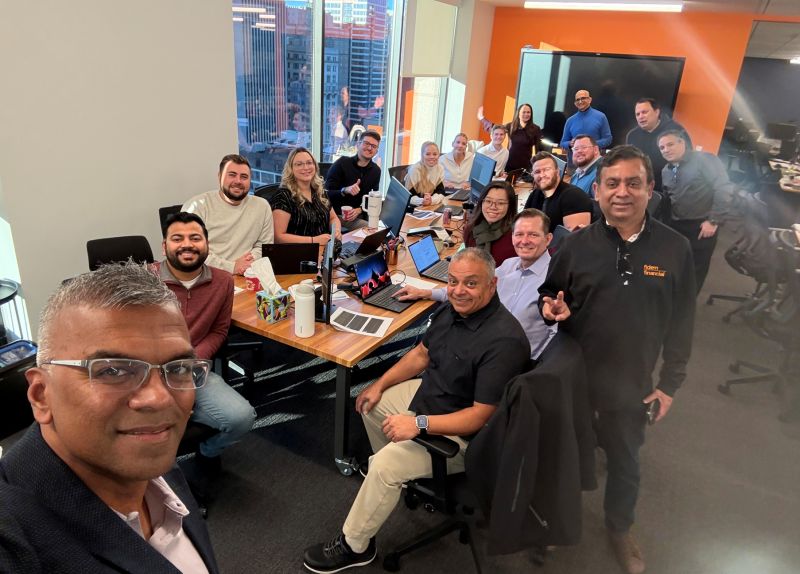
The people around the table
A business spanning capital, credit, and customer relationships requires people who can own different decisions. In November 2025, Fidem announced four senior hires: Nayan V. Kisnadwala in finance, Rachana Bhatt in marketing, Tony Hill in corporate development, and Susan Steinthal as general counsel. Gunawardena welcomed them publicly. The mix of responsibilities explains something about the company’s direction without needing a slogan.
Risk leadership followed. In April 2026, Fidem appointed Yasmine Anavi Chief Risk Officer, reporting directly to him. The announcement tied the appointment to increasingly complex portfolios and the expansion of underwriting and funding partnerships. Growth, in that account, meant increasing the capacity to make and supervise decisions as well as increasing business volume.
A smaller story provides a different view of the same workplace. Jack Burgess described spending three months as an Economic Research Intern at Fidem, working directly with Gunawardena. His work connected research questions with financial-market developments, particularly in credit cards. He combined remote work with trips to Philadelphia and thanked the team for its guidance.
An internship is a modest episode beside a multibillion-dollar acquisition figure. It is nevertheless a useful one. It places the chief executive in a working relationship with someone at the beginning of a career, discussing the economic forces that shape the business. The distance between a school speech and a company office becomes rather smaller.
Back to the students
At Nalanda, Gunawardena spoke about a working world changing around the next generation. His own route had taken him through education in Georgia and Toronto, institutional finance, and founding a company in Philadelphia. Returning to the school let him address the question from another end of the journey: how does a young person choose work before knowing where it will lead?
His answer centered on interests and strengths. It was personal advice, delivered with the perspective of a former pupil who had been away for decades. There was no promise that students could copy his career step for step. The circumstances he described were changing too quickly for that.
In his business, the next step involves partners, portfolios, and decisions that have to hold together over time. In the school speech, it involved choosing something worth pursuing. Both leave room for the work that follows an initial commitment. Gunawardena’s career gives that idea a practical setting: a transaction can be signed, a company can be founded, a student can leave school. Then the daily work begins.