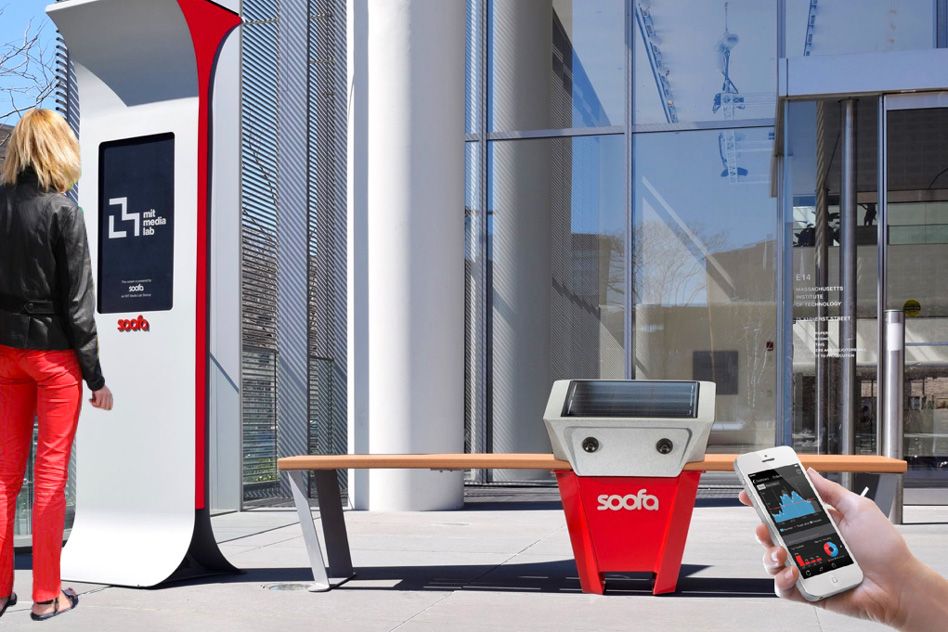
Sandra Richter thought the USB ports looked like eyes. The concrete, she said, looked like a little head. In Boston in 2014, the future of the city had acquired a face, and it was attached to a park bench. People could sit down, plug in a phone and let sunlight do something useful. A municipal technology strategy had become an object you could encounter on a walk.
Richter had helped invent that object with Nan Zhao and Jutta Friedrichs. Their company, Soofa, began with an impatience familiar to anyone who has sat through a presentation about the future: at some point, somebody ought to make a thing. The bench gave their ideas somewhere to land. It also gave a person with a dwindling battery a reason to stop.
Today, Richter works publicly as Sandra Ferguson. Her current project, Riffhaus, makes clothing inspired by music. Between the solar bench and the garment lies a career in which technology repeatedly meets the ordinary pleasures of being outside, being among people and having something to express. There are municipal partners in this story. There are also flowers.
A bench with little eyes
She came from Germany, studied at the University of the Arts in Berlin and arrived at MIT and in Boston in 2012. Her early research included urban mobility. The subject was large: how people move through cities, and how design might influence their choices. But her interests reached beyond the efficient passage of vehicles. In describing her Black Forest background, she spoke of loving the outdoors while depending on her phone as a gateway to information.
That combination helps explain the appeal of the bench. The phone and the park could coexist. Someone could stay outside and still have access to a connected life. Charging a device was a small convenience, but the setting made it a public one. An outlet usually belongs to a building, a business or a private room. Soofa put the possibility of a charge alongside a seat.
Richter and Zhao began developing the fixture as a side project in 2013; Friedrichs joined them. By June 2014, a prototype stood in Boston’s Titus Sparrow Park. That same month, Richter participated in the first White House Maker Faire, where the solar-powered bench appeared among inventions selected for a presidential showcase. An object designed for a neighborhood had made a rather ambitious excursion.
The Boston pilot then put benches into everyday use. Residents were invited to give them names. Hedy, Nan, Mia and Franklin were among the early arrivals. Naming a piece of infrastructure is a cheerful concession to the fact that people do not form attachments to procurement categories. A bench called Franklin has at least a chance of becoming a landmark.
“Dream big but keep your feet on the ground.”Sandra Richter, 2015
Richter used that phrase to describe the company’s approach. Her frustration with smart-city talk was explicit in an early interview, as was her concern about an industry dominated by large, male-led corporations. She saw room for smaller interventions. There was considerable ambition behind the smallness: she wanted urban residents to participate in the technology surrounding them, rather than merely live beneath it.
The bench was also a communication device for the idea itself. Solar power could be seen doing a job. A wireless connection and sensors could extend the fixture’s usefulness. Its approachable form lowered the temperature of the discussion. You might have opinions about urban technology; you could also simply need a seat. The object allowed both sorts of encounter.
The neighborhood gets a noticeboard
The next useful surface was vertical. With the Soofa Sign, the company moved from somewhere to sit to somewhere to look. Transit information, local events and civic notices could share a digital display. It was a change in the product, and a continuation of the same concern: how to make information available in the places people already occupy.
In August 2016, Richter presented a proposed digital community bulletin board to the Cambridge Redevelopment Authority. The proposal concerned Kendall Square. This is the less photogenic work behind a public object: a presentation, a site, permission to put something there. A street fixture needs a relationship with the people responsible for the street.
Richter also described a commercial opening. Traditional outdoor advertisements could be expensive to produce and were often associated with national brands. A digital surface could change its content more easily. That made room for civic communication, businesses and residents on the same platform. The display’s value depended partly on the variety of people who could use it.
Soofa called the sign a neighborhood news feed. The phrase is useful because a neighborhood is already a network, with its own recurring information needs. A visitor wants directions. A resident wants to know what is happening nearby. A local business wants to be noticed by someone who might actually walk through its door. A screen on a sidewalk can meet those needs at their shared geographical point.
In June 2021, Soofa introduced AdBuy, an online platform for purchasing neighborhood outdoor advertising. Buyers could select locations and campaign dates without the traditional sequence of planning with a sales representative. Richter described the goal as making the medium available to businesses of different sizes. The practical challenge had shifted again, from access to electricity to access to an audience.
These products placed her in a world of multiple customers and constituencies. Former colleague Ed Krafcik recalled working alongside her on products serving municipalities, property owners, advertising agencies and businesses. His account emphasized her attention to customers and her ability to organize people around their problems. The bench might look simple. The relationships required to put it into circulation were considerably less so.
An office with room to grow
There is another way to measure a founder’s work: follow what happens to the people who join the company. In 2019, Molly LaFlesh described arriving at Soofa almost by accident, encouraged by a friend to interview. She was drawn to the mission, the women-founded team and an office where dogs wandered around. It sounds like a job interview with several competing attractions.
LaFlesh wrote that Richter helped her advance from Office Manager to Chief of Staff before the end of her first quarter. She also credited Richter with introductions to women who could mentor her. This is a concrete account of opportunity: a change in responsibility, followed by access to people further along the same road.
Other employees described related experiences. One joined after hearing Richter speak at an InspireHER event. Another had interviewed for a different opening before Richter asked her to take a role connecting businesses with their communities. These recollections belong to particular colleagues and a particular period. They show a leader willing to see possibilities beyond the original job description.
The office details are pleasingly specific. LaFlesh mentioned a purple couch, a book club and documentary screenings about Beyoncé and Ruth Bader Ginsburg. In the same account, she described direct feedback and hard work. The company’s social life and its expectations occupied the same room. A couch can make an office welcoming; it still leaves plenty of space for an uncomfortable conversation about a deadline.
Richter’s own role eventually changed too. A later LinkedIn recommendation from a successor to the Soofa CEO position describes her as a patient coach and mentor during that transition, and refers to her subsequent business-development work. Her present biography looks back on Soofa as a decade spent building public technology systems. She has since chosen another field in which to build.
Flowers made by a machine
By the 2023 MassArt x SoWa Design Biennial, Sandra Ferguson was showing work through Karlaah Atelier. Its inspiration included Hermann Hesse’s 1918 poem “Voll Blüten.” The pieces combined 3D-printed flowers with hand-painted detail. A literary image had become a fabrication problem, then something that could be worn.
That combination of processes deserves a close look. A printer supplies a form; painting brings another kind of attention to its surface. The work asks different things of technology than a solar bench does. A garment can pursue delicacy, theatricality and personal meaning. It can be impractical in ways that a municipal installation would have difficulty explaining at a meeting.
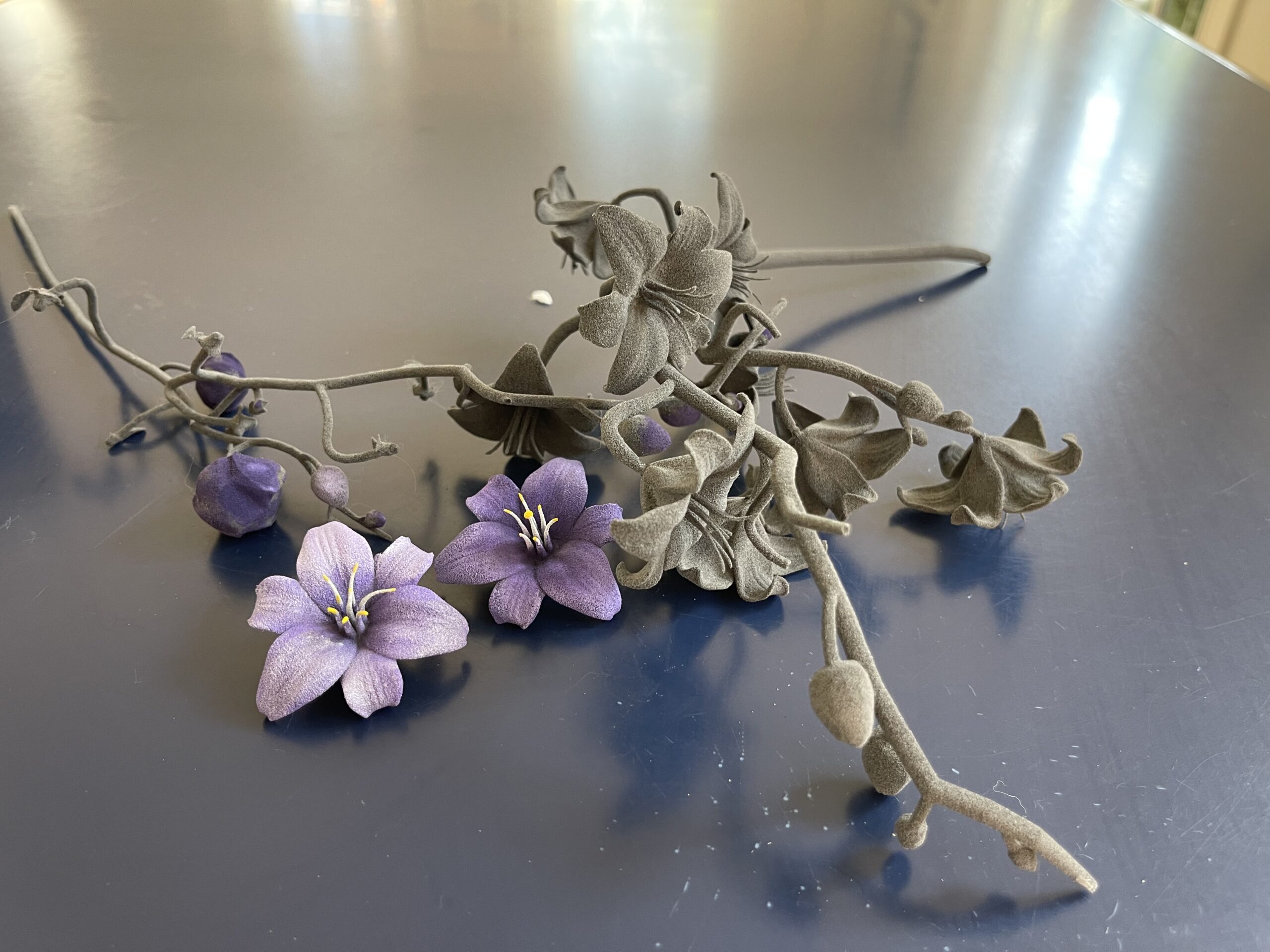
The atelier’s name paid tribute to Karl Lagerfeld, with an added “aah” of surprise. Even the naming makes room for a little theatrical business. Her move into fashion widened the range of objects she could make, while keeping a technical process close to the work. Public furniture had offered one set of constraints. Couture offered another.
A song you can put on
Riffhaus, whose company profile gives 2025 as its founding year, is her current expression of that shift. Ferguson describes herself as a Cambridge-based artist, designer and technologist. The project works across knitwear, printed textiles and generative image systems. Collections are called riffs, and songs can supply their starting points.
Its production model makes the experiments visible. Pieces are made to order, with small runs and an archive. A collection can begin with a musician, a film, a season or a fixation. Each has permission to be particular. The clothes do not have to answer every question the designer might ever ask.
In December 2025, she published an Advent Calendar pairing daily music selections with garments. Contributors chose songs; the project invited readers into the act of translating listening into form. The format supplied both a deadline and a sequence. A new day opened a new door, and the garment had a musical reason for being there.
The distance from a park bench to a music-inspired collection is substantial. Soofa had to coordinate public sites, hardware and commercial partners. Riffhaus can begin with the feeling inside a song. Yet both give an intangible idea a physical address. One might be encountered in a park. The other might be worn into a room.
Richter’s first famous object invited people to sit down for a moment. Ferguson’s newer work invites them to choose what they want to carry into view. Her career has kept making room for those encounters: a useful charge, a neighborhood message, a printed flower. The little eyes on the bench were an early clue. She wanted the things she built to have some personality.