Mapping the least-measured place on Earth
Ninety percent of the planet's livable space is underwater, and we have measured almost none of it. Ravi Pappu treats that not as a tragedy but as a bug worth fixing.
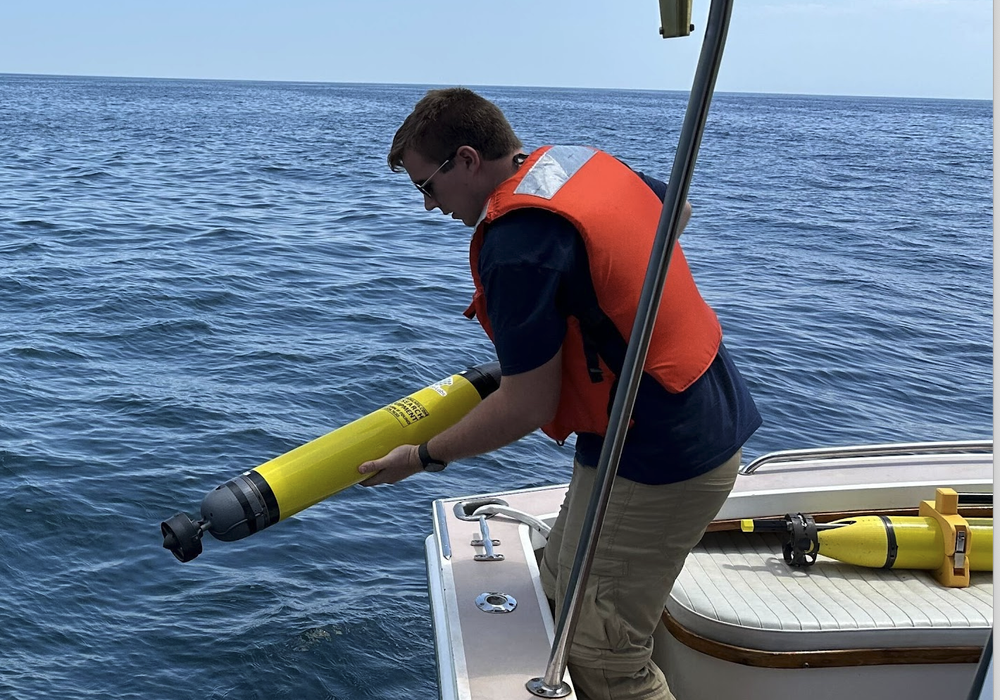
At Apeiron Labs in Cambridge, the product is a tube. Three feet long, five inches across, roughly twenty pounds. It does not look like the future of climate science. It looks like a thermos that went to engineering school. You toss it off a boat or drop it from a plane, and it begins a slow vertical commute: down 400 meters, back up, again and again, sipping temperature, salinity, pH and sound once or twice a day for half a year. Scatter a few thousand of them 10 to 20 kilometers apart and you get something oceanographers have wanted for a century and never had - a living grid of the sea.
Pappu's pitch is mercifully short. "We think of ourselves as the CubeSat for the ocean." Before the CubeSat, getting to space meant a billion-dollar mission. Then small standardized satellites turned orbit into something a university lab could afford. The ocean, he argues, is stuck in the pre-CubeSat era. The instruments are exquisite and ruinously expensive, and the ships that carry them burn $100,000 a day in diesel before they have measured a single thing.
In the last century, oceanographers resigned themselves to calling it the century of undersampling.
That phrase - the century of undersampling - is the whole problem in five words. The ocean runs the weather, soaks up the carbon, hides the storms before they have names. A hurricane spins up because of a pool of warm water hundreds of kilometers wide, invisible from a ship's deck and invisible from a satellite that only reads the surface. "These pools are everywhere," Pappu says. "They can be hundreds of kilometers wide and are literally invisible to us." His robots are the eyes for the part of the ocean nobody can see.
The economics of an expedition
Figures paraphrased from Pappu's public interviews. Bars are illustrative, not to exact scale.
Here is the part that makes Pappu hard to file under any single heading. The ocean is his fourth act, not his first. He did not arrive from marine biology. He arrived from cryptography, RFID tags, and a stint inside the venture arm of the CIA - and the through-line is that each time, he built the cheap tool a field did not know it was allowed to want.
The first tool was an idea most people have used without ever hearing its name. During his MIT PhD, Pappu shined a laser through a disordered chunk of material - tiny glass beads frozen in epoxy - and recorded the chaotic speckle pattern that came out the other side. That pattern is effectively impossible to clone, because you would have to reproduce the exact 3D position of every microscopic bead. He turned physical messiness into an uncopyable fingerprint and called it a Physical One-Way Function. The world renamed it the Physical Unclonable Function, baked it into chips, and largely forgot whose dissertation it came from.
Humanity needs ocean measurements, and we need them at a scale that has never been attempted before.
The origin story is better than the resume. Growing up in 1980s India, Pappu saw a hologram on the cover of National Geographic and could not let it go. "I was so taken by it that I decided I needed to learn how to make those three-dimensional images." There was no internet to consult, so he did the analog thing: he found out who the world's holography authority was - Steve Benton at the MIT Media Lab - and mailed him a letter addressed, more or less, to "Steve Benton, holography researcher, MIT, USA." It arrived. Benton wrote back. For roughly ten years the professor mentored a teenager an ocean away, until Pappu finally showed up in person. "Eventually, about 10 years after I saw my first hologram, I wrote to Steve and I said, 'I did all these things you asked me, now I want to study with you.'"
That is the tell. A man who will wait a decade for a teacher is not in a hurry to be impressed by hard problems. After MIT he co-founded ThingMagic, an RFID-reader company that helped make the early internet-of-things readable; Trimble bought it in 2010. Then came In-Q-Tel, where as CTO he sat at the strange intersection of frontier technology and national security, scouting quantum, AI, IoT and 5G. It was there, looking at what the world could and couldn't measure, that the ocean problem snapped into focus.
The float, by the numbers
Apeiron, founded in 2022, is what happens when that observation gets a budget. In February 2026 the company closed a $9.5 million Series A led by Dyne Ventures, RA Capital's Planetary Health practice and S2G Investments, with Assembly Ventures, Bay Bridge Ventures and TFX Capital joining. The customer list reads like a list of people who lie awake at night for very different reasons: the Pentagon, which wants to hear submarines; fisheries, which want to find fish; meteorologists, who want to see the storm before it forms; and offshore-wind developers, who need to know the water before they build in it.
The robots are deliberately humble. They deploy from boats or aircraft, plug into existing Navy launch gear, and phone their readings home to a cloud platform. No diesel, no expedition, no $100,000 day. "We lower the carbon footprint and cost of gathering ocean data because everything else needs a diesel ship," Pappu says. The radical move is not any single sensor. It is the decision to make the sensor cheap enough that you can have thousands of them, and to treat ocean data the way the rest of tech treats data - as something that should be abundant, continuous and boring.
Ask him what he is actually doing and the answer is disarmingly plain: "What we're focused on is figuring out how the ocean works." He has cut the cost of an ocean data point roughly a hundredfold. He says that is not enough. He wants a thousand. Given that the last person who underestimated his patience was waiting on a letter from a teenager in India, betting against the timeline seems unwise.
The team he has gathered tells you what kind of company this is. His VP of engineering, Will O'Halloran, founded Square Robot and ran technical operations at Bluefin Robotics, including work on the searches for MH370 and Amelia Earhart's plane - which is to say, he has spent his career looking for things lost at the bottom of the ocean. The AUV architect, Knut Streitlien, has been designing underwater vehicles for decades, with the Bluefin and Remus lineages on his resume. Jeremy Brown, who runs autonomy, founded Jaybridge Robotics before Toyota bought it. These are not people who needed a new job. They are people who saw a chance to do underwater robotics without the usual ceiling of cost.
That ceiling is the quiet villain of the whole story. For decades the field optimized for capability: build the most sensitive instrument, mount it on the most capable ship, accept that you will only get a handful of measurements because each one is precious. Pappu inverted the equation. Make each measurement cheap enough to be disposable, and abundance does the rest. It is the same intellectual move he made with PUFs - take something messy and physical, the speckle of a laser through glass beads, and convert it into something useful and scalable - and the same move the CubeSat made for space. He keeps finding fields that have mistaken expensive for necessary.
There is an environmental argument folded inside the engineering one. Every legacy ocean measurement rides out on a diesel ship; Pappu's floats drift on currents and battery, then surface to report. Cheaper data and a smaller carbon footprint turn out to be the same design choice. For a problem whose urgency comes from a warming climate, building the measurement tool that does not itself burn fuel is more than a marketing line - it is the point.
Quotable
"Getting data from the subsurface ocean has always been really hard. Everything's an expedition."
"We think of ourselves as the CubeSat for the ocean."
"Our mission is to lower the barriers to ocean data."
"These pools are everywhere... and are literally invisible to us."
Things that don't fit on a resume
- His Erdos number is 3 - a short hop, mathematically speaking, from Paul Erdos himself.
- He reached his future PhD advisor by mailing a letter with no street address, just a name and "MIT, USA."
- The invention from his dissertation now lives inside chips around the world, usually credited only by its acronym, PUF.
- He describes himself as a "science / technology / mathematics omnivore."
- Apeiron's floats sample temperature, salinity, pH and acoustics - and listen for endangered species with hydrophones.
- The company was incubated alongside Applied Invention and S2G Investments.