BREAKING: Triton minesweeper configuration reported "ready now" for U.S. Navy - Mar 2026
90 days at sea on sun and wind, zero diesel, zero crew
$60M raised through Series D - Lockheed Martin among backers
Gulfport plant can build up to 360 Tritons a year
Tested in the Persian Gulf, Black Sea, West Africa & the Gulf of America
BREAKING: Triton minesweeper configuration reported "ready now" for U.S. Navy - Mar 2026
90 days at sea on sun and wind, zero diesel, zero crew
$60M raised through Series D - Lockheed Martin among backers
Gulfport plant can build up to 360 Tritons a year
Tested in the Persian Gulf, Black Sea, West Africa & the Gulf of America
Who they are now
A 14-foot machine, alone in the Persian Gulf, watching
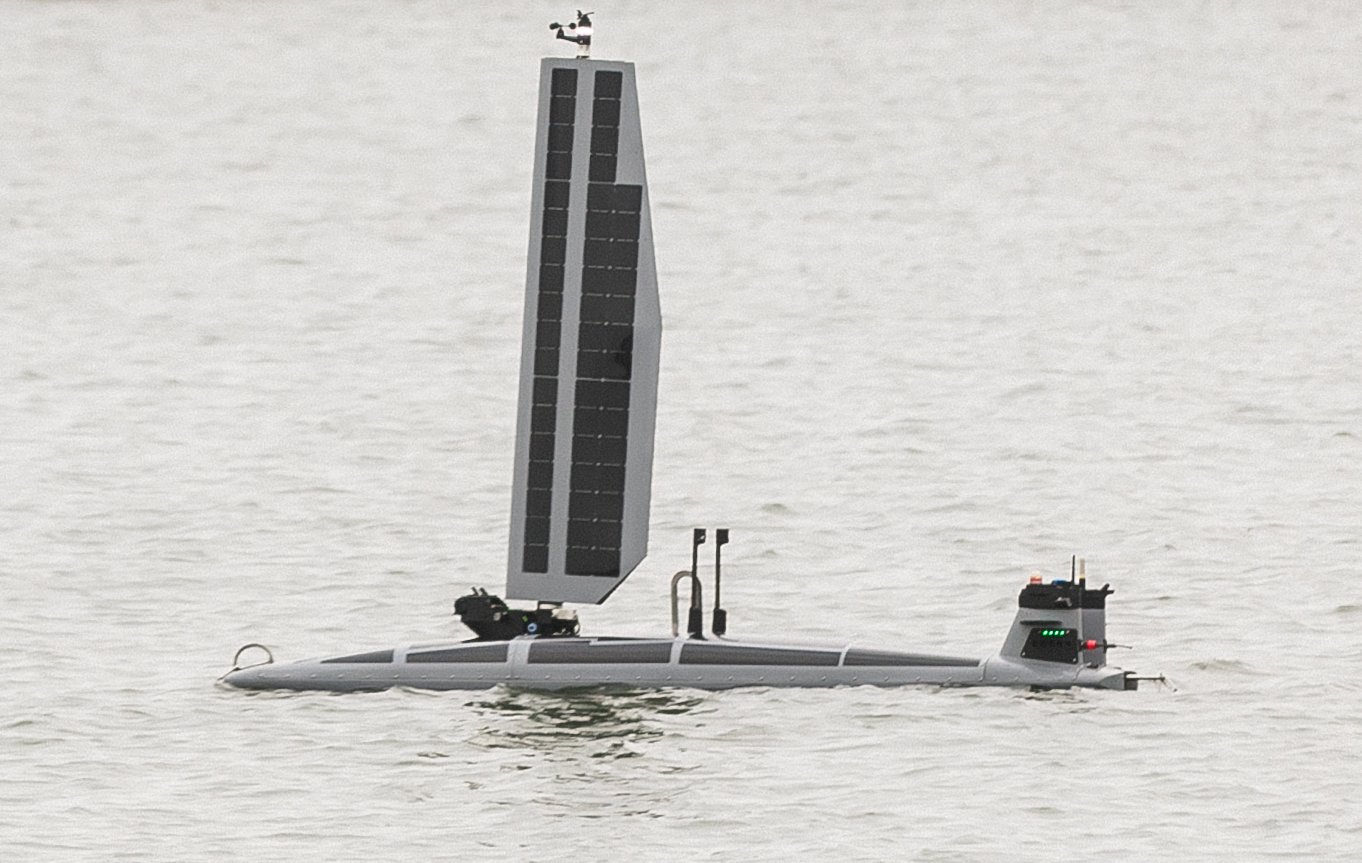
Somewhere off the coast, a vehicle the size of a small dinghy is doing something no other machine can. It is sailing on the surface, soaking up sunlight. Then it folds down, slips under the waves, and disappears for days. No engine noise. No diesel slick. No one aboard. When it surfaces, it relays back what it saw - above and below the waterline - and keeps going.
That machine is the Triton, and the company behind it is Ocean Aero, headquartered in Gulfport, Mississippi. It calls itself a team of nearly one hundred people who source their parts from the U.S. and its allies. What it actually is, increasingly, is one of the more interesting answers to a question navies and scientists have been asking for decades: how do you keep eyes on the ocean without putting people there?
"We bring the ocean and its data to you, with novel hardware and software."- Ocean Aero, company mission
The problem they saw
Ocean work is expensive, dangerous, and dirty
The ocean does not give up its data cheaply. Traditionally, watching it means a crewed ship burning diesel, a crew that needs to sleep and eat and come home, and a budget that climbs the moment you leave the dock. Send people somewhere contested - a minefield, a chokepoint, a stretch of water where someone might be watching back - and the cost stops being financial.
Ocean Aero's framing is blunt: ocean exploration is expensive, dangerous, and dirty. Three problems, one vehicle. Take out the diesel and you lose the dirty. Take out the crew and you lose most of the danger. Make it run for months instead of hours and the math on expensive starts to bend.
"Ocean exploration is expensive, dangerous, and dirty - the Triton is designed to change all three."- The case for the Triton
The founders' bet
Navy veterans who wanted something smaller
Ocean Aero was founded in 2012 by a group of U.S. Navy veterans. Their bet was contrarian for the time: instead of bigger, faster, more powerful crewed platforms, they wanted smaller, quieter, crewless ones that could simply outlast everything else. Endurance over horsepower. Patience over speed.
It is the kind of idea that sounds obvious in hindsight and slightly mad at the start. A boat that runs on sunlight will never win a race. But the founders weren't trying to win a race - they were trying to stay out longer than anyone could afford to chase. Today the company is led by CEO Kevin Decker, with a leadership bench that includes CTO Mark Henderson, COO Robert Marthouse, and Chief Strategy Officer Jordan Cousino.
"A team of nearly one hundred people, sourcing parts from the US and our allies."- Ocean Aero, on its made-in-USA stance
The product
One vehicle, two worlds
The Triton is an Autonomous Underwater and Surface Vehicle - an AUSV, a category Ocean Aero more or less had to invent a name for. Roughly 14.5 feet long and around 775 pounds, it is powered by 740 watts of solar panels plus wind. On the surface it can sail continuously for up to three months. When it wants to hide, it submerges for as long as five days, leaving a low radar and visual signature behind it.
The hull is really a platform for sensors. Customers bolt on what they need: high-resolution and thermal cameras, solid-state radar, side-scan and gap-filler sonar, magnetometers, bathymetry sensors, passive towed arrays, water-quality instruments. Autonomy software handles the navigation, collision avoidance, and the part that matters most - getting the data back to you, from anywhere, at any time.
Sail
Up to ~3 months on the surface, powered only by sun and wind. No fuel runs to ruin the mission.
Submerge
Up to 5 days underwater, with a low radar and visual signature when it wants to stay unseen.
Sense
Swappable multi-sensor payloads: cameras, radar, sonar, magnetometers, water-quality kit.
Send
Real-time data relay and fleet software bring the ocean back to a screen on shore.
The proof
Customers, theaters, and a manufacturing line
A clever vehicle is a science project until someone deploys it. Ocean Aero's Triton has been put through its paces by the U.S. Navy across an uncomfortable list of places: the Persian Gulf, West Africa, the Black Sea, and the Gulf of America. In 2023, several Tritons operated alongside Task Force 59 in the Persian Gulf during maritime situational-awareness experiments. The use cases run from intelligence, surveillance and reconnaissance to mine countermeasures.
It isn't only defense. The Port of Gulfport now uses a Triton to continuously monitor its own seabed for infrastructure changes, carrying bathymetry, side-scan sonar, and magnetometer payloads. Offshore energy operators and oceanographic researchers round out the customer list. And the Gulfport facility is built to scale - up to 360 Tritons a year, which is close to one a day.
360
TRITONS / YEAR CAPACITY
Endurance is the whole pitch
Roughly how long the Triton can keep working, by mode
*Illustrative comparison - crewed endurance is limited by fuel, crew rotation and cost, not capability. Triton figures are vendor-stated maximums.
"Powered by 740 watts of solar panels, the vehicle can sail continuously for up to three months."- Reported Triton specifications
The mission
Sustainable, crewless, and proudly domestic
Ocean Aero ties three threads together: sustainability, autonomy, and a made-in-America supply chain. The vehicle runs on weather, not fuel. It runs without people aboard. And the company is pointed about sourcing its parts from the U.S. and its allies, with American investors - a stance that matters when your biggest customer wears a uniform.
That last point is more than flag-waving. Defense buyers care intensely about where hardware comes from, and a clean domestic supply chain is a sales argument as much as a value. The fact that it also happens to align with the founders' conservation-minded origins is the kind of coincidence that good companies learn to lean into.
"The world's only autonomous submarine powered entirely by solar and wind energy."- On the Triton's place in maritime defense
Why it matters tomorrow
The ocean is getting more crowded, and more contested
Underwater cables carry the internet. Offshore wind farms and oil platforms need watching. Mines are cheap and patient. Illegal fishing fleets go dark. Every one of these is a job that is too long, too dull, or too dangerous for a crewed ship to do well - and exactly the kind of job a vehicle that runs for three months on sunlight was built for.
Competitors exist - Saildrone and Liquid Robotics among them - but Ocean Aero's particular trick is the dual mode. Surface when you want range and power; submerge when you want to disappear. Whether that bet pays off at scale is the open question. The manufacturing line says the company intends to find out.
"Initially appearing as a mere toy boat, it has emerged as a key player in the military's pursuit of unmanned systems."- IndraStra Global, on the Triton
Back to that machine in the Gulf. A decade ago it would have been a crewed ship, a fuel bill, and a roster of people far from home. Now it is a solar-and-wind robot that sails, dives, watches, and reports - and then does it again tomorrow, and the day after, for three months. The ocean is still expensive, dangerous, and dirty. The thing sent to watch it no longer has to be.