Twenty parcels a day is an awkward extracurricular activity. Samuel Okwuada was studying at the University of East Anglia in Norwich while running Oyoyo, a business that helped Nigerian shoppers buy fashion from the United Kingdom. Orders were coming in. So were the deliveries. The university, he later recalled, was less enthusiastic about the arrangement than his customers.
It is an excellent introduction to a career spent discovering what happens after an idea works. A web scraper can load a catalogue. Currency conversion can make a price legible. Shipping costs can be calculated. Eventually, somebody has to receive the parcels. Okwuada’s student business had reached the point where the internet required rather a lot of floor space.
He sold Oyoyo after about eighteen months. He also built and sold Macbundler, a venture connecting people with Mac software. Years before co-founding Remedial Health, he had already encountered the less photogenic parts of entrepreneurship: distribution, changing markets and a timetable with competing claims on it. His career would keep returning to those practical details.
The student who kept opening businesses
Okwuada’s early ambitions included becoming a pilot. His eventual course of study emerged from a negotiation with his parents. He went to the University of East Anglia to study pharmacy, completing his studies in 2014. The qualification and the software projects proceeded alongside one another. A university course supplied one kind of education; customers supplied another, with fewer scheduled holidays.
By then, he had been teaching himself programming since his teenage years. The appeal of making things long preceded a company name. “I like to build things,” he has said. That is a modest description of an appetite that can make a quiet student room a surprisingly busy place.
Macbundler addressed a question familiar to software developers: how do people discover what you have made? Okwuada ran it for four years before selling to a US company. Apple’s arrival with its own Mac App Store changed the landscape. A founder can write the code and still find that somebody else has rearranged the shopfront.
His interests also extended beyond selling. At university, he represented ethnic minority students and later international students in the students’ union. His public project list includes Retain, a tool concerned with customer relationships and keeping users. Representation, acquisition, retention: the vocabulary changes between a union meeting and a software product, but each requires paying attention to other people.
These early projects give the later founder biography some useful texture. His experience was already crossing between building, selling and organising. Selling a venture also closes a chapter. The next business has to find its own customers, justify its own demands and survive its own particular inconveniences. A previous exit cannot receive tomorrow’s deliveries.
“I like to build things.”
Samuel Okwuada
The passenger seat apprenticeship
After studying and working in the UK, Okwuada returned to Nigeria. He wanted to understand how business worked on the ground. Rather than assume that a degree and some entrepreneurial experience supplied the answer, he sought internships and offered to work without pay. The arrangement surprised some prospective employers. It also gave him a clear reason to be there: learning.
In 2015, Adpharm accepted him and paired him with Victor Benjamin, an experienced sales representative. The future co-founders first worked together in the ordinary course of a working day. Their business relationship developed through visits and sales, with Okwuada learning a market that Benjamin already knew. The partnership began several years before Remedial Health.
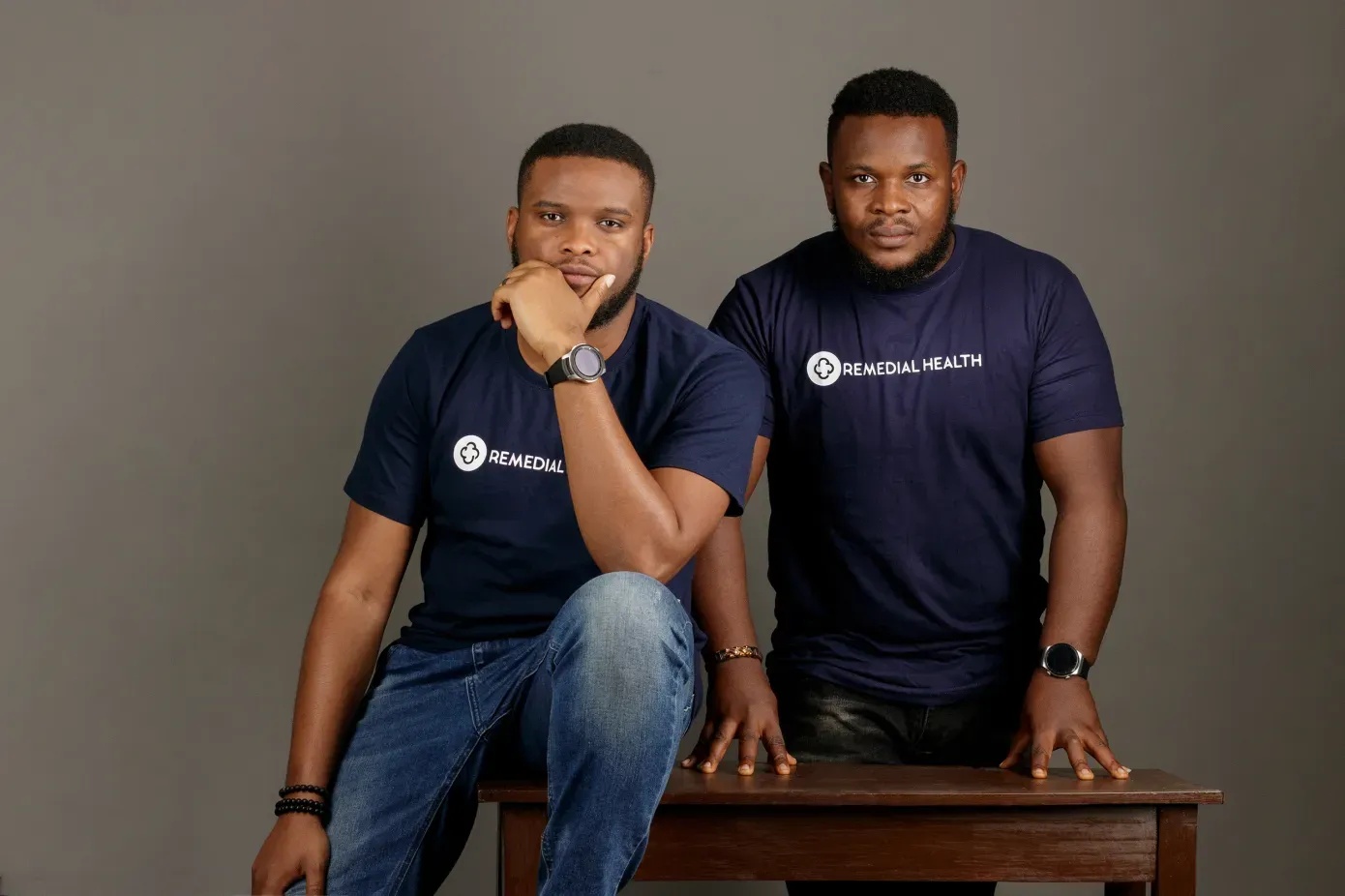
The pairing matters because founder biographies tend to follow one name at a time. A company has no such obligation. Benjamin brought a long sales background; Okwuada brought experience developing software and starting ventures. Their investor, Ventures Platform, has described a close personal and professional bond alongside those complementary skills. The relationship was part of the business’s working equipment.
Okwuada subsequently started an import business in 2016, with Benjamin supporting sales. Remedial Health followed, with Y Combinator listing its founding year as 2021. The sequence contains several changes of role. The student entrepreneur became a returning graduate, the graduate an intern, and the intern a collaborator. Each move put him in contact with something his previous experience had left out.
When the transaction leaves the screen
Remedial Health brought ordering, inventory, financing and distribution into the same business. Its development followed customer requests that went beyond the founders’ earlier product offering. Okwuada has described building an internal distribution system, supported by regional hubs and outside partners when additional capacity was needed. The company had to organise the movement of goods alongside the movement of information.
That is a recognisable complication for anyone who has watched an online order become a delivery. The screen can make buying look wonderfully compact. The work expands again on the other side. Stock has to be available. An order has to be assembled. Transport needs to turn up. Finance has to follow terms that make the transaction workable for both sides.
Four connected jobs in the operating model. A conceptual diagram.
Okwuada has been specific about the difficulty of moving goods between Nigerian states. Poor roads, unreliable third parties and encounters with tax collectors make a delivery schedule more complicated than a line drawn on a map. Software still has work to do. So does the person responsible for the vehicle. A route on a dashboard has the considerable advantage of never needing fuel.
His response has been to build around the operating conditions. In his 2026 reflections, he describes credibility, coordinated systems and financial discipline as foundations for the company. “Strategy must reflect the terrain.” The sentence is short enough for a slide. Its consequences include hiring, transport, working capital and a great many decisions that will never appear on one.
The money had two different jobs
Remedial Health entered Y Combinator’s Winter 2022 batch. That year brought pre-seed and seed funding. In 2023, it announced a twelve-million-dollar package: eight million dollars in Series A equity and four million dollars in debt. QED Investors and Ventures Platform co-led the equity financing. Y Combinator, Tencent and Gaingels also participated.
Announced financing, split by instrument. Company funding, not personal wealth.
The distinction between equity and debt belongs in the story. An inventory business has cash requirements as well as product-development costs. The funding announcement describes different sources of capital serving a company with several connected responsibilities. Reducing everything to a single total makes the headline tidy while losing something useful about the work underneath it.
Ventures Platform had backed the company from its pre-seed stage. It described helping with operational guidance, introductions and access to debt capital as the relationship developed. The outside network was growing alongside the internal one. For Okwuada, company building now included people whose contribution arrived through financing and connections as well as through product development or sales.
A company has to learn without its founder
Growth also changes the founder’s own job. In a 2024 ecosystem report, Okwuada described company culture as something shaped by founders and early employees. His practical response involved hiring for the principles he wanted to preserve and asking employees for feedback, including anonymously. The organisation needed ways to tell him what was happening inside it.
The anonymous part is worth lingering over. A founder can explain what a company stands for; employees encounter what it rewards and tolerates. Inviting a reply without a name attached creates another route for information to travel. In Okwuada’s account, maintaining culture involves listening as well as choosing colleagues. A larger organisation cannot rely entirely on the founder’s personal impressions.
By his February 2026 conversation with Peace Itimi on Founders Connect, the company was described as employing about 450 people and operating roughly 100 vehicles. He discussed delegation and allowing new hires room to work. Those are interview-era figures, but they suggest the scale of the change from a student managing his own projects.
The bedroom developer can personally alter a product. A company with hundreds of employees needs decisions to happen in many places at once. Giving people responsibility changes the founder’s relationship with his own creation. The work includes choosing who should act, establishing expectations and resisting the temptation to make every question return to the same desk.
The route he chose
In that same long conversation, Okwuada identified honesty as a non-negotiable value and talked about the place of fundraising in his approach. The discussion also offered small details of routine, including early mornings and coffee. These are ordinary ingredients in a career often presented through funding figures. The company still has to be run on a particular morning by particular people.
His stated ambition remains to build coordinated infrastructure in Nigeria, with an eventual reach across Africa. That ambition has a history behind it: software ventures during university, a return home, an apprenticeship in sales, a co-founder relationship and an organisation whose responsibilities extend well beyond its application. The scale has changed. The practical questions have kept their place.
The student whose business generated too many parcels is now responsible for a company in which distribution is part of the design. It is a pleasing continuity, though probably less pleasing when a delivery goes wrong. Okwuada’s education has kept finding new classrooms. Several of them have wheels.
Keep the conversation going
Explore Remedial Health, follow Samuel on LinkedIn or X, and see the Y Combinator company profile.
Watch Samuel with Peace ItimiFounders Connect · February 2026 · 1 hr 39 minThe early ventures and partnership
The 2023 financing announcement
Nigeria’s startup ecosystem and company culture
A 2026 conversation about building for the long term