The first thing samdesk built was useful. That was the problem. In 2014, the Edmonton startup then known as Social Asset Management gave journalists a cloud workspace for finding, sorting, annotating, and verifying the flood of eyewitness material spilling out of Twitter and Instagram. A reporter could label a post fake, verified, approved, or cleared. Newsrooms in the United States and Britain used it. The Associated Press later invested. The tool made a difficult job faster, which is exactly how a company can spend years polishing the wrong abstraction.
Founder James Neufeld, who came from broadcast technology and journalism, eventually described the original approach with a phrase that founders should tape above their desks: “We had built a faster horse.” A person still had to sit at the controls and hunt. Samdesk had improved the interface around the bottleneck without removing the bottleneck.
01 / The pivotAutomate the search, then follow the expensive delay
Around 2017 and 2018, the company began automating what a good journalist did manually: notice an unusual cluster of posts, test whether the accounts and images looked credible, locate the event, and keep the story updated as new evidence arrived. The raw material was the same. The product changed from a better pair of binoculars into a radar.
That change also revealed customers beyond media. A newsroom wants to publish first without publishing nonsense. A security team wants to know whether a fire is near a warehouse. A travel manager wants to know whether an airport closure catches an executive in transit. A delivery platform wants to know which workers and orders sit inside a danger zone. The second group has a direct operational cost attached to every minute of uncertainty.

Samdesk raised C$3.6 million in 2020 as COVID-19 made the weakness of lagging crisis-monitoring routines hard to ignore. In September 2021, newly rebranded from SAM, it raised a C$13.5 million Series A led by McRock Capital, with HarbourVest Partners, Export Development Canada, and Adventure Capital participating. Public reporting put total financing at roughly C$20 million at the time. The company said it would invest in product development and expand sales, marketing, and customer success.
02 / The machineAn alert is only the first draft of a decision
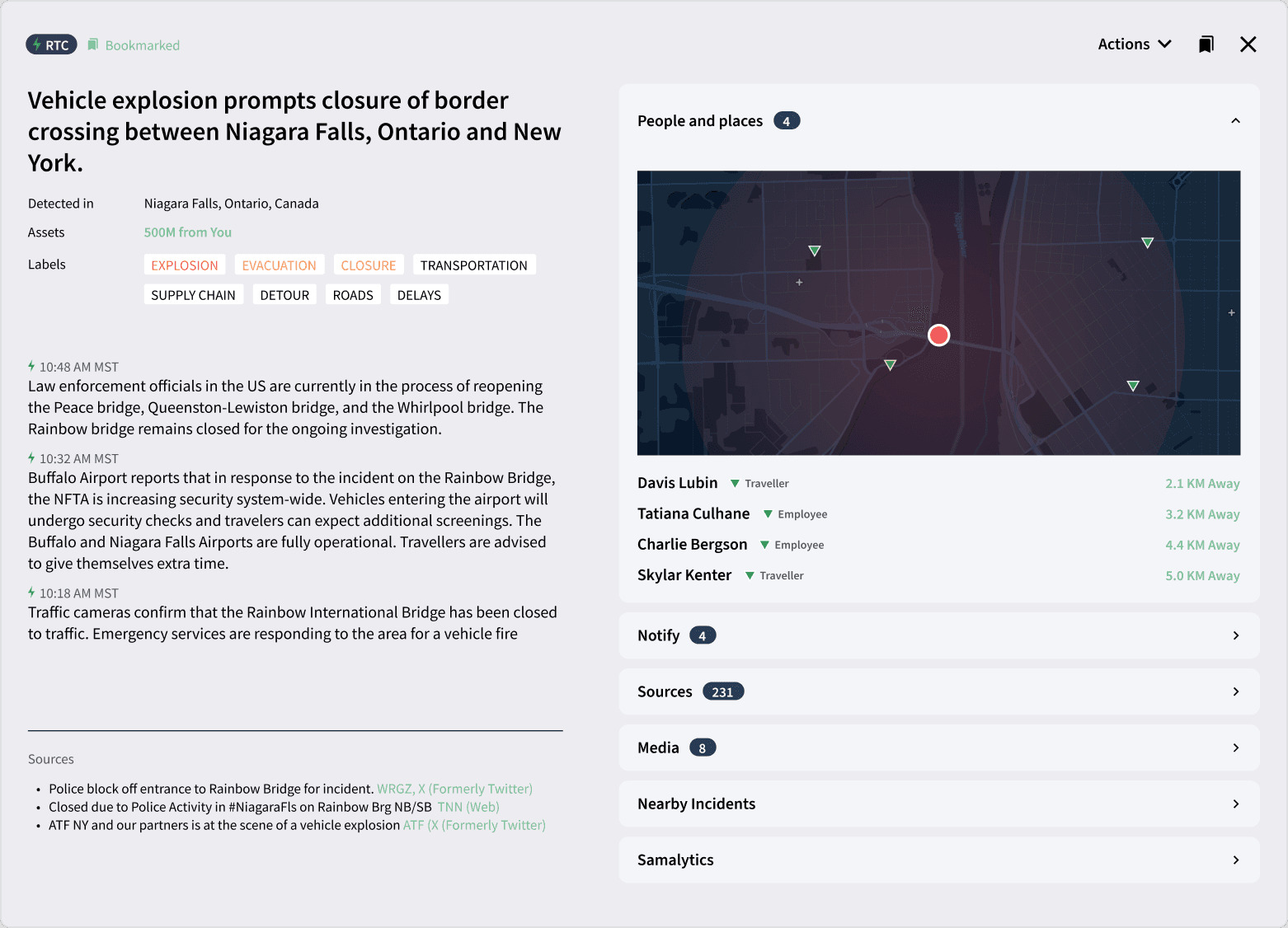
Today, samdesk presents itself as a decision platform for modern security operations. It ingests open and licensed material from social platforms, local news, official sources, weather feeds, community networks, and other streams. Machine-learning systems look for unusual activity, cluster related fragments into one evolving incident, classify severity, geolocate it, and produce a summary. Human analysts validate the important alerts. Customer context then answers the question that generic breaking news cannot: who and what is close enough to care?
A samdesk alert can include source material, visuals, a severity score, location, nearby assets, and updates as facts change. Integrations move that intelligence into ArcGIS, Slack, Microsoft Teams, Resolver, HR systems such as Workday and BambooHR, travel tools including SAP Concur and Egencia, and protective-communications software from Genasys. Its API lets partners embed the feed in their own maps and dashboards. This is the strategic center of the company: not another destination that asks an analyst to stare at a screen, but a layer that travels into the operating system the team already uses.
03 / The customerDoorDash does not need breaking news. It needs the next safe move.
The cleanest explanation comes from DoorDash. Its around-the-clock trust-and-safety operation watches a footprint that includes Dashers, merchants, customers, delivery zones, and active orders. During a developing incident, the team must separate weak reports from credible danger, understand proximity, and decide whether to warn a driver, pause orders, reroute deliveries, update a merchant, or escalate internally.
In samdesk’s published case study, DoorDash says an alert around a Mall of America incident triggered a safety workflow 40 minutes before the official lockdown. During the French Quarter attack in New Orleans, the company says an alert arrived within two and a half minutes, allowing exposure checks and operational adjustments before public updates. Those are vendor-published examples, but they identify the right unit of value. The customer is not buying more alerts. It is buying earlier, more confident intervention.
Where the value appears
Editorial model, not a company metric. Context compounds the usefulness of speed.
Other named users span Nutrien, NATO, LA Metro, and Canada Goose. The use cases stretch across physical asset security, workforce safety, travel risk, executive protection, supply chains, and defense force protection. That breadth is an advantage when the underlying detection engine can be reused. It is also a sales challenge: “crisis intelligence” means something different to a school district, a mining company, and a multinational retailer.
04 / The marketThe contest is not for the loudest alarm
Samdesk sits in a busy neighborhood. Dataminr and Factal compete in real-time event detection. AlertMedia, Everbridge, OnSolve, and Crisis24 overlap through threat intelligence, emergency communication, and broader risk services. The free alternative is a determined analyst with news feeds, social search, maps, and a group chat. “Free” becomes expensive when coverage must run globally, around the clock, with enough consistency to earn trust.
Samdesk differentiates on the combination: early detection, AI clustering, human verification, street-level geolocation, customer-specific impact, and integrations that connect awareness to response. The human layer matters. A machine can find a burst of posts about smoke; an operations team needs confidence that the smoke is real, current, correctly located, and relevant. Samdesk reports 98.5 percent alert accuracy, but buyers should test that figure against their own geographies, languages, incident types, and tolerance for misses.
Its business model is conventional enterprise SaaS with custom pricing and demo-led sales. No public rate card exists. That makes the purchasing test unusually concrete: compare the subscription and implementation cost with analyst hours, duplicate tools, avoidable downtime, duty-of-care exposure, and the cost of a late response. The software fits organizations with distributed people or assets and a team empowered to act. It is harder to justify for a small, stationary operation that can already monitor its local environment.
05 / The limitsEarly warning cannot repair a missing response plan
The product has structural limits. Public data is uneven. A crisis in a well-connected city may generate rich, visual signals; an incident in a censored, offline, rural, or low-connectivity area may not. Licensed feeds reduce dependence on any one social network, but platforms change access rules. Language, sarcasm, recycled video, coordinated manipulation, and ambiguous place names remain stubborn ingredients. Human verification improves trust while introducing cost and a capacity constraint.
Then comes the organizational limit: knowing sooner does not guarantee acting better. If nobody owns the alert, employee locations are stale, escalation rules are vague, or leaders wait for perfect certainty, the extra minutes evaporate. Samdesk works best as part of a rehearsed system with clean asset data, clear thresholds, multiple communication routes, and authority close to the incident. It will not make an unprepared organization resilient by subscription.
What a builder can steal
- Name the manual bottleneck. If the customer still performs the hard step, a prettier tool is only a faster horse.
- Follow the customer with the costliest delay. Newsrooms valued speed; security teams could attach it to safety and operational loss.
- Turn output into context. “A flood exists” is weaker than “a flood sits two kilometers from three travelers.”
- Deliver into the existing workflow. APIs and integrations reduce the tax of adopting one more dashboard.
- Pair automation with trust. In high-stakes markets, a visible human check can be part of the product rather than an embarrassment.
06 / The betMake the map answer back
Recent partnerships make samdesk’s direction legible. Official Reddit API access added community discussion to its data network. Esri named it a 2025 partner-conference Innovation Award winner for real-time ArcGIS work. Genasys connected detection to protective communication. Nextdoor put samdesk-powered safety alerts into neighborhood feeds, reaching a reported 100 million neighbors. ProMED added expert-moderated infectious-disease intelligence. These deals expand both sides of the system: more trustworthy inputs and more places where the resulting decision can go.
The company is also pushing Atlas, a historical and predictive risk product. The logic is appealing. Once years of incidents are normalized and geolocated, a customer can ask not only “what is happening near this site?” but “what tends to happen here, in this season, under these conditions?” The danger is familiar: prediction invites grander claims than detection. Atlas will be useful where historical patterns are stable, data coverage is adequate, and operators treat probability as a planning aid. It will be less useful around novel shocks and thin data.
Samdesk’s story is not that AI can foresee chaos. It is more practical. The internet often notices a crisis before institutions publish a clean account. Software can gather those fragments, machines can organize them, analysts can challenge them, and customer context can turn them into a decision. The company spent its first act helping journalists search the haystack. Its second act began when it decided to find the needle itself.