The Company That Turned Corporate Security Into a Single Screen
Corporate security teams drown in tabs, feeds and spreadsheets. Ontic bet that connecting all of it in one place - now with AI - is worth $287 million to investors and the attention of the Fortune 50.
Open the browser of a corporate security analyst on a busy morning and you will find a familiar mess: a threat feed in one tab, a background-check tool in another, an email chain about a fired employee, a spreadsheet tracking an executive's travel, and a map that has not refreshed since yesterday. The work of keeping people safe has quietly become the work of switching windows. Ontic, an Austin company founded in 2017, built its whole business on closing most of those tabs.
Ontic sells software for a job most people never think about until something goes wrong: physical security. Not firewalls and phishing, but the analog dangers - a threatening letter to a CEO, a stalker outside a facility, a former employee who will not let go, a person of interest showing up in three unrelated reports. The company calls its category "protective intelligence," and more recently "connected security intelligence." The pitch underneath both phrases is the same. The signals that predict real-world harm usually exist before the harm does. They are just scattered across systems that do not talk to each other.
01 / The problemSecurity by browser tab
Large companies have spent two decades pouring money into cameras, badge readers, and guard contracts. What they did not buy was a place to make sense of it all. Intelligence lived in one team's inbox, investigations in a case tool nobody outside the department could see, and executive-protection logistics in whatever spreadsheet a coordinator built by hand. When a threat crossed between those silos - and real threats almost always do - the connection depended on somebody remembering they had seen the name before.
That gap is where liability lives. If a company misses a warning sign that later turns into violence, the first question in the aftermath is what the security team knew and when. Answering it from a dozen disconnected tools is slow, and slow is expensive. Ontic's founders looked at that and saw a system-of-record problem, the same kind Salesforce solved for sales and ServiceNow solved for IT.

02 / What it doesOne record, many jobs
The Ontic Platform is a configurable base that a security team layers products on top of. There is Integrated Research for pulling identity and open-source signals into a case without opening ten more tabs. There is a module for Incidents, Investigations and Case Management, which turns a threatening voicemail into a tracked, documented workflow. There is Real-Time Threat Detection, which watches multiple sources around the clock and flags geo-risk near people and sites. There are structured Threat, Vulnerability and Risk Assessments, so a judgment call about how dangerous someone is follows a defensible method instead of a gut feeling.
In March 2026 the company added Ontic Dispatch, which pulls guard dispatch and physical response into the same platform where the intake, the incident, and the investigation already live. The point is not a new app. The point is that the response now writes itself into the same record, with SLA tracking, instead of vanishing into a radio call nobody logged.
03 / The customersWho is actually paying
Ontic aims at the top of the market. Its customers include Fortune 500 and Fortune 50 companies across technology, financial services, and consumer goods, along with U.S. federal agencies. Named users include Honeywell, Visa, Ally, Meijer, UNFI, American Family Insurance, and Arcfield. Put together, the company says the organizations it protects generate roughly $30 billion in collective revenue and employ more than 14 million people.
That scale is the tell. Protective intelligence software is not a tool a five-person shop buys on a credit card. It is bought by security programs with real budgets, real board exposure, and a legal team that wants every decision documented. The buyer is often a corporate security leader who has spent a career being treated as a cost center and now wants to be seen as a strategic partner. Ontic sells them the thing that makes that argument for them: metrics, a paper trail, and fewer surprises.

04 / The moneyThe $230M KKR bet
In August 2025, Ontic raised a $230 million Series C led by funds managed by KKR, with JMI Equity, Silverton Partners, Ridge Ventures, and Ten Eleven Ventures joining. It is one of the largest single rounds ever raised in physical-security software, and it took Ontic's total funding to about $287 million since a small seed round in 2019. The plan for the money is straightforward: pour it into AI for faster threat detection and automation, expand internationally, and push harder into the U.S. public sector.
Ontic funding by round
Bars scaled to the $230M Series C. Total raised: ~$287M.
When KKR writes a check that size, it is not betting on a feature. It is betting the category is real and durable. Its own partner framed Ontic as setting the standard for what modern security operations should look like, from multinationals to federal agencies. Translation: private equity thinks corporate security is a large, under-tooled market that is finally consolidating onto software - and it wants the platform layer.
05 / The edgeHow it is different
The security-software aisle is crowded, and most of the neighbors do one slice well. Dataminr is strong on real-time alerting. AlertMedia focuses on mass notification. Resolver leans into risk and case workflows. PSIM tools stitch cameras and sensors together. Ontic's argument is not that it beats any single one of them at their specialty, but that it is the connective tissue between all of those jobs - intelligence, investigations, GSOC, executive protection, and response - inside one record instead of five.
Most competitors sell a better tab. Ontic sells the thing that lets you close the other tabs - and keeps a defensible record of every decision you made across them.
That framing also explains the AI push. In a world where every vendor now claims "AI," Ontic's version has a specific job: reduce noise. Summarize a flood of signals, triage what matters, draft the assessment, connect the name in today's report to the one from eight months ago. The value is not magic. It is a smaller pile for a stretched human team to read.
06 / The peopleFounders and the long game
Ontic was started by three people with complementary backgrounds. Lukas Quanstrom, the CEO, came from Sprinklr, where he learned to sell software to Fortune 500 enterprises. Thomas Kopecky brought two decades in investigative research and security. Gagan Jain, a former Sprinklr colleague with stops at Yahoo and SAP Labs, built the engineering. Quanstrom still runs the company; Kopecky and Jain have moved into advisory roles as a broader executive bench - including a chief technology and product officer and a chief revenue officer - has taken over day-to-day scale.
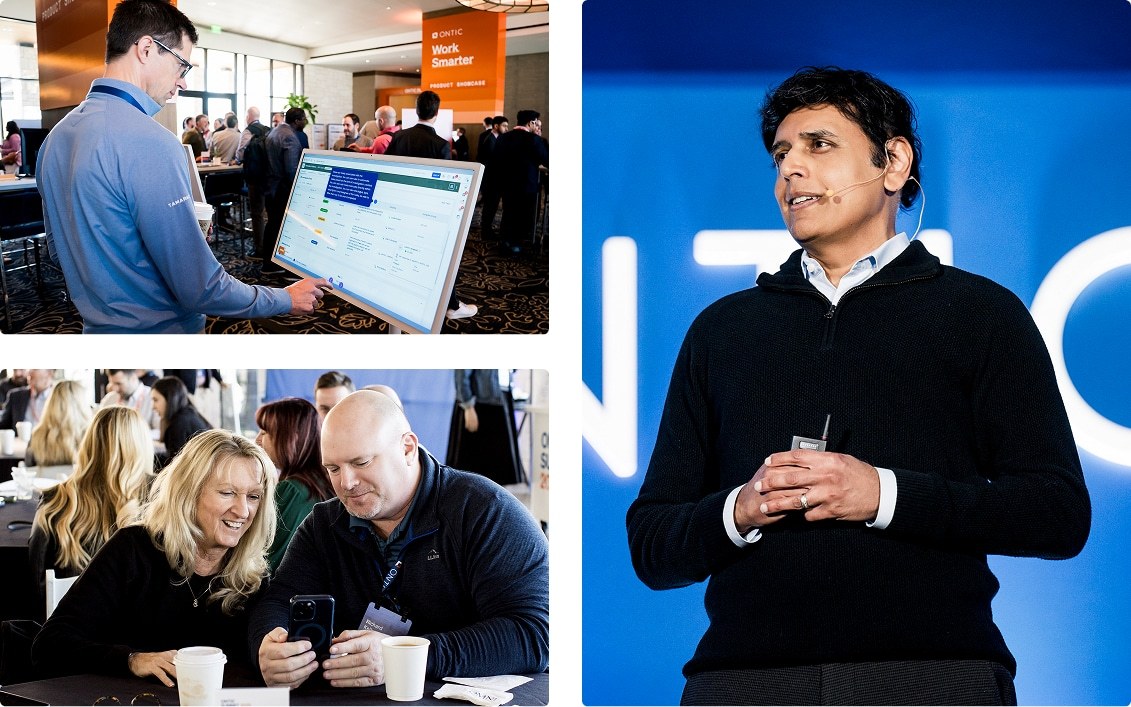
The company also plays a longer positioning game than most vendors. It runs a Center for Protective Intelligence and an annual Ontic Summit, casting itself as a hub for the security profession rather than just a software seller. It is a smart move in a field where the buyers are a tight-knit community that trusts practitioners over marketing.
07 / The catchWhere the bet could wobble
None of this is guaranteed. Selling prevention is hard because the best outcome is invisible - the threat that never became an incident is difficult to put on an invoice. Enterprise security budgets tighten in downturns, and a platform priced for the Fortune 50 has a narrower base than a self-serve tool. "AI that reduces noise" is also exactly what every rival now promises, so execution, not the slogan, will decide it. And moving into government means FedRAMP, procurement cycles, and a compliance bar that slows everyone down.
Still, the shape of the bet is clear and unusually legible. Corporate security has more data and more liability than it has ever had, and less tolerance for missing the signal that was there all along. Ontic's wager is that the answer is not another feed to watch, but one place to watch all of them. The $230 million behind that wager suggests some serious money agrees.