Founder / CEO · Reveal Technology
Garrett Smith
He spent twenty years making life-or-death calls off paper maps. Then he built the software he wished he'd had.
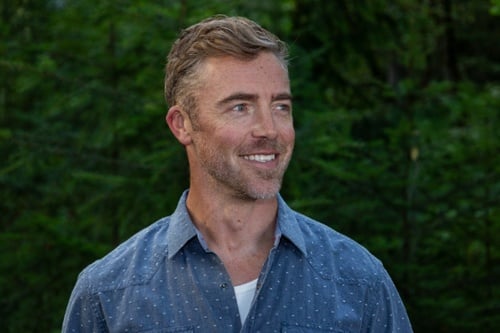
Garrett Smith, near Bozeman. The office has trees for walls.
He spent twenty years making life-or-death calls off paper maps. Then he built the software he wished he'd had.
Reveal Technology sits in Bozeman, Montana, closer to the trout streams than to any venture office. From there, Garrett Smith is shipping software to the sharpest end of modern conflict.
The pitch - Point a drone at a valley. Seconds later, a full-color, high-resolution 3D map of that valley is sitting in your palm. No signal. No cloud. No waiting for a satellite pass or a reachback cell. That is Farsight, Reveal's flagship product, and it exists because its founder once stood in exactly the wrong place with exactly the wrong map.
Smith is the founder and CEO. He is also, still, a U.S. Marine Corps reserve officer. That double life is not a bio detail he keeps quiet - it is the entire operating thesis of the company. Reveal builds for people who have been shot at, by people who have been shot at. Roughly half the team are active military or veterans.
In July 2025, that thesis got a $30 million endorsement. Ballistic Ventures led a Series B, joined by defy.vc, Booz Allen Ventures, Shield Capital, Next Frontier Capital, and Madison Valley Partners. Kevin Mandia - the man who built Mandiant and sold it to Google for $5.4 billion - took a board seat next to General Peter Pace and investor Les Craig.
The most valuable tools are the ones that work when everything else breaks down. - Garrett Smith
The world had gone digital. The battlefield had not. Smith spent more than two decades as a Marine Corps infantry and intelligence officer, with leadership roles in Force Recon and special operations. He describes the core problem in a single sentence that should make any technologist wince: "You're making all these crazy, impactful decisions on the fly with almost no situational awareness."
Everyone in the fight was carrying a supercomputer in a chest rig. Nobody had a live map. The imagery was hours old, the terrain models lived on a server three time zones away, and the network - the thing every consumer app assumes is always there - was the first thing to vanish under fire.
So in December 2018, Smith and his co-founders started Reveal to close that gap. The name is the whole promise. Reveal what the terrain hides. Reveal who is standing in front of you. Do it on the device in your hand, and do it when the signal is gone.
His route to a software company is not the standard one. Smith studied linguistics at Brigham Young University, with a background in Mandarin. He earned a Master of Arts in International Policy Studies from Stanford and a certificate in innovation and entrepreneurship from Stanford's business school. And then - the detail that gives the whole story its texture - he taught himself to code through freeCodeCamp, earning a full-stack web development certification. Mandarin linguist to reconnaissance officer to self-taught full-stack developer. On paper it should not cohere. In person, apparently, it does.
Before Reveal, he had already been circling the seam between defense and technology - head of business development at drone startup Kespry, a senior associate at BMNT Partners, project work at CombatIV. Each stop was a rehearsal for the thing he actually wanted to build.
The Woodside connection - The relationship that seeded Reveal's early backing started at an elementary school. Smith's family and the family of defy.vc's Neil Sequeira knew each other through the Woodside, California community; their kids were classmates. "Garrett had a vision to build a business around technology to help the US military while simultaneously building it for enterprise applications," Sequeira said. "If there's anyone who can do this, it is Garrett and his partner who were both Marine special forces."
That dual-use instinct - defense first, but not defense only - is a thread that runs through everything Reveal ships. The tools that map a contested valley also map a wildfire perimeter. The biometrics that vet a stranger at a checkpoint can identify a disaster victim. Smith keeps one foot in the world he came from and one in the far larger one next door.
Why offline is the whole game - Most software written this decade assumes the network is a given. Smith's entire career taught him the opposite. The places his customers work - a ridgeline in eastern Ukraine, a valley with no towers, a building where the signal died the moment things got interesting - are precisely where the cloud isn't. So Reveal inverts the modern default. The processing happens on the device. The map renders on the phone. Nothing has to phone home. It is a quiet, stubborn engineering choice, and it is the reason the product survives contact with reality.
Converts raw drone video into high-resolution 3D maps on a smartphone, offline, in minutes. It plugs into ATAK (the Android Team Awareness Kit) so a squad can share the same terrain in real time. Operational since 2021 with USSOCOM, the Army, and the Marines - and with allied forces in Ukraine and the UK. Maxar satellite imagery layers in on top.
Mobile biometric identity verification for tactical environments, built to run offline on a phone. Where Farsight tells you about the ground, Identifi tells you about the person standing on it. Together they give a small unit both halves of situational awareness - the terrain and the human - without a network to lean on.
In the next couple of years, we're going to be in that same category as the Andurils of the world. - Garrett Smith
Smith is candid about timing. "In the defense ecosystem, the moment when you really want to dump gasoline on the fire is when you've got product market fit and contracts that allow customers to execute purchase orders with you very quickly." Translation: he waited for the machine to prove it worked, then poured in the fuel.
The receipts back him up - a $33.6M STRATFI contract, a $3.2M Marine Corps Warfighting Lab award, revenue that has multiplied year over year. The comparison he reaches for is Anduril, the defense-tech giant. It is a big claim from a company headquartered where the nearest traffic jam is elk. He seems to like it that way.
The board he has assembled reads like a signal to the rest of the market. Kevin Mandia spent his career on the offensive edge of cybersecurity before selling Mandiant to Google. General Peter Pace served as Chairman of the Joint Chiefs of Staff, the most senior officer in the entire U.S. military. Les Craig came up as an intelligence officer, a founder, and now a venture investor. Smith did not collect names for a letterhead. He collected people who know exactly how hard it is to sell software the Pentagon will actually trust with lives.
What Reveal is really selling is speed. Not raw compute speed - decision speed. The gap between a commander seeing a valley and understanding it. The gap between a soldier meeting a stranger and knowing who they are. Smith spent twenty years living inside those gaps, watching good people make bad calls because the information arrived late or not at all. The company is one long attempt to close them, built by someone who felt every second of the delay.
"Investors are starting to see what operators have known for years: the most valuable tools are the ones that work when everything else breaks down."
"You're making all these crazy, impactful decisions on the fly with almost no situational awareness."
"In the next couple of years, we're going to be in that same category as the Andurils of the world."
"The moment you want to dump gasoline on the fire is when you've got product market fit and contracts customers can execute against quickly."