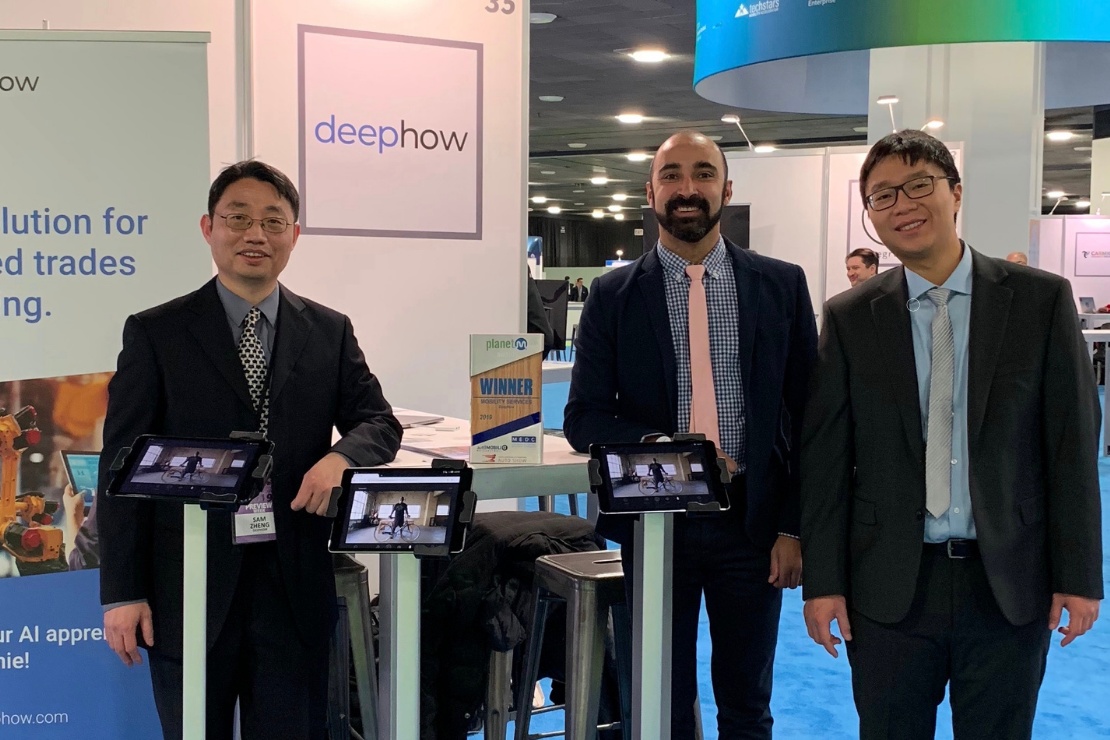
A bicycle factory is an agreeable place to test a theory about knowledge. The product eventually has to move. In 2018, while Sam Zheng and his colleagues were taking part in the Techstars Detroit Mobility program, DeepHow began a pilot with Detroit Bikes. The assignment was to capture experienced workers’ know-how and help new technicians learn it. For a founder trained in psychology and statistics, this was a useful encounter between an idea and a working floor.
Much of the company’s later story is contained in that early experiment. Someone already knows how to do the job. Someone else needs to learn. Between them sits a process that may be difficult to describe, expensive to teach repeatedly, and surprisingly easy to leave out of a document. Zheng wanted to make that exchange less cumbersome. The expert would demonstrate the work. Software would help turn the demonstration into instructions.
There is a pleasing modesty to the starting point. A factory can buy another machine; purchasing another decade of experience is more awkward. DeepHow’s proposition gave the knowledge already inside an organization a way to travel. The bicycle pilot also gave Zheng something a research background alone could never provide: an early customer with a practical reason to care whether the idea worked.
A psychologist among the machines
Zheng’s route into industrial software began with the study of people. He earned a doctorate in engineering psychology and a master’s degree in statistics at the University of Illinois Urbana-Champaign. Psychology supplied his interest in how skills develop. Statistics supplied tools for working with machine learning. In his account, these subjects belonged together: understanding intelligence and building mathematical systems that could help people use theirs.
He then spent more than a decade at Siemens, working on digital innovation. The setting mattered. Industrial technology has to coexist with an operator’s attention, an established sequence of tasks, and the ordinary complications of a workday. A theoretically elegant interface can still be a nuisance at the moment somebody needs it. Zheng’s work concerned that meeting point between a system’s capabilities and a person’s ability to put them to use.
One project was the cloud Digital Inspection Jacket, designed to help engineers and technicians capture and share technical knowledge. His team received second place in the Siemens US Innovation Award in 2017. The project’s reported benefits included a 38 percent reduction in time, alongside fewer errors and less rework. That figure belongs to the earlier Siemens project, rather than serving as a blanket promise for every later DeepHow customer.
The inspection work provides a concrete link between the researcher and the founder. Before DeepHow had a name, Zheng was already working on the problem of getting useful technical experience out of one person’s working routine and into a form other people could use. The eventual startup carried a familiar question into a different organizational setting.
“Technology should help people, not replace people.”Sam Zheng
Leaving the laboratory’s comfortable furniture
In 2018, Zheng co-founded DeepHow with Patrik Matos da Silva and Wei-Liang Kao. The team came out of Siemens. Zheng and Matos had worked together for nearly a decade by the time they entered Techstars. Their relationship had already survived the less photogenic parts of making products: development, deployment, and the effort required to make an invention usable.
Next47 helped connect Siemens employees with the accelerator. During the Detroit program, the DeepHow team met more than 200 mentors over several weeks and explored potential pilots with companies including Ford. The Detroit Bikes project arrived within the first few weeks. The founders were moving from the resources of a large corporation into the rather different discipline of persuading someone to try a young company’s product.
Zheng acknowledged the difficulty plainly: “Building a successful startup is very hard”. Leaving Siemens meant leaving a corporate environment and its resources. The remark is useful because it gives the transition its proper weight. A founder’s origin story tends to look inevitable once a company has customers. At the time, there were meetings to attend, assumptions to test, and a demonstration that still had to earn its audience.
The expert supplies the expertise
DeepHow called its early AI system Stephanie. Its task was to help capture a worker’s demonstration and organize it into interactive, step-by-step how-to videos. The name made an abstract technical system sound like someone who might help with the afternoon’s work. The underlying idea was straightforward: preserve the demonstration, then make its parts easier to find and follow.
The important distinction in Zheng’s approach is between possessing knowledge and describing it. A skilled person may perform a sequence fluently while leaving small details out of a verbal account. Demonstration retains context that can disappear when someone reconstructs a task from memory. A camera lets the work itself become part of the explanation. AI can then assist with the labor of organizing the recording.
Editing is a less glamorous obstacle than inventing an algorithm, but it can decide whether useful material ever gets made. If producing a short instructional video consumes hours, a company must weigh that effort against everything else its experts need to do. DeepHow’s training product aimed to reduce the effort required to turn raw recordings into something teachable.
- 01DemonstrateAn expert records the task.
- 02OrganizeAI helps structure the footage.
- 03LearnA colleague follows the steps.
The diagram looks simple because the premise is simple. Its practical consequence is more interesting: a worker’s experience can become a resource for colleagues who were never present at the original demonstration. The expert remains the starting point. That choice explains why Zheng keeps returning to people when discussing a company built around artificial intelligence.
A bicycle pilot grows a passport
DeepHow’s early customer list expanded into larger industrial organizations. Sierra Ventures, describing its investment in 2021, identified users including AB InBev, SAIC Motors, Siemens, and Stanley Black & Decker. The investor connected Zheng’s human-factors background with the challenge of getting knowledge capture adopted inside manufacturing businesses. A product could have useful technology and still fail if the people expected to use it found the process burdensome.
In April 2023, DeepHow announced a $14 million Series A led by Owl Ventures, with LG Technology Ventures joining existing investors. The company said the financing would support growth, product development, and generative AI work. Funding bought room to build and sell; the original task remained helping organizations move technical know-how between people.
By its sixth anniversary in July 2024, Zheng reported more than 100 enterprise and small-business customers, deployment at over 500 sites, and a presence in 28 countries. These are his published figures for that moment, rather than a current audited census. He also remembered Detroit Bikes as the first customer and user. The modest pilot had remained part of the company’s account of itself.
100+customers
500+sites
28countries
A training problem changes character as it crosses borders. The original demonstration may be valuable to many colleagues, but its usefulness depends on whether those colleagues can understand and retrieve it. Scale therefore brings the company back to familiar human questions. Who is learning? What do they need? How much work stands between the question and the answer?
Learning deserves a little pleasure
Zheng’s public writing extends beyond recording instructions. In September 2024, he set out seven ways leaders could use gamification in workforce training. His suggestions included quizzes, immediate questions and answers, realistic scenarios, learning paths, recognition for contributors, visible progress, and personalized recommendations. The list treats learning as an activity that needs feedback and motivation as well as information.
Recognition for people who create training material is a particularly telling detail. A useful knowledge library depends on people choosing to contribute. The employee who explains a task is performing work that benefits others, and Zheng’s proposal gives that contribution visibility. It is a small organizational courtesy with a practical purpose: helping the next useful explanation get made.
His emphasis on progress also gives training a more human rhythm. A learner needs to see where a task begins, what comes next, and how far they have travelled. An enormous collection of material can feel less useful than a manageable next step. A progress bar is hardly a romantic object, yet it can offer the quiet satisfaction of knowing that something difficult is becoming possible.
These ideas fit a founder who has also taught psychology as an adjunct professor at Tsinghua University. They keep his educational background visible in the product’s surrounding philosophy. A video can carry information; the learning experience still needs thought. Even the most dutiful employee has probably never wished for a longer mandatory training session.
The question outlasts the job title
In November 2024, DeepHow brought in Sivakumar “Siva” Lakshmanan as CEO. Matos publicly thanked Zheng for six years of leadership and partnership and described his transition to chairman. The change placed a new executive in charge of the next phase while keeping a founder connected to the company he helped build.
The role change is an appropriate point to return to Zheng’s teachers. He has credited doctoral advisors George McConkie and Christopher Wickens with shaping his approach. From McConkie, he took the value of close observation; from Wickens, the connection between theory and practical human-factors problems. He has described curiosity, reflection, and optimism as guides through his own working life.
Those influences help make sense of the distance between a psychology doctorate and a bicycle-factory pilot. Both involve looking closely at what people actually do. Zheng’s stated ambition for DeepHow is to help skilled workers become experts. It is an aspiration that gives the company a demanding audience: the person who has to learn a real task and then perform it.
The story began with experience that was difficult to put into words. Its continuing appeal lies in making that experience available without requiring every expert to become a technical writer or a video editor. Somewhere between the worker who knows and the colleague who is learning, Zheng found a company worth leaving Siemens to build. The manual finally gets a little help from the hands.